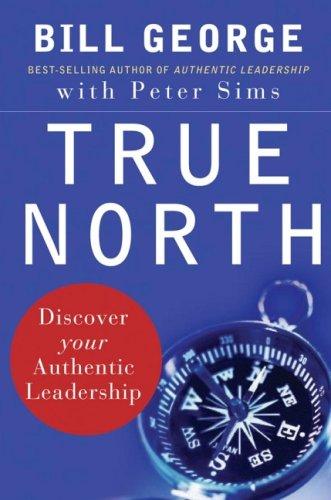
True North by Bill George is a 2007 business book about authentic leadership, self-awareness, purpose. Authentic leaders lead from their True North: the values, purpose, and motivations that are genuinely theirs, not inherited from other people's ideas about leadership.
Summary
True North is Bill George's argument that the most effective leaders are those who lead from a clear sense of who they are — their values, their purpose, their motivations — rather than from a performance of what leadership is supposed to look like. George calls this a leader's "True North": the internal compass that guides decisions when external pressures push in other directions. The book grew out of interviews with 125 leaders across industries and generations, and it leans heavily on their stories rather than on abstract theory.
George's central claim is that authentic leaders aren't born — they're developed through life experience, including failure, adversity, and the willingness to examine their own motivations honestly. He identifies five dimensions of authentic leadership: purpose, values, relationships, self-discipline, and heart. But the framework is less a checklist than an invitation to introspection. Each chapter poses questions more than it delivers answers.
The book's most useful section deals with the "crucible" moments — the defining experiences that either forge genuine leaders or expose those who were only performing. George argues that leaders who haven't processed their crucibles tend to lead from insecurity or ego, which eventually undermines them. Those who have done the inner work can lead from strength without needing to dominate.
True North is most relevant to people in formal leadership roles who sense a gap between who they are at work and who they are everywhere else. It's less useful as a practical guide to leadership technique and more valuable as a prompt for serious self-examination. The interview-heavy format means the quality of any given section depends heavily on the quality of the story being told, but the best case studies — leaders who describe specific moments where their compass was tested — are genuinely instructive.
Talk to True North like its author wrote you back.
Get the ideas that fit your life — not generic summaries.
- Chat with the book
- Audiobook-style main ideas
- Adapts to your life and goals
- Helps you take action
Key takeaways
- 1.
Authentic leaders lead from their True North: the values, purpose, and motivations that are genuinely theirs, not inherited from other people's ideas about leadership.
- 2.
Leadership development is not a career path — it's a lifelong inner journey. The self-awareness required is built through experience, reflection, and honest relationships.
- 3.
Crucible experiences — setbacks, failures, losses — are where authentic leadership is forged. How a leader processes adversity reveals more than how they handle success.
- 4.
Leaders who never examine their own motivations often lead from insecurity or fear of failure. That shows up as ego, control, or a need for external validation.
- 5.
Purpose is different from mission or strategy. It's the reason you lead that has nothing to do with compensation or status, and it's what sustains you through difficult periods.
- 6.
Support networks — mentors, peers, and close personal relationships — are not optional extras. They are infrastructure. Leaders who try to go it alone eventually lose perspective.
- 7.
Values under pressure reveal themselves differently than values stated in calm conditions. True North asks: what do you actually do when tested?
- 8.
Leading with heart doesn't mean being soft. It means understanding that people are motivated by purpose and connection, not just incentives.
Discussion questions
Use these on your own, with a book club, or as chat starters in Superbook. Book club version, ready to copy or print →
- 1.
George says your True North is your internal compass. How consistently does the way you work reflect your actual values, as opposed to the values you say you hold?
- 2.
Think of a crucible experience that shaped how you lead or work. What did you learn from it that you couldn't have learned any other way?
- 3.
George argues that leaders who haven't examined their own motivations lead from insecurity. Where in your current role does ego or insecurity affect your decisions?
- 4.
He emphasizes support networks as infrastructure, not luxury. Who are the two or three people who give you honest feedback — and when did you last actually use it?
- 5.
What's the gap, if any, between who you are at work and who you are in the rest of your life? What does that gap cost you?
- 6.
George interviewed 125 leaders who described specific moments when their compass was tested. What would that moment be for you?
- 7.
The book distinguishes purpose from ambition. Do you know the purpose behind your current work — beyond the job description and the compensation?
- 8.
Many leaders George profiles describe leading differently after failure. Has a professional failure changed how you lead? How?
- 9.
Which of the five dimensions — purpose, values, relationships, self-discipline, heart — is most underdeveloped in your own leadership right now?
- 10.
If the people you manage described your leadership style honestly, would it match how you see yourself? What would the gap tell you?
- 11.
George's leaders who drifted from their True North often didn't notice it happening gradually. What signals — in behavior, in relationships, in how you feel — would tell you that you're drifting?
- 12.
He argues that authentic leadership requires ongoing self-examination, not just a one-time values exercise. What practices do you actually use to stay honest with yourself?
Themes
Frequently asked questions
-
What is True North about?
True North argues that the most effective leaders are authentic ones — people who lead from a clear sense of their own values, purpose, and motivations. Bill George draws on interviews with 125 senior leaders to show how self-awareness and genuine purpose produce better leadership outcomes than performance or image management.
-
Is True North worth reading for early-career professionals?
It's most valuable for people already in leadership roles or actively preparing for them. Early-career readers will find the framework interesting, but many of the questions it asks require experience to answer honestly. It pairs well with a mentor conversation.
-
How is True North different from Authentic Leadership?
Authentic Leadership (2003) introduced the concept. True North (2007) expanded it with 125 new interviews and a companion self-assessment workbook. If you've read neither, start with True North — it supersedes the earlier book in depth and evidence.
-
How long does it take to read True North?
About five to six hours at an average reading pace. The interview-heavy structure means you can read chapters out of order once you understand the framework. The workbook sections reward slowing down.
-
Who should read True North?
Managers and executives who feel a gap between who they are at work and who they want to be. It's also useful for anyone in a leadership development program looking for a framework grounded in real stories rather than idealized models.