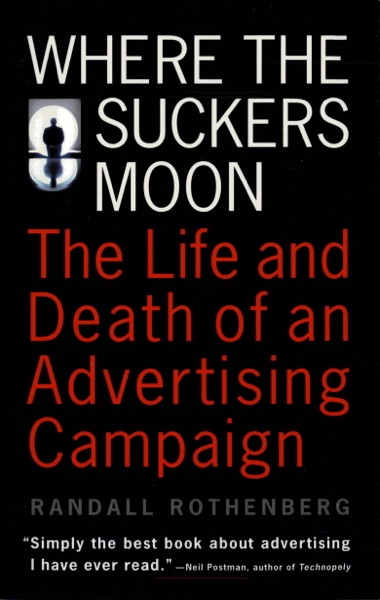
Where the Suckers Moon by Randall Rothenberg is a 1994 business book about advertising, brand strategy, corporate culture. A brand is not a product description but a set of meanings and associations, and managing those associations is fundamentally different from managing product quality.
Summary
Where the Suckers Moon is Randall Rothenberg's exhaustive account of a single advertising account review: Subaru of America's 1991 search for a new agency. The review is treated as a case study through which Rothenberg examines the advertising industry at a moment of transition — from the classic account-service model of the postwar decades to an era of media fragmentation, strategic uncertainty, and deepening tension between creative ambition and commercial necessity.
Subaru in 1991 was a car company with an identity problem. Its vehicles were associated with a counter-cultural, outdoor-oriented buyer that the rest of the automobile market had begun to colonize, and the company needed to decide whether to compete for mainstream consumers or double down on its existing identity. The agency review that followed was a year-long process involving multiple competing firms, each pitching different versions of who Subaru should be. Rothenberg, then a journalist for The New York Times, was given extraordinary access and used it to document not just the pitch but the entire subculture of the agency business.
The book is at its strongest as a portrayal of how advertising actually gets made — the internal politics of agencies, the gap between strategic thinking and execution, the fundamental difficulty of creating persuasive communication for a client who is simultaneously the decision-maker and the audience. Rothenberg is sympathetic to the creative people and skeptical of the institutional structures that constrain them.
The agency that won the review — Wieden+Kennedy — is one of the most celebrated creative shops of the era, and the book captures that firm's ethos in detail. But the story ends ambivalently: the campaign Wieden+Kennedy produced was critically admired and commercially ineffective, raising the question of whether advertising that wins awards and loses market share is actually good advertising. Where the Suckers Moon has no comfortable answer to that question, which is part of what makes it honest.
Talk to Where the Suckers Moon like its author wrote you back.
Get the ideas that fit your life — not generic summaries.
- Chat with the book
- Audiobook-style main ideas
- Adapts to your life and goals
- Helps you take action
Key takeaways
- 1.
A brand is not a product description but a set of meanings and associations, and managing those associations is fundamentally different from managing product quality.
- 2.
Agency reviews are partly theatrical — a performance of problem-solving in which the winner is not always the firm with the best ideas but the one that best understands the client's fears and desires.
- 3.
Creative advertising and effective advertising frequently diverge. Awards ceremonies and sales charts are measuring different things, and the gap between them is a genuine strategic problem.
- 4.
Subaru's identity crisis was a choice between two viable strategies: expand the mass-market appeal at the cost of distinctiveness, or deepen distinctiveness at the cost of scale. The company couldn't commit to either.
- 5.
The account planning function — consumer research brought into the creative process — was not yet standard in American agencies in 1991 and its introduction changed the pitch process significantly.
- 6.
Wieden+Kennedy's success in independent creative work came partly from being willing to say things on behalf of clients that the clients themselves were too cautious to say. That willingness depends on trust that is difficult to build with new clients.
- 7.
Agency relationships fail most often not because of bad creative work but because of misaligned expectations about what advertising is supposed to accomplish.
- 8.
The advertising industry in the early 1990s was already experiencing the disruption of media fragmentation. The response — more targeting, less mass broadcast — anticipated later shifts more than most participants realized at the time.
Discussion questions
Use these on your own, with a book club, or as chat starters in Superbook. Book club version, ready to copy or print →
- 1.
Rothenberg follows a single account review in forensic detail. What does that level of specificity reveal that a broader survey of advertising would have missed?
- 2.
The agency that won produced critically acclaimed work that didn't move cars. How do you evaluate a creative project when aesthetic success and commercial success point in opposite directions?
- 3.
Subaru faced a genuine choice between authenticity and scale. Can you think of a brand or company you admire that has navigated a similar choice well or badly?
- 4.
The account planning discipline introduced consumer research into the creative process. Is that an improvement — grounding ideas in evidence — or a constraint that prevents genuinely original thinking?
- 5.
Rothenberg is a journalist who was given unusual access. How does embedded journalism like this change what you learn compared to arms-length reporting?
- 6.
The agencies in the review made arguments about Subaru's identity that the company had never fully articulated to itself. Is that one of the legitimate functions of an outside agency, or is it overreach?
- 7.
The title refers to the advertising industry's implicit view of its audience. Do you think that view is honest, cynical, or both?
- 8.
Wieden+Kennedy built its reputation on work that was creatively ambitious and commercially effective — Nike above all. What made the Subaru relationship different?
- 9.
The book was published in 1994, before the internet transformed advertising. Which of the tensions it describes have been resolved by digital media, and which have gotten worse?
- 10.
How should a client evaluate an agency? The book suggests that the pitch process is a poor predictor of the ongoing relationship. What would a better evaluation process look like?
- 11.
Rothenberg describes advertising as a business that attracts people who want to do something other than advertising. What does that tension — between commercial work and creative ambition — look like in industries you know?
- 12.
If you were Subaru's marketing director, which of the competing pitches would you have chosen, based on what Rothenberg tells you about each? And would you now be right?
Themes
Frequently asked questions
-
Is Where the Suckers Moon still relevant given how much advertising has changed since 1994?
Yes. The specific media have changed completely — digital, programmatic, social — but the core tensions Rothenberg documents are unchanged: the gap between creative ambition and commercial results, the difficulty of brand identity decisions, and the theater of the pitch process. The book works as a lens for understanding those tensions regardless of medium.
-
Is this book only for people in advertising?
No. It is useful for anyone who manages external agencies, makes brand decisions, or is interested in how creative industries work. The sections on agency culture and client-agency dynamics are as useful for a CFO or founder as for a creative director.
-
How long is Where the Suckers Moon?
The book is around 450 pages in its original edition — a substantial read. It rewards patience and is best read alongside the history of the period it covers.
-
What happened to Subaru after the Wieden+Kennedy campaign?
Subaru's subsequent marketing strategy evolved significantly over the following decades. By the 2010s, the brand became known for its 'Love' campaign targeting loyal owners, which is frequently cited as one of the more effective examples of identity-based brand advertising. Rothenberg's account helps explain how long and difficult the path to that clarity was.
-
What is the main argument of Where the Suckers Moon?
There is no single thesis — it is journalism rather than argument. But the underlying question is whether advertising can be simultaneously creatively honest and commercially effective, and the book's answer, based on this case, is: not easily, and not without significant institutional support for the creative process.
Similar books

All Marketers Are Liars
Seth Godin
This Is Marketing: You Can't Be Seen Until You Learn to See
Seth Godin
No Filter: The Inside Story of Instagram
Sarah Frier
Positioning: The Battle for Your Mind
Al Ries and Jack Trout
