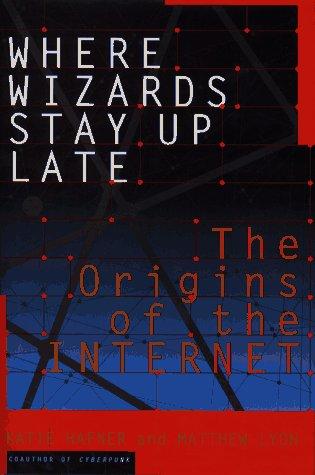
Where Wizards Stay Up Late by Katie Hafner & Matthew Lyon is a 1996 history book about internet history, computer networking, innovation. ARPANET was funded by the Department of Defense but driven by academic researchers who were more interested in computer science problems than military applications.
Summary
Where Wizards Stay Up Late is the history of ARPANET, the government-funded network that became the technical foundation of the internet. Katie Hafner and Matthew Lyon trace the project from its origins in the Defense Department's Advanced Research Projects Agency in the early 1960s through the first live transmissions in 1969 and the gradual growth of the network through the 1970s. The book is built from interviews with the actual engineers — J.C.R. Licklider, Larry Roberts, Bob Kahn, Vint Cerf, and dozens of others — and from technical documents that had not been widely read outside the research community.
The story Hafner and Lyon tell is less heroic and more mundane than the mythology that surrounds the internet's creation. ARPANET was a military research program, but its founders were motivated more by scientific curiosity and practical convenience than by any grand vision of a global communications network. The early meetings were fractious; nobody agreed on how the system should work; the specifications were written by graduate students at a time when senior researchers couldn't be bothered. The first message sent over the network crashed it after two characters. Much of what made ARPANET work was improvised and accidental.
The book is strongest on the technical details — how packet switching works, why it was a radical departure from circuit switching, how the protocols that eventually became TCP/IP were argued into existence. Hafner and Lyon explain these concepts without condescension, and the sections on Vint Cerf and Bob Kahn's development of TCP are among the clearest accounts of that process available to a general reader.
The writing is dry in places, and the book makes no attempt to be more dramatic than the material supports. Readers looking for a populist narrative in the style of Michael Lewis will be disappointed. But as a technical and organizational history of one of the most consequential infrastructure projects of the twentieth century, it remains the definitive account. Anyone who uses the internet and wants to understand where it actually came from should read it.
Talk to Where Wizards Stay Up Late like its author wrote you back.
Get the ideas that fit your life — not generic summaries.
- Chat with the book
- Audiobook-style main ideas
- Adapts to your life and goals
- Helps you take action
Key takeaways
- 1.
ARPANET was funded by the Department of Defense but driven by academic researchers who were more interested in computer science problems than military applications.
- 2.
Packet switching — breaking data into discrete packets that travel independently and reassemble at the destination — was the foundational technical idea that made the internet possible. It was not obvious, and it had serious skeptics.
- 3.
The first message sent over ARPANET in October 1969 was meant to be 'login.' The network crashed after the first two characters. The internet's birth was not auspicious.
- 4.
Much of the core protocol design was done by graduate students through a process called the Request for Comments (RFC) — a deliberate choice to make the work transparent and invitable to critique. That culture persists in internet standards development today.
- 5.
The original ARPANET connected a small number of university research computers. No one predicted email would become its dominant use case; it emerged organically and surprised everyone.
- 6.
J.C.R. Licklider's 1960 paper 'Man-Computer Symbiosis' articulated the vision of interactive, networked computing a decade before the technology existed to realize it. His ideas served as an intellectual foundation for almost everything that followed.
- 7.
Infrastructure projects rarely have single inventors. ARPANET was the product of dozens of researchers working in parallel, often in conflict, over more than a decade.
- 8.
The transition from ARPANET to the modern internet required deliberate political decisions — including opening the network to commercial use — that were not technical but economic and regulatory.
Discussion questions
Use these on your own, with a book club, or as chat starters in Superbook. Book club version, ready to copy or print →
- 1.
Hafner and Lyon show that ARPANET's success depended heavily on informal trust networks among academics. Could the same project have been built inside a private company, or did the academic context matter?
- 2.
Licklider's memo imagining an 'Intergalactic Computer Network' circulated years before the technology existed. What does his example say about the role of speculative vision in technological development?
- 3.
The Request for Comments process was designed to make protocol design transparent and collegial. In practice, decisions were still shaped by who had institutional power. Does openness actually change who wins in technical debates?
- 4.
Email emerged as an unplanned use case and quickly dominated ARPANET traffic. Can you think of contemporary technologies where the actual use diverged sharply from the intended application?
- 5.
The book describes researchers working without any business model or user growth metric. What does that context — pure research funding, no commercial pressure — allow, and what does it prevent?
- 6.
ARPANET's early community was tiny, trust-based, and largely homogeneous. The modern internet is the opposite. What was lost in the transition, and was it lost inevitably?
- 7.
Packet switching was controversial and took years to be accepted. The skeptics weren't stupid — they had real arguments. What does the story of its adoption say about how radical technical ideas gain legitimacy?
- 8.
The book is careful to credit many contributors. Does reading it change any assumptions you had about who invented the internet?
- 9.
ARPANET was military-funded but academically operated. How did that hybrid create both freedoms and constraints that shaped what was built?
- 10.
By the end of the book, the network exists but the commercial internet is still years away. What decisions in the early ARPANET period made the commercial internet easier or harder to build?
- 11.
The book was published in 1996, before the internet became central to daily life. Reading it now, what feels prescient and what feels naive about how the early builders thought about what they were creating?
Themes
Frequently asked questions
-
Is Where Wizards Stay Up Late still relevant in 2026?
Yes. The technical history it covers — packet switching, TCP/IP, the RFC process — hasn't changed, and the book is still the most readable account of how those ideas were developed. The organizational and political story of how a government research project becomes a global infrastructure is also timeless.
-
How technical is this book?
Moderately. Hafner and Lyon explain packet switching, protocols, and network architecture clearly for non-engineers. You don't need a computer science background, but you should be willing to follow a technical explanation across a few pages without skipping it.
-
Does the book cover the World Wide Web?
No. It ends with ARPANET's transition to the modern internet in the late 1970s and early 1980s. Tim Berners-Lee and the Web came later and are not discussed. For the Web's origin story, see other sources.
-
Who should read this book?
Anyone in technology who wants to understand where the internet actually came from, rather than the simplified myths. Also useful for historians of technology, policy researchers, and anyone interested in how large-scale infrastructure gets built through public investment.
-
Is the writing engaging?
It's clear and well-organized, but it doesn't try to be thrilling. This is serious history, not narrative journalism. Readers who need a dramatic story arc will find it slow in places.
Similar books

The Innovator's Dilemma
Clayton M. Christensen

Bad Blood: Secrets and Lies in a Silicon Valley Startup
John Carreyrou

American Prometheus
Kai Bird and Martin J. Sherwin
Zero to One: Notes on Startups, or How to Build the Future
Peter Thiel
