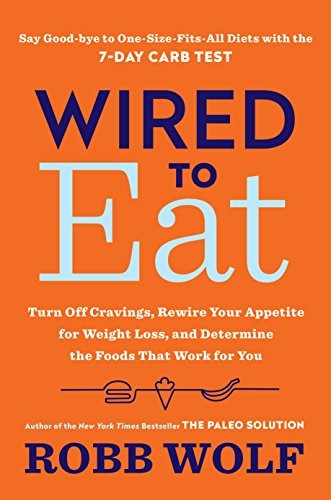
Wired to Eat by Robb Wolf is a 2017 health book about nutrition, carbohydrate tolerance, hunger regulation. Carbohydrate tolerance varies dramatically by individual. Blood glucose response to the same food differs between people due to genetics, gut bacteria, and metabolic history.
Summary
Wired to Eat is Robb Wolf's follow-up to The Paleo Solution, updated with new research on hunger neuroscience and a more individualized framework for dietary carbohydrate. Wolf's core update is that the paleo prescription is not the same for everyone. Human genetics, gut microbiome composition, activity level, and stress load all affect how an individual processes carbohydrates. What produces stable blood sugar in one person causes dramatic glucose swings in another — and those swings are the mechanism behind overeating, energy crashes, and the kind of hunger that overrides willpower.
The first section covers the neurobiology of appetite. Wolf draws on research into neuropeptide Y, leptin, ghrelin, and the reward circuitry that makes certain foods impossible to stop eating. The argument is that the modern food environment — hyperpalatable, engineered, cheap, and abundant — exploits neural systems that evolved to drive consumption in scarcity. Understanding why you're hungry when you shouldn't be, Wolf argues, is more useful than applying willpower to resist eating.
The practical core of the book is the 7-Day Carb Test: eat a standardized portion of a carbohydrate food, measure your blood glucose response, and use the results to build a personalized list of carb foods you tolerate well and those you don't. Wolf provides a four-week meal plan and protocol for identifying your personal carb tolerance range. This individualization distinguishes Wired to Eat from more prescriptive diet books and acknowledges that even within the paleo framework, the right carbohydrate level varies significantly by person.
The book is a meaningful improvement on the first in terms of nuance, though it retains some of the confident-assertion tendencies of its predecessor. Wolf remains dismissive of grains in a way that outpaces the evidence for most non-celiac individuals. But the hunger neuroscience section is genuinely useful, and the carb-testing protocol is the most actionable personalization tool in any popular diet book. Readers who found paleo results inconsistent will benefit from the more granular approach.
Talk to Wired to Eat like its author wrote you back.
Get the ideas that fit your life — not generic summaries.
- Chat with the book
- Audiobook-style main ideas
- Adapts to your life and goals
- Helps you take action
Key takeaways
- 1.
Carbohydrate tolerance varies dramatically by individual. Blood glucose response to the same food differs between people due to genetics, gut bacteria, and metabolic history.
- 2.
The 7-Day Carb Test provides a systematic method for identifying which carbohydrates cause glucose spikes in your specific biology rather than relying on generic lists.
- 3.
Neuropeptide Y, ghrelin, and leptin interact to create hunger that willpower cannot reliably override. Understanding these signals reframes overeating as a physiological problem, not a moral failure.
- 4.
The modern food environment is engineered to exploit reward circuitry that evolved in scarcity. Highly processed foods produce disproportionate dopamine responses that override satiety signals.
- 5.
Protein and fat are more satiating than carbohydrates per calorie. A meal composition that keeps you full longer is more effective than one that requires constant portion discipline.
- 6.
Sleep deprivation dysregulates the same hunger hormones that high-carb diets dysregulate. Treating sleep as nutrition is not a metaphor.
- 7.
The goal is not a perfect diet but a personalized one — knowing which foods keep your glucose stable, your hunger manageable, and your energy consistent.
- 8.
Social support and stress context affect what you eat more than information does. The behavioral environment around eating deserves as much attention as the food itself.
Discussion questions
Use these on your own, with a book club, or as chat starters in Superbook. Book club version, ready to copy or print →
- 1.
Wolf argues that willpower is insufficient against engineered hyperpalatable foods. Does framing overeating as a neurological response rather than a character flaw change how you think about your own eating?
- 2.
Have you ever noticed that the same food affects you differently depending on your sleep, stress, or activity level? What does that suggest about one-size-fits-all dietary advice?
- 3.
The 7-Day Carb Test is based on blood glucose monitoring. How would you feel about testing your own metabolic response to specific foods?
- 4.
Wolf is skeptical of willpower as a dietary tool. What mechanisms other than willpower have you found actually change eating behavior over time?
- 5.
The food reward system evolved to drive consumption in times of scarcity. How conscious are you of when you're eating from genuine hunger versus environmental cues?
- 6.
Which social situations most reliably cause you to eat things you didn't intend to? What would it take to redesign those contexts?
- 7.
If you discovered that a food you considered healthy caused a significant glucose spike in your own metabolism, would you stop eating it?
- 8.
Wolf covers hunger hormones — ghrelin, leptin, neuropeptide Y — in some depth. Did understanding the mechanism behind hunger change how you relate to it?
- 9.
The book advocates personalization over universal dietary rules. Is that framing empowering or does it add unhelpful complexity?
- 10.
What's a food you've labeled 'bad' based on general advice that might actually be fine for your specific biology?
- 11.
Wolf ties sleep quality to hunger regulation. How much of your eating behavior do you think is downstream of how well you slept?
- 12.
The transition from The Paleo Solution to Wired to Eat is partly a move toward nuance and personalization. Is that evolution typical of how dietary thinking should develop, or a sign of hedging?
Themes
Frequently asked questions
-
What is Wired to Eat about?
It explains the neuroscience of hunger and argues that carbohydrate tolerance varies by individual, providing a testing protocol to identify which carbs work for your specific metabolism.
-
Is Wired to Eat different from The Paleo Solution?
Yes. The core dietary principles overlap, but Wired to Eat adds a hunger neuroscience framework, a practical blood glucose testing protocol, and significantly more nuance about individual variation. It is less dogmatic and more useful as a practical tool.
-
Who should read Wired to Eat?
People who followed a paleo-style diet with inconsistent results, anyone interested in why they overeat despite knowing they shouldn't, and readers who want a more personalized approach than standard dietary guidelines offer.
-
What is the 7-Day Carb Test?
A protocol where you eat a standardized portion of a specific carbohydrate food, measure your blood glucose one hour later, and record the result. After testing multiple foods, you identify which carbs produce stable versus spiking responses in your own body.
-
Is the science in Wired to Eat solid?
The hunger neuroscience section is well-grounded and draws on mainstream research. The glucose variability section reflects real emerging science, though personal blood glucose testing as a dietary planning tool is more established in clinical settings than in general wellness contexts.