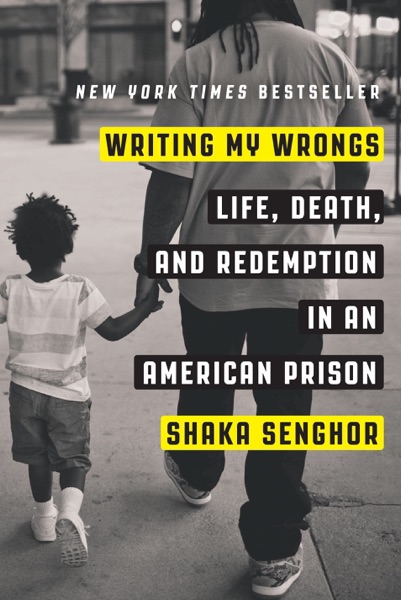
Writing My Wrongs by Shaka Senghor is a 2016 memoir book about incarceration, redemption, identity. Accountability and victimhood are not mutually exclusive. Senghor was shaped by trauma and still responsible for the harm he caused. The memoir holds both simultaneously.
Summary
Writing My Wrongs is Shaka Senghor's account of his journey from a childhood marked by abuse and neglect in Detroit, through a murder conviction and nineteen years in Michigan prisons — seven of them in solitary confinement — to his emergence as a writer, activist, and advocate for criminal justice reform. It is a memoir of accountability as much as survival.
Senghor does not write from the position of innocence. He killed a man at nineteen during a drug deal gone wrong, and he holds that fact clearly throughout the book without hiding behind circumstance. What the memoir traces instead is the internal transformation that made it possible for him to move from that act toward responsibility, empathy, and purpose. Reading and writing are the engines of that transformation. In solitary, Senghor read voraciously — Malcolm X, James Baldwin, African history — and eventually started writing, producing journals that became the raw material for this book. The act of writing forced him to examine his choices with the kind of honest attention that passive reading alone cannot generate.
The prison system Senghor describes is designed, in his account, not to rehabilitate but to further damage. Solitary confinement strips away the conditions that make human development possible. The guards and administrators he portrays are not cartoon villains but human beings operating within a system that routinely produces dehumanizing outcomes. Senghor writes about violence, trauma, and institutional cruelty with directness but without gratuitous emphasis — the point is understanding, not sensationalism.
The book ends with Senghor's release and his navigation of a world that expects former prisoners to fail, and his work connecting with young people heading toward the choices he once made. Writing My Wrongs is not a policy argument, but it is evidence: evidence that transformation is possible under the worst conditions, and that the narrative society tells about who can or cannot change is wrong.
Talk to Writing My Wrongs like its author wrote you back.
Get the ideas that fit your life — not generic summaries.
- Chat with the book
- Audiobook-style main ideas
- Adapts to your life and goals
- Helps you take action
Key takeaways
- 1.
Accountability and victimhood are not mutually exclusive. Senghor was shaped by trauma and still responsible for the harm he caused. The memoir holds both simultaneously.
- 2.
Solitary confinement inflicts psychological damage that makes rehabilitation harder, not easier. The conditions that are supposed to punish also prevent growth.
- 3.
Literacy — in the deepest sense, learning to read one's own life through books and writing — is a form of transformation that prisons often cannot completely suppress.
- 4.
The path out of cycles of violence runs through empathy, and empathy requires being able to imagine a person's interiority. Books provided Senghor with practice in that skill.
- 5.
Identity can be reconstructed even after catastrophic choices. The self that committed violence and the self that later worked to prevent it are connected but not identical.
- 6.
Mentorship and human connection matter profoundly in institutional settings. The few people who treated Senghor as a full human being in prison accelerated his transformation.
- 7.
The moment Senghor began writing — not just reading — was the turning point. Writing required him to give an account of himself that reading alone never demanded.
- 8.
Society's low expectations for formerly incarcerated people are themselves a form of structural harm. Senghor's story argues that those expectations are empirically wrong.
Discussion questions
Use these on your own, with a book club, or as chat starters in Superbook. Book club version, ready to copy or print →
- 1.
Senghor describes the abuse and neglect of his childhood in detail, but he also insists he remains responsible for his actions. How do you think about the relationship between circumstance and accountability?
- 2.
The book treats reading and writing as the mechanisms of Senghor's transformation. Is there a form of intellectual practice in your own life that has changed how you understand yourself?
- 3.
Senghor spent seven years in solitary confinement. What does his experience suggest about the goals — and effects — of solitary confinement as a practice?
- 4.
He describes a small number of people in the prison system — guards, counselors — who treated him as a person rather than a problem. What does that suggest about the power of individual behavior inside institutional structures?
- 5.
The memoir is explicitly not a claim of innocence. How did that choice affect your experience of reading it? Does it change how you receive Senghor's arguments about the prison system?
- 6.
Senghor writes that the self who committed murder was not fundamentally different from the self who later advocated for others — both were shaped by the same formative experiences. Do you find that framing convincing?
- 7.
What assumptions do you carry about who can and cannot change? Did this book challenge any of them?
- 8.
The prison Senghor describes failed systematically at rehabilitation. What would a system designed to actually produce transformation look like, based on what you learn from his experience?
- 9.
Senghor's advocacy work focuses heavily on connecting with young people before they make the choices he made. Is prevention more important than rehabilitation in your view, or is that a false choice?
- 10.
The book ends with Senghor free and doing meaningful work, but the emotional arc does not land in triumphalism. What is the emotional register of the ending, and is it appropriate?
- 11.
How do you think Writing My Wrongs should be read alongside statistics and policy arguments about incarceration? What does memoir provide that data cannot?
- 12.
Senghor was shaped by Malcolm X's autobiography. What books have shaped how you understand yourself, and in what direction?
Themes
Frequently asked questions
-
Is Writing My Wrongs suitable for book clubs?
Yes. It is emotionally demanding but not gratuitously so, and it generates substantial discussion on accountability, criminal justice, and transformation. The memoir form makes it accessible and the ethical questions it raises are genuinely difficult — exactly what a good book club book should produce.
-
What is Writing My Wrongs about?
It is Shaka Senghor's memoir of growing up in Detroit, committing murder at nineteen, serving nineteen years in Michigan prisons including seven in solitary confinement, and the internal transformation — driven largely by reading and writing — that led to his advocacy work after release.
-
How does this book compare to Just Mercy?
Just Mercy by Bryan Stevenson is an attorney's account of the criminal justice system and wrongful convictions. Writing My Wrongs is a first-person memoir by someone convicted of a crime he did not contest. Together they offer complementary perspectives — systemic and individual — on the same broken institution.
-
Is Writing My Wrongs a political book?
It is not primarily a policy argument, though it has obvious political implications. The focus stays on Senghor's specific experience. Readers will draw their own conclusions about what the system needs to change, and the book earns those conclusions through evidence rather than assertion.
-
Who should read Writing My Wrongs?
Readers interested in criminal justice, incarceration, and redemption. Also anyone thinking about the relationship between trauma, identity, and accountability, or the role of reading and writing in self-understanding. It is particularly useful alongside policy texts on mass incarceration.
Similar books
Just Mercy: A Story of Justice and Redemption
Bryan Stevenson
Between the World and Me
Ta-Nehisi Coates

The Autobiography of Malcolm X
Malcolm X and Alex Haley
Educated: A Memoir
Tara Westover
