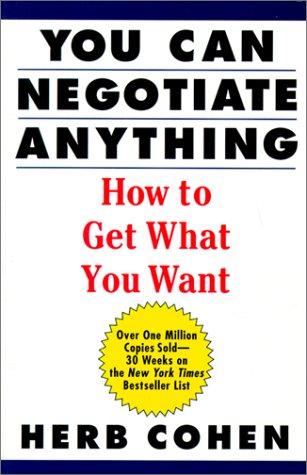
Talk to You Can Negotiate Anything like its author wrote you back.
Get the ideas that fit your life — not generic summaries.
- Chat with the book
- Audiobook-style main ideas
- Adapts to your life and goals
- Helps you take action
You Can Negotiate Anything, in detail
You Can Negotiate Anything is Herb Cohen's argument that negotiation is not a special skill reserved for diplomats and dealmakers but a basic life competence exercised continuously — in salary conversations, purchases, relationships, and workplace conflicts. Cohen, who spent decades consulting on negotiation for corporations and governments, builds his framework around three variables: power, time, and information. He argues that most people underestimate how much power they actually have in any negotiation because they think of power as an objective attribute rather than as a perception that can be shaped.
Cohen's central distinction is between what he calls Soviet-style negotiation — win-lose, positional, designed to extract maximum concession — and win-win negotiation, which seeks outcomes both parties prefer to no deal at all. He is not naive about when each style applies. The Soviet style, he explains, shows up whenever the relationship doesn't matter and the interaction is a one-time transaction. The win-win style is appropriate when you need the other party to feel good enough about the outcome that they remain a functional partner.
The book's treatment of time is particularly practical. Deadlines, Cohen argues, almost always apply more pressure to the side that reveals them. People make most concessions under time pressure, which means that the party who appears unbothered by delay has structural advantage. His advice is to appear patient even when you aren't, and to probe the other side's deadlines rather than announcing your own.
Some of the book's examples feel dated — Cohen relies heavily on retail bargaining and Cold War diplomatic analogies that reflect its 1980 origins. And the tone is occasionally closer to advice for exploiting people than for building durable agreements. Getting to Yes, published the same year, is more systematic and less combative. But Cohen's book has aged better than its age suggests because the psychological insights — about perceived power, the pace of concession, the value of information asymmetry — remain accurate. It's more a book about how negotiation actually works than about how it should work in ideal conditions.
The big ideas
- 1.
Power in negotiation is mostly perception, not reality. If the other party believes you have options, you effectively have them — even if you don't.
- 2.
Time pressure creates concessions. People in a hurry make bad deals. Whoever appears least constrained by deadlines has structural advantage.
- 3.
Information is leverage. Before negotiating, find out what the other side needs, what their alternatives are, and what their real deadline is.
