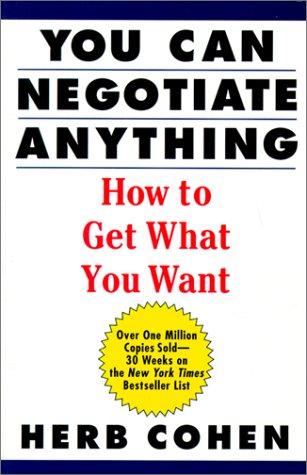
You Can Negotiate Anything by Herb Cohen is a 1980 business book about negotiation, persuasion, power dynamics. Power in negotiation is mostly perception, not reality. If the other party believes you have options, you effectively have them — even if you don't.
Summary
You Can Negotiate Anything is Herb Cohen's argument that negotiation is not a special skill reserved for diplomats and dealmakers but a basic life competence exercised continuously — in salary conversations, purchases, relationships, and workplace conflicts. Cohen, who spent decades consulting on negotiation for corporations and governments, builds his framework around three variables: power, time, and information. He argues that most people underestimate how much power they actually have in any negotiation because they think of power as an objective attribute rather than as a perception that can be shaped.
Cohen's central distinction is between what he calls Soviet-style negotiation — win-lose, positional, designed to extract maximum concession — and win-win negotiation, which seeks outcomes both parties prefer to no deal at all. He is not naive about when each style applies. The Soviet style, he explains, shows up whenever the relationship doesn't matter and the interaction is a one-time transaction. The win-win style is appropriate when you need the other party to feel good enough about the outcome that they remain a functional partner.
The book's treatment of time is particularly practical. Deadlines, Cohen argues, almost always apply more pressure to the side that reveals them. People make most concessions under time pressure, which means that the party who appears unbothered by delay has structural advantage. His advice is to appear patient even when you aren't, and to probe the other side's deadlines rather than announcing your own.
Some of the book's examples feel dated — Cohen relies heavily on retail bargaining and Cold War diplomatic analogies that reflect its 1980 origins. And the tone is occasionally closer to advice for exploiting people than for building durable agreements. Getting to Yes, published the same year, is more systematic and less combative. But Cohen's book has aged better than its age suggests because the psychological insights — about perceived power, the pace of concession, the value of information asymmetry — remain accurate. It's more a book about how negotiation actually works than about how it should work in ideal conditions.
Talk to You Can Negotiate Anything like its author wrote you back.
Get the ideas that fit your life — not generic summaries.
- Chat with the book
- Audiobook-style main ideas
- Adapts to your life and goals
- Helps you take action
Key takeaways
- 1.
Power in negotiation is mostly perception, not reality. If the other party believes you have options, you effectively have them — even if you don't.
- 2.
Time pressure creates concessions. People in a hurry make bad deals. Whoever appears least constrained by deadlines has structural advantage.
- 3.
Information is leverage. Before negotiating, find out what the other side needs, what their alternatives are, and what their real deadline is.
- 4.
Never accept the first offer. The speed of a 'yes' signals you could have asked for more. Even a small pause changes the dynamic.
- 5.
Soviet-style and collaborative styles are tools to choose, not moral positions. Which applies depends on whether the relationship matters after the deal is done.
- 6.
Legitimate authority — written policies, official prices, expert opinions — has more psychological weight than verbal assertions. Use it strategically and question it when the other side deploys it.
- 7.
Concessions have a pattern that signals your position. Making large concessions early signals that more are available. Decreasing concession size signals you're approaching your limit.
- 8.
Most people don't negotiate because they assume prices and terms are fixed. They're usually not. The willingness to ask is itself an advantage.
Discussion questions
Use these on your own, with a book club, or as chat starters in Superbook. Book club version, ready to copy or print →
- 1.
Cohen argues most people underestimate their own power in negotiations. In what situations do you consistently underestimate yours?
- 2.
Think of a negotiation you handled poorly. Which of the three variables — power, time, information — were you managing least effectively?
- 3.
Cohen distinguishes win-win from win-lose negotiations and says the choice depends on whether the relationship matters. Where do you draw that line in your own life?
- 4.
The book suggests that appearing unbothered by time pressure is a tactical advantage even when you are bothered. Is that a form of deception, and does that matter?
- 5.
Cohen says legitimate authority — written rules, stated policies — has disproportionate psychological weight. Can you think of a case where you deferred to stated authority that you should have questioned?
- 6.
Never accepting the first offer is Cohen's clearest rule. When was the last time you accepted a first offer on something significant? What stopped you from countering?
- 7.
The Soviet-style negotiator aims to extract maximum value with no regard for the other side. What are the long-term costs of applying that style to relationships that turn out to matter?
- 8.
Cohen says the willingness to walk away is one of the most powerful things you can demonstrate. How do you build genuine alternatives to the deal you're in rather than pretending to have them?
- 9.
The book was published in 1980. Which negotiating contexts it describes have changed most significantly, and which remain essentially the same?
- 10.
How is negotiation in personal relationships — salary, household decisions, parenting — different from commercial negotiation? Does Cohen's framework transfer cleanly?
- 11.
If someone applied all of Cohen's tactics against you in a negotiation, would you know it was happening? What would you do?
Themes
Frequently asked questions
-
Is You Can Negotiate Anything still worth reading?
Yes, though it shows its age. The core framework around power, time, and information remains sound, and Cohen's psychological insights are more durable than the specific examples. Read it alongside Never Split the Difference for a more contemporary view.
-
How does this compare to Getting to Yes?
Both were published in 1980 and address some of the same territory. Getting to Yes is more principled and systematic, focused on separating positions from interests. Cohen is more tactical and more willing to discuss power-based and manipulative dynamics. They complement each other.
-
What is the most useful idea in this book?
Probably the insight that most power in negotiation is perceived rather than real. If you act as though you have alternatives and remain calm under pressure, the other party's behavior adjusts accordingly — even if your actual position is weaker than it appears.
-
Who should read You Can Negotiate Anything?
Anyone who feels uncomfortable asking for better terms, prices, or outcomes in everyday situations. Cohen's tone is energetic and practical, and the book normalizes negotiation as a routine skill rather than an adversarial specialty.
-
Does the Soviet-style negotiation section mean Cohen endorses manipulation?
Cohen describes hardball tactics in detail and explains when they're used, but he frames collaborative negotiation as generally superior for ongoing relationships. The book is more descriptive of how negotiation actually works than prescriptive about ethics, which bothers some readers.
Similar books
Never Split the Difference
Chris Voss
Getting to Yes: Negotiating Agreement Without Giving In
Roger Fisher and William Ury
Influence: The Psychology of Persuasion
Robert B. Cialdini
Pre-Suasion: A Revolutionary Way to Influence and Persuade
Robert B. Cialdini
