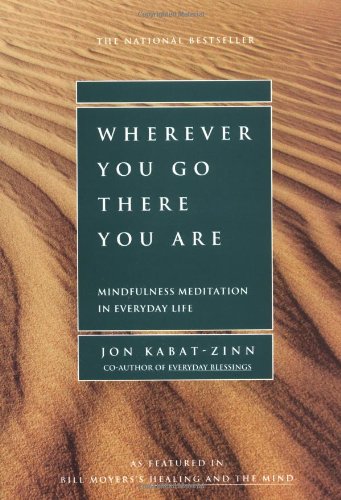
Wherever You Go, There You Are by Jon Kabat-Zinn is a 1994 health book about mindfulness, presence, meditation. Mindfulness is not about achieving a particular mental state but about relating differently to whatever mental state is present — observing without automatically reacting or identifying.
Summary
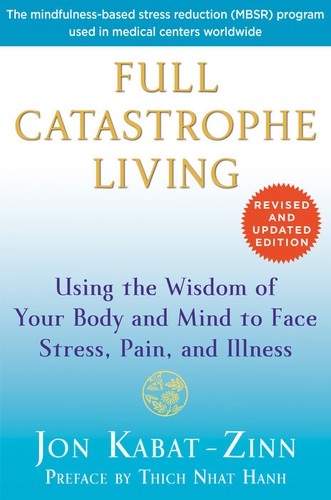
Wherever You Go, There You Are is Jon Kabat-Zinn's accessible introduction to mindfulness as a way of living rather than a formal therapeutic program. Published in 1994, four years after Full Catastrophe Living, the book distills the essence of mindfulness practice into short, readable chapters organized around specific aspects of awareness: stopping, sitting, breath, walking, lying down, being present in everyday activities, and relating to the thinking mind. It became one of the most widely read mindfulness books of its era and is still frequently the first book people encounter on the subject.
The premise is the book's title: wherever you go, there you are. No amount of travel, achievement, acquisition, or self-improvement will put you in a different relationship with your own mind. The content of life changes but the observer — the awareness that is present for all of it — remains. Mindfulness is the practice of meeting that awareness directly, rather than being perpetually swept along by the stream of thought, planning, and reaction that constitutes ordinary human consciousness.
Kabat-Zinn's voice here is warmer and more meditative than in Full Catastrophe Living. The chapters are short — most are two to five pages — and many are more poetic reflection than instruction. He covers the same core practices (breath awareness, body scanning, walking meditation) but with less clinical detail and more evocative description. The brevity and accessibility make the book a good companion to daily practice — chapters can be read in the moments before or after sitting, or as invitations to a particular quality of attention during daily activities.
What the book does not provide is a structured program or systematic evidence base. For readers who want to know whether mindfulness works and why, Full Catastrophe Living is more appropriate. Wherever You Go is better suited to someone already drawn to the practice who wants a gentle, ongoing source of encouragement and perspective. At its best, the book models the quality of attention it describes — unhurried, open, and willing to rest in uncertainty.
Talk to Wherever You Go, There You Are like its author wrote you back.
Get the ideas that fit your life — not generic summaries.
- Chat with the book
- Audiobook-style main ideas
- Adapts to your life and goals
- Helps you take action
Key takeaways
- 1.
Mindfulness is not about achieving a particular mental state but about relating differently to whatever mental state is present — observing without automatically reacting or identifying.
- 2.
The present moment is the only place life actually happens; ruminating on the past and planning the future are useful but they consume the majority of most people's conscious time at the cost of actual presence.
- 3.
Sitting still, even briefly, is itself a countercultural act in a world that values perpetual motion and productivity; learning to be comfortable with stillness is a foundational skill.
- 4.
The breath is always available as an anchor to the present moment; because it is both automatic and responsive to mental states, attending to it provides a direct link to current experience.
- 5.
Formal meditation practice — sitting with intention to be present — trains the same quality of attention that is then applied informally throughout daily life, in eating, walking, and conversation.
- 6.
Beginner's mind — approaching experience as if encountering it for the first time — counteracts the automatic categorization that makes daily life feel repetitive and dulled.
- 7.
The thinking mind generates an incessant stream of commentary, planning, judgment, and fantasy; mindfulness practice involves observing this stream without being carried away by it.
- 8.
Mindfulness is not a technique for stress relief or relaxation, though both often follow; it is a fundamental orientation toward experience — curiosity rather than reactivity, openness rather than defense.
Discussion questions
Use these on your own, with a book club, or as chat starters in Superbook. Book club version, ready to copy or print →
- 1.
Kabat-Zinn argues that you cannot escape yourself through travel, achievement, or change of circumstances. Does that ring true in your experience? When have you tried to 'go somewhere' to find peace, and what happened?
- 2.
The book is organized around short reflections rather than a structured program. Does that format make it more or less useful for establishing an actual practice?
- 3.
He covers 'beginner's mind' — approaching familiar things as if for the first time. Can you think of something in your daily life that you have stopped seeing because you assume you already know it?
- 4.
Sitting still is described as countercultural. What does your own discomfort with stillness tell you about your relationship to productivity and noise?
- 5.
Mindfulness of breathing is the book's simplest entry point. Have you tried resting your attention on your breath for even five minutes? What happened?
- 6.
Kabat-Zinn covers 'not forcing' as a principle — allowing experience rather than pushing it toward desired states. Is that compatible with goal-directed effort in other areas of your life?
- 7.
The book implies that most of our day is spent on automatic pilot rather than present-moment awareness. How much of your day do you estimate is genuinely present versus on automatic?
- 8.
He covers mindfulness in daily activities — eating, driving, walking. Have you tried bringing deliberate attention to a routine activity? What did you notice?
- 9.
Wherever You Go was first published in 1994, before mindfulness became mainstream. Does its cultural context matter — does it read differently knowing it was written before the mindfulness industry existed?
- 10.
Kabat-Zinn is careful not to make mindfulness promises — he doesn't say it will make you happy or successful. Does that restraint make the book more or less appealing?
- 11.
What is the single most memorable idea or image from the book, and does it stay with you beyond the reading?
Themes
Frequently asked questions
-
How does Wherever You Go, There You Are compare to Full Catastrophe Living?
Full Catastrophe Living is a comprehensive clinical and practical manual for the eight-week MBSR program, with detailed instructions and evidence. Wherever You Go is a lighter, more literary introduction to mindfulness as a philosophy and way of being. Most readers benefit from Wherever You Go as an accessible starting point, and Full Catastrophe Living when ready to commit to a formal practice.
-
Does Wherever You Go, There You Are require any meditation experience?
No. It is designed for complete beginners and requires no prior knowledge of meditation. The instructions for basic practices are clear and accessible. That said, the book is more inspiring than instructional — it creates the motivation to practice more than it provides the detailed technique guidance.
-
Is mindfulness as Kabat-Zinn describes it here religious?
No — the book is explicitly secular. Kabat-Zinn acknowledges Buddhist origins but frames mindfulness as a universal human capacity accessible to people of any or no religious tradition. No belief, ritual, or religious affiliation is required or assumed.
-
Is the book appropriate for someone with anxiety or depression?
Generally yes, though Full Catastrophe Living or a formal MBSR program would provide more clinical support. The book's tone is gentle and non-demanding. Readers with significant anxiety or depression who want mindfulness as part of their care should consider a structured program alongside the book.
-
How long does it take to read Wherever You Go, There You Are?
Around three to four hours. The chapters are short and the book can be read cover to cover quickly or picked up for individual chapters. Many readers keep it near where they meditate and read a chapter before or after practice.