100 Things Every Designer Needs to Know About People by Susan Weinschenk is a 2011 psychology book about psychology of perception, user experience, cognitive science. Pre-attentive processing means certain visual attributes — color, motion, size, orientation — are detected by the visual system before conscious attention. Design can use these to guide attention reliably.
Summary
Susan Weinschenk is a behavioral scientist and UX consultant, and this book is her translation of cognitive science research into practical guidance for designers. The premise is direct: people behave in predictable ways because of how their perceptual and cognitive systems work, and designers who understand those systems make better decisions than designers who work from intuition alone. Each of the 100 entries is short — one to four pages — covering a specific finding from psychology or neuroscience with a "What to do with this information" section attached.
The topics are organized into thematic chapters: how people see, how people read, how people remember, how people think, how people focus, how people feel, how people decide, how people make mistakes, and how people behave socially. The coverage is broad enough to touch most areas that matter to visual and interaction designers, from the mechanics of pre-attentive processing (why certain visual attributes grab attention before conscious thought) to the cognitive load effects of different navigation architectures to the emotional influence of color and sound.
Some of the most consistently applicable chapters address attention and perception. Weinschenk explains why human vision is essentially peripheral, how motion captures attention regardless of other content, and how the Gestalt principles — proximity, similarity, closure, continuity — are not aesthetic preferences but descriptions of how the visual cortex groups elements. For designers who learned these principles as style rules, understanding the neural basis changes how to apply them: they are perceptual facts, not taste.
The memory chapters are similarly practically useful. Working memory holds roughly four items (not seven, as older models suggested), and chunking is the technique for managing that limitation. Prospective memory — remembering to do something in the future — is fragile and context-dependent, which has direct implications for reminder systems and notification design. Long-term memory is reconstructive, not reproductive, which is why users misremember interfaces differently from how they actually worked.
The book's limitations are real. The entries are deliberately short, which means nuance and conflicting evidence often get compressed. Some findings cited have not replicated well in subsequent meta-analyses. The "what to do" sections occasionally feel formulaic. But as an introductory survey of the psychological literature most relevant to design, it remains one of the better single-volume resources, and the brevity is a practical virtue for readers without time for full textbooks.
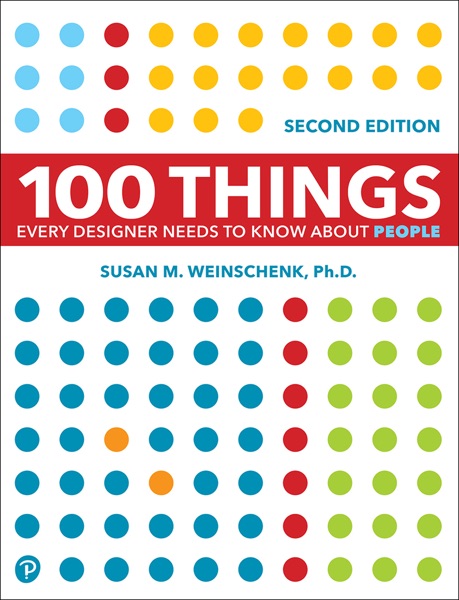
Talk to 100 Things Every Designer Needs to Know About People like its author wrote you back.
Get the ideas that fit your life — not generic summaries.
- Chat with the book
- Audiobook-style main ideas
- Adapts to your life and goals
- Helps you take action
Key takeaways
- 1.
Pre-attentive processing means certain visual attributes — color, motion, size, orientation — are detected by the visual system before conscious attention. Design can use these to guide attention reliably.
- 2.
Working memory holds about four items, not seven as older models claimed. Good design reduces cognitive load by chunking, using progressive disclosure, and not asking the user to hold many things simultaneously.
- 3.
The Gestalt principles — proximity, similarity, closure, continuity — describe how the visual cortex automatically groups elements. They are perceptual facts, not style conventions.
- 4.
Peripheral vision dominates the visual field. The center of focus is small; the rest of what 'seeing' feels like is pattern-matching from lower-resolution peripheral data.
- 5.
People don't read online — they scan. F-shaped and Z-shaped eye-tracking patterns describe default scanning behavior on text-heavy pages.
- 6.
Emotion and cognition are not separate. Emotional responses influence decision-making, memory encoding, and attention in ways that cannot be bracketed out of any design problem.
- 7.
Social proof is a powerful behavioral driver. People look to others' behavior when uncertain, and design that makes others' choices visible influences individual choice reliably.
Discussion questions
Use these on your own, with a book club, or as chat starters in Superbook. Book club version, ready to copy or print →
- 1.
Weinschenk argues designers should base decisions on psychology research rather than intuition. Where have you seen intuitive design decisions conflict with what research would predict?
- 2.
The working memory chapter limits the number of things a person can hold in mind to about four. How does that change how you think about navigation, onboarding, or form design?
- 3.
Pre-attentive attributes — motion, color, size — capture attention before conscious choice. What is the ethical implication of deliberately using these to drive user behavior?
- 4.
The Gestalt principles describe how the visual system groups elements automatically. Has understanding the neural basis changed how you apply them compared to learning them as style rules?
- 5.
She argues people scan rather than read most online content. Does your own experience match this? What conditions make you actually read instead of scan?
- 6.
The book covers 100 findings at a very high level. What's the risk of compressing complex psychological research into one-page design tips?
- 7.
Memory is reconstructive — users misremember interfaces. What are the implications for usability testing, where you ask people what they remember doing?
- 8.
How does the emotion chapter change the goal of design? If emotional response shapes cognition, is 'clear communication' an insufficient goal?
- 9.
Social proof influences behavior reliably. Where in products you use is this mechanism most visible? How do you feel about it when you notice it?
- 10.
Which of the 100 entries has most directly changed how you approach a specific design decision?
- 11.
The book was published in 2011. Which findings feel most dated, and which seem to have held up best in the subsequent decade of research?
Themes
Frequently asked questions
-
What is 100 Things Every Designer Needs to Know About People about?
It is a survey of psychological and cognitive science research relevant to design, organized into 100 short entries with practical implications for each. Topics include visual perception, attention, memory, decision-making, emotion, and social behavior.
-
Do I need a psychology background to read this?
No. Weinschenk writes for practicing designers without academic psychology training. Each entry is self-contained and includes both the research finding and a direct design implication. It is accessible to any designer or product person.
-
How long does it take to read?
About four hours cover to cover. Many readers use it as a reference, working through entries relevant to a specific design problem rather than reading linearly. The short-entry format supports either approach.
-
Are the psychological findings in this book still valid?
Most are, though the replication crisis in psychology since 2011 has weakened some individual studies. The foundational perceptual findings — Gestalt principles, pre-attentive processing, working memory limits — rest on very robust evidence. Some social and behavioral findings cited should be treated with more caution.
-
Who should read this book?
UX designers, product designers, and visual designers who want a grounding in the psychological principles behind their decisions. Also useful for product managers and developers who want to understand why certain design choices affect behavior.