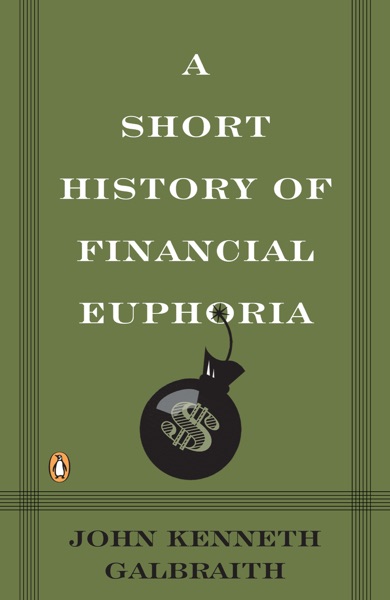
A Short History of Financial Euphoria by John Kenneth Galbraith is a 1990 economics book about financial bubbles, speculation, behavioral economics. Speculative bubbles are not accidents or anomalies. They are recurring features of capitalist economies, produced by permanent features of human psychology, and they will keep happening.
Summary
A Short History of Financial Euphoria is John Kenneth Galbraith's compressed account of speculative bubbles from the tulip mania of 1630s Holland through the 1987 US stock market crash. Galbraith—an economist, diplomat, and bestselling author who served four American presidents—was in his eighties when he wrote this book, and it shows: the prose is drily funny, the learning is lightly worn, and the argument is stated without the padding that longer books on the same subject typically require.
Galbraith's thesis is simple and pessimistic. Financial manias are not aberrations; they are recurring features of capitalist economies that will continue to recur because their psychological preconditions—optimism about asset appreciation, amnesia about the last crash, social pressure to participate in apparent prosperity—are permanent features of human nature. The specific vehicles change: tulip bulbs, South Sea shares, railroad stocks, real estate, technology companies. The mechanism is the same every time.
The mechanism Galbraith describes has three components. First, some asset appears to offer exceptional returns. Second, those who invest early are rewarded, which attracts more investors and drives prices higher, which is taken as vindication of the initial enthusiasm. Third, the people who own the asset become invested not just financially but psychologically—dismissing skeptics as people who fail to appreciate the exceptional circumstances, and constructing increasingly elaborate justifications for why this time is different. When the collapse comes, it's typically sudden and nearly total, and the participants blame fraud, manipulation, or bad luck rather than their own credulity.
The book is short enough—around 100 pages—to be read in a single sitting, and its compression is itself an argument: nothing about speculative manias is complicated. The historical evidence is clear, the mechanism is understood, and yet bubbles keep happening because the cognitive and social conditions that produce them are not amenable to correction by information alone. Galbraith is skeptical that regulation can solve the problem but even more skeptical that individual investors will protect themselves through education. The correct response, the book implies, is permanent wariness—which is much easier to maintain in the abstract than in the middle of a genuine boom.
Talk to A Short History of Financial Euphoria like its author wrote you back.
Get the ideas that fit your life — not generic summaries.
- Chat with the book
- Audiobook-style main ideas
- Adapts to your life and goals
- Helps you take action
Key takeaways
- 1.
Speculative bubbles are not accidents or anomalies. They are recurring features of capitalist economies, produced by permanent features of human psychology, and they will keep happening.
- 2.
The central mechanism of every bubble is the same: rising prices produce apparent validation, which attracts more buyers, which drives prices higher, until the price can no longer be sustained by the underlying value.
- 3.
Amnesia is the financial system's most important vulnerability. Each new generation encounters the same conditions as a novelty, without adequate memory of how previous episodes ended.
- 4.
During a bubble, skeptics are dismissed as failing to grasp the exceptional circumstances of the moment. This is never a coincidence; the dismissal of skeptics is a defining feature of mania, not an incidental one.
- 5.
The assets that bubbles form around are typically real and genuinely valuable: railroads, internet infrastructure, real estate in desirable locations. The problem is price, not underlying worth.
- 6.
Leverage amplifies bubbles in both directions. When prices fall, forced selling by leveraged buyers drives prices further down faster than cash markets would allow.
- 7.
No regulatory structure has successfully prevented the recurrence of speculative manias, though they can moderate the aftermath. Galbraith is skeptical about what institutions can achieve against deep psychological tendencies.
Discussion questions
Use these on your own, with a book club, or as chat starters in Superbook. Book club version, ready to copy or print →
- 1.
Galbraith argues that bubbles are caused by permanent features of human psychology. If that's true, what's the point of studying them? Can knowing change behavior?
- 2.
The book was written in 1990. What bubbles have occurred since then that fit Galbraith's model? What, if anything, was different about them?
- 3.
Have you ever participated in a speculative asset purchase — real estate, stocks, crypto, collectibles — where you were aware of the possibility of a bubble but bought anyway? What was the reasoning?
- 4.
Galbraith is dismissive of people who claim to predict bubble collapses. Is that fair? What would genuine prediction require, and why is it so difficult even in retrospect?
- 5.
The book is short by design. Does a short book on financial bubbles risk being too superficial, or is the brevity itself an argument about how simple the mechanism actually is?
- 6.
What's the current equivalent of the speculative assets Galbraith describes? Where are the conditions for a mania most visible today?
- 7.
Galbraith argues that during a boom, skeptics are socially penalized. Have you experienced a professional or social environment where expressing skepticism about a popular investment thesis carried real cost?
- 8.
He is skeptical that regulation can prevent bubbles but doesn't oppose it. What kinds of regulation would you support, knowing that you can't prevent the underlying psychology?
- 9.
The book covers European financial history (tulip mania, South Sea Company) and American history (1929, 1987). Is there anything distinctive about financial manias in different cultural contexts?
- 10.
Galbraith was himself a prominent public intellectual who sometimes influenced market expectations through his writing. Does that create any tension with his pose as a detached analyst?
- 11.
What's the most important difference between a speculative bubble and a genuine period of rapid value creation? How would you tell them apart in real time?
Themes
Frequently asked questions
-
Is A Short History of Financial Euphoria still relevant today?
Very. The mechanism Galbraith describes—rising prices, social pressure to participate, dismissal of skeptics, inevitable collapse—has repeated in internet stocks, real estate, cryptocurrency, and other assets since the book was published. The specific examples are dated; the analysis isn't.
-
How long does it take to read?
About two hours. The book is around 100 pages and reads quickly. It's one of the shortest serious books on financial history available.
-
What's the main argument of the book?
That financial bubbles are not accidents or the result of fraud. They are recurring products of human psychology — optimism, amnesia about past crashes, and social pressure to participate in apparent prosperity — and they will keep happening regardless of regulation or education.
-
How does this compare to other bubble books like Extraordinary Popular Delusions or Manias, Panics, and Crashes?
Galbraith is shorter, funnier, and more pessimistic than Kindleberger. Charles Mackay's Extraordinary Popular Delusions is more colorful on historical detail. Galbraith is the most concentrated statement of the mechanism, best read alongside the others rather than instead of them.
-
What's the most important takeaway for an individual investor?
That the rational-sounding arguments made during a boom to justify high prices are consistently wrong, and that the social pressure to participate is real and should be treated as a warning signal rather than a reason to join in.