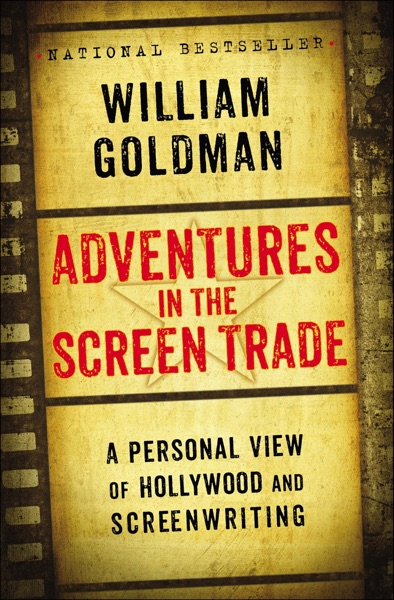
Adventures in the Screen Trade by William Goldman is a 1983 memoir book about screenwriting, hollywood, creative process. Nobody knows anything. This is Goldman's most famous assertion: no one in Hollywood can reliably predict whether a film will succeed, and the belief that anyone can is a collective self-deception.
Summary
William Goldman wrote Butch Cassidy and the Sundance Kid, All the President's Men, Marathon Man, and The Princess Bride, among many others. Adventures in the Screen Trade, published in 1983, is his account of how Hollywood actually works — and the opening line has become one of the most quoted in the industry: "Nobody knows anything." Goldman means it literally: no studio executive, no director, no star, no producer can reliably predict which films will succeed. The blockbuster business runs on hunch, luck, and the inability to learn from failure.
The book moves between two modes. The first is memoir: Goldman describes his career, the films he's worked on, the collaborations that went well and the ones that didn't. He is candid about his own failures and unusually direct about the industry's structural dysfunctions — the star system, the development process, the relationship between writers and directors that almost always results in the writer losing. He writes about Dustin Hoffman's behavior during the filming of Marathon Man with a directness that was considered startling at the time.
The second mode is craft instruction. Goldman constructs an extended example, taking a short story and developing it into a full screenplay, showing the decisions at each stage. This section is genuinely useful for anyone trying to understand what screenwriting actually requires, as distinct from prose fiction or theatrical playwriting. The key insight is structural: films are built backwards from an ending, and every scene exists to serve a dramatic function in a larger architecture. Character exists in service of story, not the reverse.
Goldman's voice is self-deprecating, funny, and blunt. He has no patience for pretension in any direction — neither the studio system's pretense that it knows what audiences want nor the auteur's pretense that commercial filmmaking is beneath serious consideration. His argument is that movies are enormously difficult to make well, that the writer's contribution is systematically devalued, and that understanding this doesn't require any cynicism about the medium — only honesty about the institution. The book is thirty years old and the industry has changed, but the human dynamics Goldman describes — ego, fear, power, and the genuine love of story that motivates people despite all of it — haven't changed much.
Talk to Adventures in the Screen Trade like its author wrote you back.
Get the ideas that fit your life — not generic summaries.
- Chat with the book
- Audiobook-style main ideas
- Adapts to your life and goals
- Helps you take action
Key takeaways
- 1.
Nobody knows anything. This is Goldman's most famous assertion: no one in Hollywood can reliably predict whether a film will succeed, and the belief that anyone can is a collective self-deception.
- 2.
Stars matter enormously in Hollywood not because they make films better but because they make films financeable. The economic logic determines the creative one.
- 3.
Screenwriting is structural work. A script is built from the ending backward, and every scene must serve a dramatic function. Beautiful prose in a screenplay is nearly irrelevant.
- 4.
The writer in Hollywood is subordinate by default. The director controls the final cut, and the studio controls the director. Understanding this early saves a lot of anguish.
- 5.
The development process — the sequence of notes, rewrites, and second-guessing — is designed to make films safe and predictable. It reliably produces mediocrity.
- 6.
Goldman's 'rule' for scene construction: enter late, leave early. Every scene should start as close to its purpose as possible and end the moment that purpose is served.
- 7.
Character in film is revealed through action, not exposition. What people do under pressure is who they are. Explaining this in dialogue is almost always wrong.
- 8.
The screenwriter's job is to make the director look good. Understanding that your work will be transformed and often misunderstood is part of the work, not an injustice to be corrected.
Discussion questions
Use these on your own, with a book club, or as chat starters in Superbook. Book club version, ready to copy or print →
- 1.
Goldman's 'nobody knows anything' claim has become a cliché in the industry. Is it still a useful observation, or has data-driven development changed the underlying reality?
- 2.
He argues that the writer is structurally powerless in Hollywood. Is that unique to film, or does the dynamic operate in other creative industries where many people's money is at stake?
- 3.
Goldman is candid about specific people by name, including Dustin Hoffman and various studio executives. Does that candor make the book more trustworthy or less?
- 4.
His extended screenplay development example is one of the book's most useful sections. What does the process reveal about the difference between writing prose fiction and writing for film?
- 5.
The book was published in 1983. The industry has changed dramatically — streaming, superhero franchises, international box office, independent film. Which of Goldman's observations feel timeless and which feel dated?
- 6.
Goldman says stars are cast primarily for financing reasons, not creative ones. What effect does that have on the quality of films, in your observation as an audience member?
- 7.
'Enter late, leave early' is his scene construction principle. Can you think of films that do this well, or scenes where you've noticed a director failing to apply it?
- 8.
He describes the development process as reliably producing mediocrity. Is that a systemic problem that can be fixed, or is it inherent to the economics of commercial filmmaking?
- 9.
Goldman is both cynical about the industry and clearly devoted to it. How do those two things coexist in the book, and do they coexist in people you know who work in similar industries?
- 10.
The book opens with 'nobody knows anything.' What's the professional equivalent in your own field — the thing that everyone in the industry knows but rarely admits out loud?
- 11.
Goldman says the screenwriter's job is to make the director look good. Is that a healthy professional attitude or a rationalization for subordination?
Themes
Frequently asked questions
-
Is Adventures in the Screen Trade still relevant for aspiring screenwriters?
Yes and no. The craft principles — structure, entering scenes late, character revealed through action — are timeless. The industry Goldman describes has been transformed by streaming, franchise films, and international markets. Read it for the craft and the human dynamics, not for an accurate map of how Hollywood works today.
-
What is Goldman's 'nobody knows anything' argument?
That no one in Hollywood can reliably predict whether a film will succeed. Not the studio heads, not the stars, not the directors. The business runs on hunch and luck, and the assumption of expertise is mostly performance. Goldman says this repeatedly throughout the book.
-
Is this a memoir or a screenwriting manual?
Both. The first two-thirds is memoir and cultural analysis. The final third is a sustained craft demonstration, taking a short story through to a complete screenplay draft with extensive commentary. The two parts work well together.
-
Who should read Adventures in the Screen Trade?
Aspiring screenwriters, film critics, anyone curious about how creative industries actually work versus how they're presented publicly, and fans of Goldman's films who want insight into how he thought about story. It's also an unusually honest memoir of a career in a powerful, often dishonest industry.
-
How does Goldman feel about the treatment of screenwriters?
He is clear-eyed and not particularly bitter. He understands the economics that make writers subordinate and doesn't pretend it's otherwise. His argument isn't that writers should have more power — it's that everyone in the process should be honest about where the power actually lies.