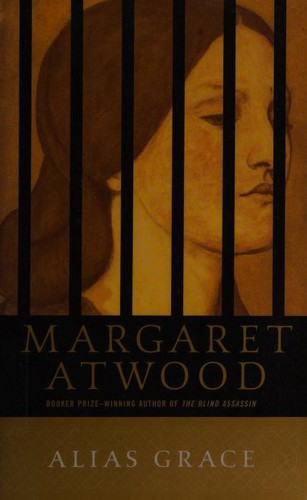
Alias Grace by Margaret Atwood is a 1996 historical fiction book about memory and unreliable testimony, gender and power, class in victorian society. Grace's account of herself is so carefully calibrated to her audience that the novel becomes a study in how women learn to manage the expectations others project onto them.
Summary
Alias Grace is based on the historical case of Grace Marks, a young Irish immigrant servant who was convicted in 1843, along with stable hand James McDermott, of the murders of her employer Thomas Kinnear and his housekeeper Nancy Montgomery in Upper Canada. McDermott was hanged; Grace received a commuted sentence and served thirty years in prison. The novel takes place in 1859, when a young American doctor named Simon Jordan visits Grace to conduct interviews aimed at determining whether she is innocent, guilty, or — the most unsettling possibility — simply unable to remember.
The novel is constructed around an irreducible ambiguity. Grace narrates her own life in meticulous, seductive detail — a fatherless childhood in Ireland, a horrific sea voyage, years of domestic service, a close friendship with a fellow servant named Mary Whitney who dies badly — but the events leading directly to the murders remain, at the narrative's center, a blank. Grace may be suppressing the memory, may be genuinely amnesiac, or may be lying throughout with extraordinary skill. Atwood will not resolve this for you. The novel is constructed to prevent resolution.
The formal intelligence here is considerable. Atwood builds a portrait of mid-Victorian life in domestic service with impressive historical specificity, and she uses the competing voices of the novel — Grace's testimony, Dr. Jordan's letters, newspaper accounts, court records, poetry — to suggest how thoroughly any woman's story could be rewritten by the people around her. Grace understands exactly what various observers need her to be, and she shapes her presentation accordingly. Whether this is cunning or innocence is the question the novel refuses to answer.
Alias Grace is slower and more novelistic than The Handmaid's Tale, and less overtly satirical. It rewards readers who enjoy historical fiction, unreliable narrators, and genuine moral ambiguity. A Netflix miniseries adaptation in 2017 was widely praised for capturing the novel's atmosphere. Readers who need their protagonists to have clear intentions will be frustrated; readers who enjoy the experience of sustained uncertainty will find this one of Atwood's most accomplished works.
Talk to Alias Grace like its author wrote you back.
Get the ideas that fit your life — not generic summaries.
- Chat with the book
- Audiobook-style main ideas
- Adapts to your life and goals
- Helps you take action
Key takeaways
- 1.
Grace's account of herself is so carefully calibrated to her audience that the novel becomes a study in how women learn to manage the expectations others project onto them.
- 2.
The novel does not answer whether Grace is guilty. Atwood has said explicitly that she does not know either. The ambiguity is not a withheld answer but the actual point.
- 3.
Dr. Jordan is a portrait of a certain kind of Victorian male intellectual: genuinely well-intentioned, scientifically modern, and still unable to see Grace as anything other than a case to be solved.
- 4.
The quilting sections that frame the chapters are not decorative — the novel uses needlework as a metaphor for the construction of narrative, the piecing together of fragments into a shape that may or may not reflect the original materials.
- 5.
Class and gender operate in tandem throughout: Grace's vulnerability to accusation is inseparable from her status as a servant, a woman, and an immigrant. Each characteristic makes her testimony more easily dismissed.
- 6.
The novel shows how the same story can be told as tragedy, as melodrama, as medical case study, and as criminal confessional — and how each framing serves the needs of the teller rather than the truth.
- 7.
Mary Whitney's death — and the question of what Grace absorbs from it — is the emotional and psychological pivot of the novel, even more than the murders.
- 8.
Atwood's historical research is dense and visible: the novel's engagement with nineteenth-century discourses of mental illness, hypnotism, and criminal psychology gives it an intellectual texture beyond most historical fiction.
Discussion questions
Use these on your own, with a book club, or as chat starters in Superbook. Book club version, ready to copy or print →
- 1.
By the end of the novel, do you think Grace is guilty? Does the novel want you to reach a conclusion, or does it want you to sit with not knowing?
- 2.
Grace narrates her story in a way that is clearly shaped by her awareness of what Simon Jordan wants to hear. Is she manipulating him, protecting herself, or doing something more complicated?
- 3.
Simon Jordan is the novel's secondary protagonist, and he fails in his project of understanding Grace. What does his failure say about the limits of psychological expertise — then and now?
- 4.
The hypnosis scene is one of the most unsettling in the novel. What do you think happens during it? Does Atwood give you enough to form a view?
- 5.
Grace draws explicit parallels between her situation and the patterns of the quilts she sews. Which patterns feel most resonant to you as a description of the novel's structure?
- 6.
The novel includes real historical documents — court records, newspaper accounts — alongside Atwood's invention. Does mixing fact and fiction in this way feel appropriate for a novel about a real crime?
- 7.
Nancy Montgomery, the murdered housekeeper, is rendered as a morally ambiguous figure — neither entirely sympathetic nor entirely culpable. Does the novel treat her fairly?
- 8.
Grace has survived thirty years in prison and an asylum by the time the novel begins. How has that survival shaped her? Is she someone you trust?
- 9.
The men in the novel — Kinnear, Jordan, the chaplain, McDermott — all project different versions of Grace onto her. What do those projections have in common? What does that say about how the period understood female criminality?
- 10.
The novel's ending is deliberately open. Did you find that satisfying or frustrating, and why?
- 11.
The 2017 Netflix miniseries was widely praised. If you've seen it, how does the adaptation handle the novel's central ambiguity? Does it make any choices the novel refuses to make?
- 12.
Atwood has said Grace represents all women who have been judged by men without adequate access to their actual inner lives. Is that claim supported by what the novel actually does with Grace, or does it flatten her?
Themes
Frequently asked questions
-
Is Alias Grace worth reading?
Yes, particularly if you enjoy historical fiction, unreliable narrators, and moral ambiguity. It is one of Atwood's most carefully constructed novels, and the central question — is Grace guilty? — sustains genuine tension across 500 pages without being resolved cheaply.
-
Is Alias Grace based on a true story?
Yes. Grace Marks was a real person who was convicted in 1843 for her role in the murders of her employer and his housekeeper. The historical record is genuinely ambiguous about her role and her mental state, which is precisely what drew Atwood to the case.
-
How does Alias Grace compare to The Handmaid's Tale?
They are quite different books. The Handmaid's Tale is compressed, satirical, and overtly political. Alias Grace is expansive, historically grounded, and more interested in psychological ambiguity than political allegory. Both are concerned with how women's stories are controlled by the men around them, but the approaches are very different.
-
Is Alias Grace hard to read?
No, but it is long — around 500 pages. Grace's voice is distinctive and readable. The challenge is that the novel resists resolution, and readers who reach the end hoping for a clear answer will be disappointed. If sustained ambiguity feels like evasion, this will frustrate you.
-
Who shouldn't read Alias Grace?
Readers who need clear moral stakes and a definitive conclusion. The novel is built around refusing to tell you what happened, and it does not apologize for that refusal. It also depicts some violence and sexual coercion in ways that are not graphic but not sanitized.