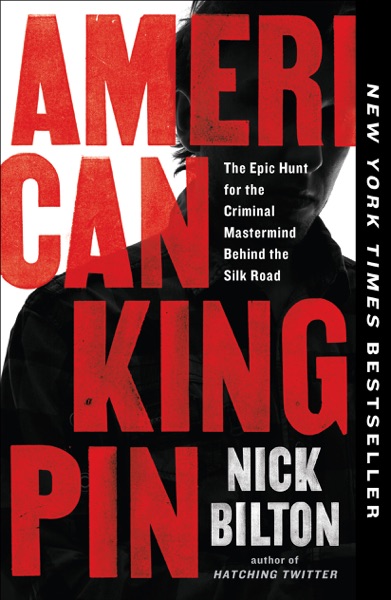
American Kingpin by Nick Bilton is a 2017 biography book about dark web, cybercrime, idealism and corruption. Ross Ulbricht's libertarian conviction that a free drug market would reduce harm was not obviously wrong in theory, but the reality of running an illegal enterprise on that theory produced compromises he hadn't anticipated.
Summary
American Kingpin is Nick Bilton's account of the rise and fall of Silk Road, the dark-web drug marketplace run by Ross Ulbricht under the pseudonym "Dread Pirate Roberts." Bilton traces the story from its ideological origins — Ulbricht's libertarian belief that a free market for drugs would reduce violence, cut out cartels, and let individuals make their own choices — through its rapid growth into a billion-dollar operation, and finally to the multi-agency investigation that culminated in Ulbricht's arrest in a San Francisco public library in 2013.
The book's most striking quality is its portrait of ideological drift. Ulbricht starts as a graduate student in physics and a committed libertarian, genuinely believing he is building something beneficial: a platform where consenting adults can transact without government interference. As Silk Road grows, the complications multiply. He is soliciting contract killings — never carried out but paid for — by 2012. His belief that the market was morally self-regulating collided repeatedly with the reality that markets for illegal goods attract people who solve disputes through violence.
Bilton also follows the investigators: a DEA agent in Baltimore, an IRS special agent in San Francisco, and a team of FBI agents who converged on the case from different directions, often unaware of each other's efforts. The investigation itself was complicated by the fact that two of the federal agents turned corrupt — one stealing Bitcoin, one extorting Ulbricht directly — crimes that would complicate the subsequent prosecution.
The book reads like a thriller and moves quickly. Bilton is a journalist, not a legal scholar, and the technical details are sometimes simplified to the point of imprecision. The moral framing is also fairly straightforward: Ulbricht's libertarian idealism is presented as naivety that reality gradually consumed. Readers who find that framing too tidy may want to read more deeply into the legal debates around Ulbricht's case, which remains contested in some circles.
Talk to American Kingpin like its author wrote you back.
Get the ideas that fit your life — not generic summaries.
- Chat with the book
- Audiobook-style main ideas
- Adapts to your life and goals
- Helps you take action
Key takeaways
- 1.
Ross Ulbricht's libertarian conviction that a free drug market would reduce harm was not obviously wrong in theory, but the reality of running an illegal enterprise on that theory produced compromises he hadn't anticipated.
- 2.
The dark web is not technically impenetrable. Ulbricht's operational security failures — using personal email, logging into forums from home — were ultimately more decisive than any cryptographic breakthrough by investigators.
- 3.
Two of the federal agents investigating Silk Road stole money and extorted Ulbricht, illustrating that the corruption it attracted wasn't only on the criminal side.
- 4.
Scale changes the moral calculus of a platform. At small scale, Silk Road was a curiosity. At hundreds of thousands of users and hundreds of millions in transactions, Ulbricht's decisions had consequences he could no longer personally evaluate.
- 5.
Identity is fragile under sustained pressure. Ulbricht's online persona as Dread Pirate Roberts took on its own logic, demanding decisions the offline Ross Ulbricht might not have made.
- 6.
Bitcoin's public ledger, designed for transparency, ultimately helped investigators trace transactions despite being the currency of a marketplace designed for anonymity.
- 7.
The multi-agency investigation suffered from jurisdictional competition and poor information sharing. Coordination problems between law enforcement agencies are a recurring failure mode in complex cases.
- 8.
Ideological projects that depend on participants behaving well tend to fail when the ideology attracts participants who don't share its premises.
Discussion questions
Use these on your own, with a book club, or as chat starters in Superbook. Book club version, ready to copy or print →
- 1.
Ulbricht believed he was building a harm-reduction platform. At what point in the story, if any, does his original justification become untenable?
- 2.
The book portrays Ulbricht's drift from idealist to someone commissioning murder contracts as gradual. What were the incremental steps, and were there moments where a different decision might have changed the trajectory?
- 3.
Two of the federal investigators turned corrupt. Does that change your view of the moral framing the book applies to Ulbricht?
- 4.
Silk Road's harm-reduction argument — that a regulated marketplace for drugs is safer than unregulated street markets — has academic support. Does the argument stand separately from Ulbricht's conduct?
- 5.
The dark web was supposed to guarantee anonymity, but Ulbricht's downfall came partly from basic operational security mistakes. What does that say about the relationship between technical tools and human behavior?
- 6.
Bilton frames the story as a rise-and-fall narrative. Does Ulbricht's story fit the genre conventions of that form, or does it complicate them?
- 7.
Bitcoin's design made Silk Road possible but also, eventually, helped investigators trace transactions. Is there a general principle here about technologies intended to empower individuals?
- 8.
The multi-agency investigation was hampered by competition and information hoarding. Where else have you seen coordination failures produce worse outcomes than any individual actor would have chosen?
- 9.
Ulbricht's sentence — life without parole — was longer than many convicted murderers receive. Is that proportionate, and what principles should govern sentencing for crimes of this kind?
- 10.
The libertarian case for drug legalization didn't end with Silk Road. Does Ulbricht's story strengthen or weaken that case?
- 11.
Bilton is a journalist writing for a popular audience. What details or questions does the journalistic framing leave out that you'd want to explore further?
- 12.
What draws smart, principled people to build operations that require them to gradually abandon their principles?
Themes
Frequently asked questions
-
Is American Kingpin worth reading?
Yes, if you want a fast-paced narrative account of Silk Road. Bilton is a skilled storyteller and the book reads like a thriller. Readers who want deeper analysis of the legal, political, or technical dimensions should supplement it with more specialized sources.
-
How long does it take to read American Kingpin?
About six to seven hours at average pace. The chapters are short and the pacing is tight, so many readers finish it in two or three sittings.
-
What happened to Ross Ulbricht?
Ulbricht was convicted in 2015 on seven counts including drug trafficking and money laundering, and sentenced to life in prison without the possibility of parole. The severity of the sentence remains controversial, and advocacy for his case continues.
-
Does the book take sides on the drug legalization debate?
The book is more interested in Ulbricht as a character than in the policy debate. Bilton presents the libertarian idealism sympathetically at the start but allows its contradictions to accumulate as the story progresses. Readers with strong views on drug policy will likely find the framing either fair or evasive depending on their priors.
-
What's the most disturbing thing in the book?
Probably the revelation that two of the federal agents investigating Ulbricht were themselves committing crimes — theft of Bitcoin and direct extortion — while Ulbricht was being prosecuted. It complicates the clean moral narrative the case is often given.
Similar books
Bad Blood: Secrets and Lies in a Silicon Valley Startup
John Carreyrou
Super Pumped: The Battle for Uber
Mike Isaac
The Everything Store: Jeff Bezos and the Age of Amazon
Brad Stone
No Filter: The Inside Story of Instagram
Sarah Frier
