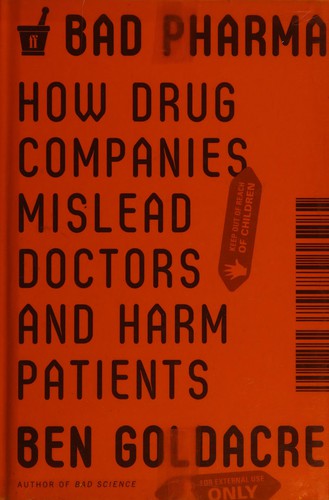
Bad Pharma by Ben Goldacre is a 2012 health book about pharmaceutical industry, evidence-based medicine, regulation. Selective publication of clinical trial results means doctors prescribe drugs based on a biased subset of the evidence. Negative trials routinely go unpublished.
Summary
Bad Pharma is Ben Goldacre's sustained indictment of the pharmaceutical industry's manipulation of clinical trial evidence, and of the regulatory and academic institutions that have failed to stop it. Where Bad Science was primarily about pseudoscience and media failures, Bad Pharma is focused on a more troubling problem: the systematic corruption of the medical evidence base by companies with enormous financial incentives to produce favorable-looking results for drugs that are, in many cases, no better than existing alternatives.
The book's central argument is about missing data. Pharmaceutical companies run many trials, publish the ones with positive results, and bury the ones with negative or ambiguous findings. Regulators see trial data that companies choose to submit; doctors and patients see only what gets published. The consequence is that the published medical literature is systematically biased toward overstating treatment benefits and understating harms. Goldacre documents this through specific cases — Tamiflu, antidepressants, rosiglitazone — where missing trials materially changed the risk-benefit calculation that doctors and patients were making.
The structural problems go beyond selective publication. Goldacre covers ghost-writing of academic papers by industry employees, the design of trials to maximize statistical significance rather than clinical relevance, the use of surrogate endpoints that correlate imperfectly with outcomes patients care about, and the underpowering of trials designed to detect side effects. Each practice is documented with specific examples, and the cumulative picture is of an industry that has captured many of the institutions designed to hold it accountable.
Goldacre is explicit that most pharmaceutical researchers and many company employees are not cynical actors but people working within a system that has built-in incentives toward these behaviors. The book is not a conspiracy theory; it's an institutional analysis. His prescriptions — mandatory trial registration before results, full data sharing, reformed medical education on conflicts of interest — are technical and achievable, which is both the book's strength and, given how slowly change has come, its continuing frustration. Bad Pharma is more demanding than Bad Science but delivers a more important argument.
Talk to Bad Pharma like its author wrote you back.
Get the ideas that fit your life — not generic summaries.
- Chat with the book
- Audiobook-style main ideas
- Adapts to your life and goals
- Helps you take action
Key takeaways
- 1.
Selective publication of clinical trial results means doctors prescribe drugs based on a biased subset of the evidence. Negative trials routinely go unpublished.
- 2.
The Tamiflu case study showed that governments stockpiled billions of dollars of medication based on studies that were never published and turned out to have inflated benefit claims.
- 3.
Trial design can legally produce favorable-looking results without fraud: using the wrong comparator, measuring surrogate endpoints, enrolling patients unlikely to show side effects.
- 4.
Ghost-writing — where industry-employed writers draft papers published under academic names — is common and systematically undisclosed in pharmaceutical research.
- 5.
Conflicts of interest in medical education and continuing professional development are pervasive and not adequately disclosed to practitioners or patients.
- 6.
Regulatory agencies like the FDA receive trial data that companies submit for approval; they don't have access to unpublished trials, which means regulation is based on incomplete evidence.
- 7.
Mandatory trial registration before enrollment began would solve the selective publication problem by creating a public record of what trials were run.
- 8.
The incentive structure of pharmaceutical development systematically underinvests in treatments for diseases that affect poor populations and in long-term comparative effectiveness research.
Discussion questions
Use these on your own, with a book club, or as chat starters in Superbook. Book club version, ready to copy or print →
- 1.
Goldacre argues that missing trial data is the central problem. What would it take to mandate full data disclosure globally, and what are the barriers?
- 2.
The Tamiflu case is the book's most striking example: governments stockpiled a drug based on data that turned out to be unavailable. What does this say about the competence of regulatory bodies?
- 3.
He distinguishes between individual bad actors and systemic incentives. Is that distinction convincing, or does it let companies off the hook too easily?
- 4.
Publication bias in medical research has been documented for decades. Why has it persisted despite being widely known?
- 5.
What's your reaction to the ghost-writing chapters? Is undisclosed ghost-writing straightforwardly unethical, or is there a defensible version of industry-academic collaboration?
- 6.
Goldacre's proposals are technically achievable — trial registration, data sharing. What political and economic obstacles block them?
- 7.
How do you evaluate the argument that the pharmaceutical industry, despite these problems, has produced genuine advances in human health? Does that offset the distortions he documents?
- 8.
Most patients can't evaluate the evidence behind the drugs they're prescribed. What obligations does that asymmetry create for doctors, regulators, and companies?
- 9.
If you were a clinician reading this book, how would it change how you approach treatment decisions for patients?
- 10.
The AllTrials campaign that Goldacre helped found has had partial success. How do you measure progress on a problem like this?
- 11.
Bad Pharma focuses on the pharmaceutical industry, but similar publication bias problems exist in other fields of research. How far do you think the argument generalizes?
- 12.
What's the most important reform Goldacre proposes, and what's the first step toward implementing it?
Themes
Frequently asked questions
-
Is Bad Pharma worth reading?
Yes, if you want to understand how pharmaceutical evidence actually works and why the treatments your doctor prescribes may be based on an incomplete or biased evidence base. It's more demanding than Bad Science but more important if you're interested in healthcare policy or medical practice.
-
What is the main argument of Bad Pharma?
That pharmaceutical companies systematically suppress unfavorable trial results, manipulate trial design, and influence medical education, producing an evidence base that overstates drug benefits and understates harms — and that the regulatory and academic institutions designed to catch this have largely failed.
-
Does Goldacre argue that all pharmaceutical drugs are unsafe?
No. His argument is more specific: that the evidence base is distorted and incomplete in ways that make it difficult to know which drugs are genuinely better than alternatives. He acknowledges real advances in medicine; his target is the manipulation of evidence about the margins.
-
How does Bad Pharma differ from Bad Science?
Bad Science is about pseudoscience, media failures, and alternative medicine. Bad Pharma is about failures within mainstream medicine and the pharmaceutical industry. Bad Pharma is more technical and more legally careful; it documents systemic practices rather than taking on individual quacks.
-
What has changed since Bad Pharma was published?
Trial registration requirements have expanded and the AllTrials campaign achieved partial success in requiring more disclosure in the UK and EU. However, full data sharing remains contested, many trials are still registered incompletely, and the underlying incentive structures Goldacre describes remain largely intact.
Similar books
Bad Science
Ben Goldacre
Empire of Pain: The Secret History of the Sackler Dynasty
Patrick Radden Keefe
The Checklist Manifesto
Atul Gawande
The Immortal Life of Henrietta Lacks
Rebecca Skloot
