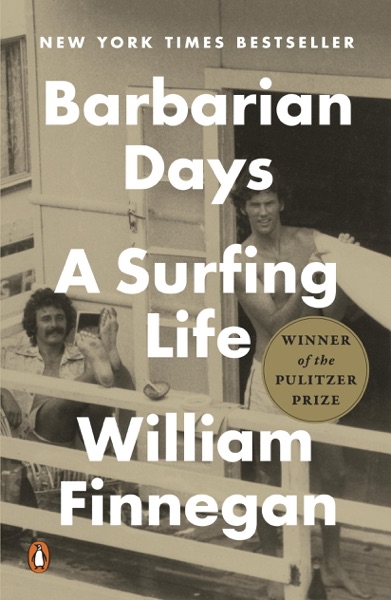
Barbarian Days by William Finnegan is a 2015 memoir book about surfing, obsession, travel. Surfing, for Finnegan, is less a sport than a parallel world with its own geography, social codes, and rewards. Understanding it requires treating it with the same seriousness as any other demanding practice.
Summary
Barbarian Days is William Finnegan's memoir of a life spent surfing — from his childhood in Los Angeles and Hawaii through decades of obsessive searching for waves across the Pacific, Asia, Africa, and eventually the cold waters of New York. It won the 2016 Pulitzer Prize for biography or autobiography. Finnegan, a longtime staff writer for The New Yorker, brings the same precision and moral seriousness to surfing that he brings to the conflict zones he has covered professionally. The result is the best book ever written about surfing, and one of the best American memoirs of recent decades.
The memoir does not romanticize surfing so much as describe what it actually demands: years of physical dedication, the mathematical study of ocean behavior, the specific geography of particular breaks, and the elaborate social hierarchies that form around the best waves. Finnegan is interested in the way surfing creates a second life running parallel to ordinary life — a parallel world with its own geography, its own status systems, its own obsessive pleasures. He writes about his most important surf breaks — Honolua Bay, a reef in Madeira, the fearsome waves at Ocean Beach in San Francisco — with a precision that is both technical and deeply personal.
The book is also a portrait of male friendship, particularly the partnership between Finnegan and Bryan Di Salvatore, with whom he traveled the Pacific for years, sharing waves and surfing secrets with a ferocity that excluded others. The ethic of surf tribalism — the territorial aggression, the closed knowledge passed between serious surfers, the pleasure of having a secret spot — runs throughout. Finnegan is honest about the costs this obsession imposed on his relationships, his career, and his sense of proportion.
Non-surfers often worry they'll find this book inaccessible. They typically don't. Finnegan's prose is good enough to carry anyone who is curious about the nature of obsessive mastery, travel with purpose, and the strange durability of passions formed in adolescence. The ocean descriptions are physical and precise, and the book's emotional argument — that chasing a passion across decades shapes character in ways that conventional achievement cannot replicate — is legible whether or not the reader has ever seen a surfboard.
Talk to Barbarian Days like its author wrote you back.
Get the ideas that fit your life — not generic summaries.
- Chat with the book
- Audiobook-style main ideas
- Adapts to your life and goals
- Helps you take action
Key takeaways
- 1.
Surfing, for Finnegan, is less a sport than a parallel world with its own geography, social codes, and rewards. Understanding it requires treating it with the same seriousness as any other demanding practice.
- 2.
Obsession is not the same as enthusiasm. The book traces how a true obsession reshapes your life's geography, your relationships, and the decisions you make about where and how to live.
- 3.
The best surf breaks require years of study — reading swell patterns, tide charts, seasonal changes. Surfing at the highest level is as much cognitive as physical.
- 4.
Surf tribalism is real and has a logic. Localism — the aggressive protection of a wave by its resident surfers — is partly about preserving something genuinely scarce and easily destroyed by crowds.
- 5.
Male friendship of the kind Finnegan describes — built around shared obsession and mutual exclusion of others — is rare and fragile. The book is partly an elegy for relationships that can't survive adulthood.
- 6.
Writing about a physical discipline precisely enough to convey its interior experience is a significant literary achievement. Finnegan's descriptions of specific waves are models of technical writing that don't sacrifice atmosphere.
- 7.
The parallel life that surfing represents is also a way of maintaining a part of the self outside professional identity and social obligation. The tension between the two lives is the book's underlying drama.
- 8.
The Pulitzer Prize was a surprise to many in the literary world, but it signaled something real: that a book about surfing could be as serious and lasting as any other form of memoir.
Discussion questions
Use these on your own, with a book club, or as chat starters in Superbook. Book club version, ready to copy or print →
- 1.
Finnegan describes surfing as a parallel life running alongside his professional career. What obsession in your own life, if any, operates that way — with its own rules, geography, and rewards?
- 2.
The book is partly about male friendship built around shared obsession. How does the exclusivity of that kind of bond compare to friendships built differently?
- 3.
Surf localism — locals defending their breaks against crowds — has real costs and real logic. How do you think about the ethics of guarding scarce pleasures from others?
- 4.
Finnegan is honest about the personal costs of his obsession: strained relationships, deferred ambitions, questionable priorities. Does he justify those costs, or just describe them?
- 5.
Non-surfers often find this book accessible anyway. What makes writing about a specific, technical subculture readable to outsiders? What techniques does Finnegan use?
- 6.
The book is structured geographically — each major chapter is organized around a different place and its waves. How does that structure serve or limit the memoir's other concerns?
- 7.
Finnegan is also a serious journalist who has covered war and poverty. How does the surfing life relate to that other life? Does the book ever reckon with the disproportion?
- 8.
Adolescent obsessions that persist into adult life are unusual. What do you think explains why surfing retained its hold on Finnegan when most passions fade?
- 9.
The best surf writing creates a sense of physical experience in readers who've never surfed. Read any of the wave descriptions carefully: what specific choices make them work?
- 10.
The Pulitzer for a surfing memoir surprised many people. What does the choice say about what gets recognized as serious literature, and what tends to be overlooked?
- 11.
Finnegan describes learning waves in specific places over years. Is there an analogy to how we master anything complex — understanding that knowledge is always local and specific?
- 12.
If you were to write a memoir organized around a parallel obsession in your own life, what would it be, and what would it reveal about your choices that biography couldn't?
Themes
Frequently asked questions
-
Is Barbarian Days worth reading if you don't surf?
Yes, and most of its fans don't surf. The book is about obsession, travel, friendship, and the way a lifelong passion shapes character — surfing is the vehicle, not the point. Readers who've been deeply absorbed by anything will recognize the interior experience Finnegan describes.
-
Why did Barbarian Days win the Pulitzer Prize?
Because Finnegan writes with the same precision and seriousness he brings to long-form journalism about conflict and poverty, and he applies it to a subject that literary culture tends to dismiss. The combination of technical accuracy and emotional depth was recognized as genuinely excellent memoir writing.
-
How long is Barbarian Days?
Around 430 pages. At average reading pace, about eight to nine hours. The book is organized into loosely chronological chapters, each centered on a particular place and period of Finnegan's life, so it can be read in sections without losing the thread.
-
Is the book suitable for a book club?
Very suitable. The questions it raises — about obsession, male friendship, work versus passion, the costs of an unconventional life — generate real discussion. The non-surfing chapters, particularly on Finnegan's reporting career and his relationships, give non-surfers plenty of grounding.
-
What is the most memorable passage?
Many readers cite the Madeira chapter, where Finnegan describes surfing a perfect but dangerous reef called Jardim do Mar for years without telling anyone else about it. The description of the wave, and the ethics of withholding it from other surfers, captures the book's tension between obsession and generosity.