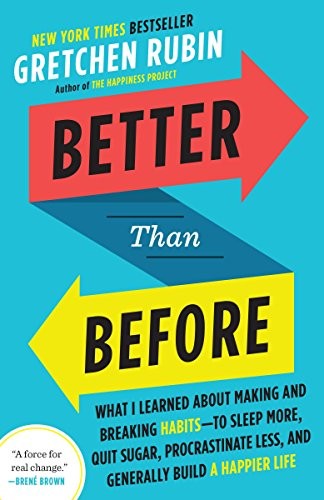
Better Than Before by Gretchen Rubin is a 2015 self-help book about habits, behavior change, self-knowledge. The Four Tendencies — Upholder, Questioner, Obliger, Rebel — describe how different people respond to inner and outer expectations. Habit strategies that work for one tendency often fail for another.
Summary
Better Than Before is Gretchen Rubin's synthesis of years of research and personal experimentation on habits. Rubin's specific contribution to the crowded habit literature is the observation that different people respond to habits differently based on how they relate to inner expectations (self-imposed commitments) versus outer expectations (commitments to others). This observation produces her Four Tendencies framework: Upholders (who meet both inner and outer expectations), Questioners (who meet inner expectations but resist outer ones), Obligers (who meet outer expectations but struggle with inner ones), and Rebels (who resist all expectations).
The framework is the book's most valuable and original contribution. It explains why the same habit advice works for some people and fails for others: an Obliger, who struggles to keep commitments to herself, responds well to external accountability structures. A Rebel, who resists any directed behavior, needs to frame habits as an expression of identity rather than an obligation. A Questioner needs to understand the reason behind a habit before committing to it.
The rest of the book is organized around strategies for building habits, each one analyzed through the lens of which tendencies it serves. Convenience, inconvenience, monitoring, identity, scheduling, accountability — Rubin examines each strategy honestly, noting which personality types they work for and which they don't. The approach is more individualized than most habit books, which tend to offer universal prescriptions.
Rubin is honest that habits are not a problem to be solved once but a practice to be maintained. She is also honest about the limits of self-knowledge: most people overestimate how disciplined they will be in the future, underestimate how much their environment influences their behavior, and mistake familiarity for habit strength.
Talk to Better Than Before like its author wrote you back.
Get the ideas that fit your life — not generic summaries.
- Chat with the book
- Audiobook-style main ideas
- Adapts to your life and goals
- Helps you take action
Key takeaways
- 1.
The Four Tendencies — Upholder, Questioner, Obliger, Rebel — describe how different people respond to inner and outer expectations. Habit strategies that work for one tendency often fail for another.
- 2.
Obligers, the most common tendency, struggle to maintain habits for themselves but are highly reliable when accountable to others. External accountability structures are essential for Obligers.
- 3.
The clean slate effect: new beginnings — new year, new job, new home — lower the psychological cost of starting a new habit. Using these moments intentionally is more effective than trying to change at a random time.
- 4.
Convenience dramatically increases the probability of a habit. Reducing friction — putting exercise clothes out the night before, keeping healthy food at the front of the fridge — is more reliable than trying to increase motivation.
- 5.
Monitoring behavior changes it. The act of tracking a habit makes it more salient and more likely to be maintained, regardless of the tracking method.
- 6.
Pairing habits — attaching a new habit to something you already do — works well for Upholders and some Questioners but may feel like deprivation to Obligers and Rebels.
- 7.
Abstaining is sometimes easier than moderating. For some people and some habits, 'never' is simpler to maintain than 'sometimes.' Knowing which category you fall into prevents failed moderation attempts.
- 8.
Identity is a powerful habit anchor: 'I am a runner' is a more durable habit scaffold than 'I run three times a week.'
Discussion questions
Use these on your own, with a book club, or as chat starters in Superbook. Book club version, ready to copy or print →
- 1.
Which of the Four Tendencies most accurately describes you? Has knowing your tendency changed how you think about habits you've failed to build or break?
- 2.
Obligers succeed with external accountability. If you are an Obliger, what accountability structure would most support the habit you most want to build?
- 3.
Rubin argues that convenience is underestimated as a habit driver. What is one habit you want to build where reducing friction — environmental redesign rather than more willpower — might work?
- 4.
The clean slate effect: what new beginning is coming up in your life — job change, move, new year — that you could intentionally use as a habit reset?
- 5.
Abstaining versus moderating: what is a habit you've tried to moderate that might actually be easier to give up entirely? How do you know which category applies to you?
- 6.
Rubin says monitoring behavior changes it. What in your life would you be willing to track for thirty days? What do you think you would discover?
- 7.
Identity as a habit anchor: pick a habit you want to build. Can you frame it as a claim about who you are rather than something you're trying to do? What does that shift feel like?
- 8.
The book describes 'treats' — small, self-given rewards — as important for maintaining motivation. What are your most reliable treats? Are you giving them to yourself appropriately?
- 9.
Rubin talks about the difference between a resolution and a habit. What's the difference, in your experience, between the two? Why do resolutions fail where habits succeed?
- 10.
She notes that people are surprisingly bad at knowing their own tendencies and overestimate their future discipline. Where do you consistently overestimate yourself?
- 11.
Which of the book's strategies — pairing, scheduling, convenience, monitoring — have you already used successfully? Which have you never tried?
- 12.
Better Than Before is more individualized than most habit books because it argues that different people need different approaches. Do you find that liberating or frustrating?
Themes
Frequently asked questions
-
Is Better Than Before worth reading?
Yes if you want a more personalized approach to habits than Atomic Habits provides. Rubin's Four Tendencies framework is genuinely useful for understanding why generic habit advice doesn't work for everyone. Some readers find the personal anecdotes excessive, but the framework content is solid.
-
How long does it take to read Better Than Before?
About four to five hours at average pace. The chapters are organized around specific strategies and can be read selectively if you know which approaches you want to explore.
-
What are the Four Tendencies?
Upholders meet both inner and outer expectations. Questioners resist outer expectations unless they understand the reason. Obligers meet outer expectations but struggle with inner ones. Rebels resist all expectations and do best when habits are framed as identity choices. Most people are Obligers; Upholders are the smallest group.
-
How does Better Than Before compare to Atomic Habits?
Atomic Habits provides a universal habit framework built on environmental design and behavioral loops. Better Than Before provides a personality-based approach that explains why the same techniques work for some people and fail for others. Reading both gives you both the universal mechanics and the individual variation.
-
Who should read Better Than Before?
People who have tried standard habit advice — habit stacking, tracking, accountability — and found some of it works and some doesn't without understanding why. Rubin's framework helps you identify which strategies are likely to work for your specific tendency.