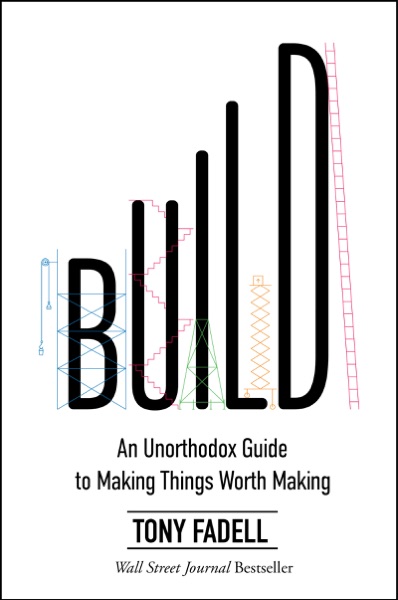
Build by Tony Fadell is a 2022 business book about product development, leadership, startup culture. Great products solve problems people have normalized — frictions and frustrations they've stopped noticing because no one has offered them a better alternative.
Summary
Tony Fadell was the engineer who built the iPod, the executive who led the team that created the original iPhone, and the founder of Nest, the thermostat company he sold to Google for $3.2 billion. Build, published in 2022, is his attempt to transmit what he learned across those experiences — a practical guide to making products, building teams, and navigating a career in technology without losing your principles or your sanity.
The book is organized around a set of pressing questions that anyone building a product or leading a team will face: How do you hire well? How do you manage up? How do you decide what to build? When should you leave a job? What does a great product feel like from the inside? Fadell addresses these through specific stories from his career — the negotiations with Steve Jobs, the technical decisions behind the iPod's click wheel, the conflicts inside Apple and Nest — and through the mental models he developed over time.
One of the book's central ideas is that great products solve problems people don't yet know they have. Fadell's examples — the iPod, the Nest thermostat — were not responses to expressed user demand but to frustrations that users had normalized: carrying hundreds of CDs, ignoring the programmable thermostat on the wall. His argument is that product intuition — the ability to feel a friction before it's articulated — is a learnable skill, developed by obsessive attention to how things are used in daily life.
The leadership material is direct and occasionally pointed. Fadell is clear about what he thinks good management looks like — giving feedback early and specifically, making decisions visibly, firing slowly or not slowly enough, depending on the situation — and about the patterns of dysfunction he's seen most often. He is not a systematic thinker in the way that management books often are; the advice is more anecdotal and more personal, which makes it both more readable and harder to apply as a framework. Build is long and uneven, but the sections that are good — particularly on product intuition and on navigating organizational conflict — are as practically useful as anything in the genre.
Talk to Build like its author wrote you back.
Get the ideas that fit your life — not generic summaries.
- Chat with the book
- Audiobook-style main ideas
- Adapts to your life and goals
- Helps you take action
Key takeaways
- 1.
Great products solve problems people have normalized — frictions and frustrations they've stopped noticing because no one has offered them a better alternative.
- 2.
Product intuition is developed by paying detailed, obsessive attention to how real people use real things in daily life — not by user research alone, but by direct, sustained observation.
- 3.
The click wheel wasn't an invention but a synthesis: Fadell's team borrowed a mechanism from Bang and Olufsen, refined it for a new context, and built a product experience around it.
- 4.
Hiring is the most consequential decision a manager makes. Fadell argues for hiring for trajectory and judgment rather than current skill level, and for being willing to bet on people who haven't proven themselves in a specific domain.
- 5.
Feedback should be specific, early, and delivered as useful data — not as evaluation. Vague or withheld feedback is one of the most common management failures.
- 6.
Organizational dysfunction — the patterns of bad behavior, unclear ownership, and avoided conflict that sink companies — is almost always caused by failures of leadership, not failures of individual contributors.
- 7.
Knowing when to leave a job is as important as knowing how to succeed in one. Fadell argues that the decision to stay or leave should be made on principle rather than on calculation of short-term gain.
- 8.
Build is explicit about the experience of working with Steve Jobs — the demands, the vision, the irrationality, and the extraordinary results. Fadell's conclusion is that Jobs's methods produced outcomes that conventional management would not have, at a human cost that is worth examining honestly.
Discussion questions
Use these on your own, with a book club, or as chat starters in Superbook. Book club version, ready to copy or print →
- 1.
Fadell argues that great products solve problems people have normalized. What's a product or service in your life that has done that for you — solved a friction you'd stopped noticing?
- 2.
He describes product intuition as a learnable skill built through obsessive observation. How would someone develop that skill deliberately? What practices or habits would it require?
- 3.
The iPod and the iPhone were both built inside Apple's existing organizational structure, under Steve Jobs's direct control. What does that tell us about the relationship between organizational form and product quality?
- 4.
Fadell is honest about the dysfunction he observed and sometimes created at both Apple and Nest. What does he identify as the root causes of organizational breakdown?
- 5.
His advice on hiring — bet on trajectory and judgment over current skill — runs counter to the way most companies hire. What are the conditions under which that approach works? When does it fail?
- 6.
He recommends giving feedback early, specifically, and as data rather than evaluation. What makes that approach hard to execute consistently? What gets in the way?
- 7.
Fadell sold Nest to Google for $3.2 billion and then had a difficult experience inside Alphabet. What does his account of that experience suggest about the integration of acquisitions by large technology companies?
- 8.
The book argues that dysfunction is almost always a leadership failure. Do you think that's true? Are there sources of organizational dysfunction that originate outside leadership?
- 9.
Build is long and covers career advice, product philosophy, management practice, and personal experience. Does that breadth make it more or less useful than a more focused book would be?
- 10.
Fadell's experience with Steve Jobs is a significant thread through the book. How do you evaluate his attempt to be honest about Jobs's methods and their human cost?
- 11.
He argues that knowing when to leave is as important as knowing how to succeed. What are the signals he identifies? Are they applicable to careers outside technology?
- 12.
Who has been the most influential mentor or manager in your own career, and what specifically did they do that made them effective?
Themes
Frequently asked questions
-
What is Build by Tony Fadell about?
It is a practical guide to building products, teams, and careers, organized around the key challenges Fadell encountered at Apple, Nest, and throughout his career. The core themes are product intuition, hiring and management, organizational dysfunction, and how to navigate ambition without losing integrity.
-
Is Build worth reading if I'm not in tech?
Mostly yes. The product intuition material and leadership advice translate well to any field where people make things for other people. The Apple and Nest war stories are specifically about Silicon Valley, but the underlying lessons about observation, feedback, and organizational behavior are broadly applicable.
-
How long does Build take to read?
Most readers finish it in eight to ten hours. It is long — over 400 pages — and structured as a series of standalone essays that can be read out of order. The chapters on product intuition and on hiring are the most reread.
-
What is the most important idea in Build?
That great products solve problems people have normalized — the frictions they've learned to live with because no one has offered a better alternative. Identifying those frictions requires deliberate, sustained observation of how people actually use things, not just what they say they want.
-
Is this book primarily about Apple and Steve Jobs?
No, though Apple and Jobs appear throughout. The Nest story and the broader career and management advice take up at least as much space. Readers primarily interested in the Apple history will get less than they might expect; readers interested in product and leadership practice will get more.