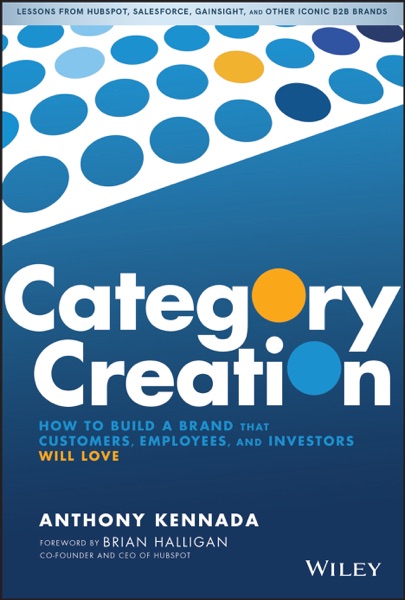
Category Creation: How to Build a Brand That Customers, Employees, and Investors Will Love by Anthony Kennada is a 2019 business book about category design, brand strategy, marketing. Category creation means identifying a problem that exists but isn't yet named, naming it, and becoming the definitional leader of the conversation around it. The company that names the category typically leads it.
Summary
Category Creation is Anthony Kennada's account of how Gainsight, where he served as chief marketing officer, built the customer success management category from scratch — and the broader argument that this approach to marketing, creating a new market category rather than competing within an existing one, produces compounding advantages that conventional brand-building rarely matches. The book is part memoir of a specific company's marketing journey, part framework for how to attempt the same.
Kennada's central argument is that category creation is not primarily about product features or competitive positioning. It's about identifying a problem that exists but isn't yet widely named, naming it, and then becoming the definitional leader of the conversation that forms around that problem. Gainsight didn't just sell software for managing customer retention; it defined "customer success" as a business function, gave it a job title, and built a community of practitioners who needed that function to exist. The software sale followed the category creation, rather than the other way around.
The book is structured around what Kennada calls the four pillars of category creation: creating a market-defining point of view, building a community of believers, developing a dedicated brand for the category itself (not just the company), and mobilizing customers as advocates. He is specific about tactics: the types of content that establish thought leadership, how Pulse (Gainsight's annual conference) was designed to build community identity rather than just generate leads, and how to separate the category brand from the company brand in a way that makes both stronger.
The book is honest about the scope of the commitment. Category creation requires years of sustained investment in content, community, and evangelism before it produces measurable commercial return. It is a strategy for companies with the patience and resources to invest in long-cycle returns — not a quick-growth tactic. Kennada is also candid that category creation can fail: if the problem doesn't resonate widely enough, or if a better-resourced competitor defines the category before you do, the investment can go unrewarded.
Talk to Category Creation: How to Build a Brand That Customers, Employees, and Investors Will Love like its author wrote you back.
Get the ideas that fit your life — not generic summaries.
- Chat with the book
- Audiobook-style main ideas
- Adapts to your life and goals
- Helps you take action
Key takeaways
- 1.
Category creation means identifying a problem that exists but isn't yet named, naming it, and becoming the definitional leader of the conversation around it. The company that names the category typically leads it.
- 2.
Community is the most durable moat in category creation. A category-leading company doesn't just have customers — it has a professional community whose identity is tied to the category itself.
- 3.
The category brand and the company brand are different assets. Building the category brand first creates a rising tide that lifts the company, while protecting against any single competitor claiming category leadership.
- 4.
Gainsight's insight was that 'customer success' as a job function didn't yet exist at scale but was clearly needed. Category creation requires finding the same kind of latent organizational or professional need.
- 5.
Thought leadership that defines a category is different from thought leadership that promotes a product. The former is credible to people who will never buy from you; the latter is only credible to people already in your funnel.
- 6.
A dedicated community event — Gainsight's Pulse conference — creates social infrastructure for a category that no individual member could create alone. This is a high-cost but high-return investment in category stickiness.
- 7.
Category creation is a long-term strategy. It requires years of investment before the commercial return is clear, which makes it suited to well-funded or patient companies, not early-stage startups running lean.
- 8.
Customers who believe in the category become advocates who recruit other customers. The category becomes self-reinforcing when practitioners hire peers who adopt the same tools and beliefs.
Discussion questions
Use these on your own, with a book club, or as chat starters in Superbook. Book club version, ready to copy or print →
- 1.
Kennada argues that naming a category is the first act of category creation. What unmet need in your industry or profession is real but doesn't yet have a name?
- 2.
He distinguishes between competing in an existing category and creating a new one. What are the conditions that make category creation the right strategy versus competing on features in an existing market?
- 3.
Gainsight built Pulse, a conference that became the industry gathering for customer success practitioners. What would the equivalent community infrastructure look like in your market?
- 4.
The category brand and company brand argument is counterintuitive — you invest in making the category credible even for non-customers. What's the risk of this approach, and when does it break down?
- 5.
Kennada says customer success as a job function barely existed when Gainsight started. Can you identify a job function or professional role that is emerging in your industry but hasn't crystallized yet?
- 6.
Category creation requires patience. How do you make the case to investors or executives for a multi-year marketing investment when the commercial return is hard to measure early?
- 7.
He emphasizes customer advocacy as a pillar of category creation. What does it actually take to convert satisfied customers into advocates who actively recruit peers?
- 8.
What categories have been created in the last decade in your industry? Who created them and what was the first-mover advantage worth?
- 9.
Kennada admits the strategy can fail if the problem doesn't resonate widely enough. How do you test whether a problem is big enough to support a category before committing fully?
- 10.
How does category creation differ from simply being good at content marketing and community building? Is there a meaningful distinction, or is the category framing mostly rhetorical?
- 11.
If you applied Kennada's four pillars — point of view, community, category brand, customer advocacy — to a product you work on, which pillar would be hardest to build and why?
Themes
Frequently asked questions
-
What is Category Creation about?
It's the story of how Gainsight built the customer success management software category from scratch, and a framework for how other companies can use the same approach — naming a new problem, building community around it, and becoming the definitional company in that space.
-
Is category creation only for large companies?
No, but it requires patience and resources. Early-stage startups can begin laying the groundwork — content, community, point of view — but the full strategy takes years to pay off commercially. Companies without runway or investor patience for long-cycle returns may struggle to sustain it.
-
How is this different from conventional marketing strategy?
Conventional marketing competes within an established category on features, price, or brand. Category creation argues that the biggest commercial return comes from defining the category itself, so that competitors have to position against you rather than the other way around.
-
Who should read this book?
Marketing leaders, founders, and anyone in B2B who wants to think beyond conventional product positioning. It's most useful for companies that believe their market is underserved or doesn't yet fully exist, rather than for companies competing directly against established alternatives.
-
What's the most practical takeaway?
Build the community before you need it commercially. The practitioners who adopt the category as part of their professional identity become the most durable source of advocacy, recruitment, and market legitimacy — but only if you invest in building that community before it has obvious near-term commercial value.
Similar books
This Is Marketing: You Can't Be Seen Until You Learn to See
Seth Godin
Obviously Awesome
April Dunford

Contagious: Why Things Catch On
Jonah Berger
Building a StoryBrand
Donald Miller
