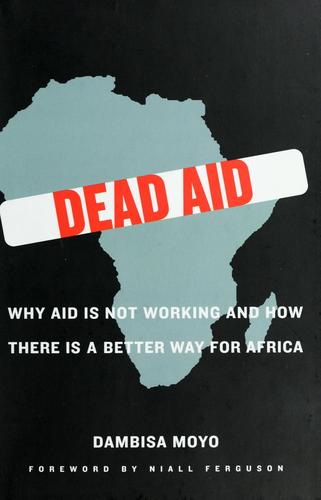
Dead Aid: Why Aid Is Not Working and How There Is a Better Way for Africa by Dambisa Moyo is a 2009 economics book about foreign aid, african development, debt. Systematic government-to-government aid has failed Africa: over fifty years, more than a trillion dollars in aid coincided with declining per-capita incomes and rising poverty.
Summary
Dead Aid is Dambisa Moyo's argument that the system of aid flowing from rich countries and multilateral institutions to sub-Saharan Africa has not only failed to generate growth but has actively made things worse. Over roughly fifty years, more than a trillion dollars in aid has moved into the continent, and yet per-capita incomes in many recipient countries have declined, corruption has deepened, and dependency has calcified. Moyo's central claim is that aid is the problem, not the solution.
The book distinguishes between three kinds of aid: emergency and humanitarian aid for crises, charitable aid from NGOs, and the government-to-government or multilateral flows that Moyo targets. It is this last category — systematic, bureaucratized development aid — that she argues creates a cycle of dependency, props up corrupt governments, crowds out domestic entrepreneurship, and relieves the pressure on states to be accountable to their own citizens. When a government can fund itself through aid rather than taxes, it answers to foreign donors rather than local populations.
Moyo's alternative is not charity — it's capital market access, direct foreign investment, trade liberalization, and microfinance. She argues that African countries should wean themselves off aid within five years, issue bonds in international markets, court Chinese investment, reform land rights, and build institutions that can attract private capital. The prescription is deliberately provocative, and Moyo defends it against the objection that cutting aid would harm the poorest. Her answer: it already is.
The book reads as a sharp corrective to aid-industry consensus rather than a comprehensive development blueprint. Critics have noted that some of its evidence is selectively presented and that it underweights cases where aid did help build infrastructure or fund vaccines. But the core challenge to the "more aid equals more development" assumption is serious and draws on a substantial body of economic research. It is most usefully read alongside more nuanced work in development economics, not as a standalone verdict.
Talk to Dead Aid: Why Aid Is Not Working and How There Is a Better Way for Africa like its author wrote you back.
Get the ideas that fit your life — not generic summaries.
- Chat with the book
- Audiobook-style main ideas
- Adapts to your life and goals
- Helps you take action
Key takeaways
- 1.
Systematic government-to-government aid has failed Africa: over fifty years, more than a trillion dollars in aid coincided with declining per-capita incomes and rising poverty.
- 2.
Aid creates perverse incentives: governments funded by foreign donors become accountable to aid agencies rather than their own citizens, undermining democratic development.
- 3.
Aid crowds out domestic institutions. Countries that don't need to tax their citizens have no incentive to build the administrative and legal structures that taxation requires.
- 4.
Aid perpetuates dependency. A country that cannot attract private capital or generate domestic savings has no buffer when aid flows slow or stop.
- 5.
Moyo's alternative rests on capital market access, trade liberalization, microfinance, and direct foreign investment — channels that require and reward accountability.
- 6.
The comparison class matters: countries that developed without large-scale aid — South Korea, Taiwan, Botswana — offer more useful models than those that absorbed it.
- 7.
Chinese investment in Africa, often criticized in the West, is closer to Moyo's preferred model: it comes with conditions tied to project delivery rather than governance benchmarks.
- 8.
Emergency and humanitarian aid is not under attack here. Moyo's argument is specific to the long-running development aid pipeline, which she wants phased out within five years.
Discussion questions
Use these on your own, with a book club, or as chat starters in Superbook. Book club version, ready to copy or print →
- 1.
Moyo distinguishes between humanitarian aid and development aid. Does that distinction hold up in practice, or do the two categories bleed into each other?
- 2.
Her argument assumes that aid undermines state accountability. Can you think of countries where large aid inflows coexisted with improved governance? What explains those cases?
- 3.
Moyo says African countries should issue bonds on international markets. What would have to be true about those markets for that to work as a development strategy?
- 4.
If aid creates dependency, why do recipient governments keep asking for it? What does that tell us about who benefits inside those countries?
- 5.
She argues that Chinese investment in Africa is preferable to Western aid. What does that comparison assume about what 'better' means for development?
- 6.
The book targets multilateral development aid but not NGO or emergency aid. Where would you draw the line, and on what basis?
- 7.
Is the five-year phase-out timeline a genuine policy proposal or a rhetorical device to force a conversation? Does it matter which?
- 8.
What would it look like to hold Western aid agencies accountable for outcomes the way she wants recipient governments held accountable?
- 9.
Moyo is from Zambia, trained at Oxford and Harvard, and worked at Goldman Sachs. How does her background shape her argument, and does it undercut or strengthen it?
- 10.
Her alternative relies on private capital flows. What happens to the poorest countries that cannot attract investment regardless of their policies?
- 11.
Is it coherent to argue simultaneously that aid undermines democracy and that aid recipients should unilaterally decide to refuse it?
- 12.
How would you evaluate Moyo's argument in light of what happened to countries that did liberalize and court private capital in the 1990s?
Themes
Frequently asked questions
-
What is Dead Aid about?
It argues that systematic foreign aid to sub-Saharan Africa has made things worse rather than better by fueling corruption, undermining state accountability, and creating dependency. Moyo proposes replacing aid with capital markets, trade, and investment.
-
Is Dead Aid worth reading?
Yes, especially if you've taken the value of development aid for granted. The book is a focused, readable challenge to aid-industry consensus and draws on real economic research. It works best read alongside critics who dispute its evidence base, because the issue is more complicated than any single argument captures.
-
Who should read Dead Aid?
Anyone interested in development economics, African politics, or the gap between intentions and outcomes in international policy. It's also useful reading for anyone who donates to international aid organizations and wants to think harder about whether those donations accomplish what they're meant to.
-
What does Moyo say should replace aid?
She argues for African countries accessing international bond markets, attracting direct foreign investment, microfinance, trade liberalization, and land reform. The common thread is building systems that require accountability to function rather than systems that work around accountability.
-
What are the main criticisms of Dead Aid?
Critics argue that Moyo cherry-picks evidence, overstates the harms of aid, ignores cases where aid funded genuinely useful infrastructure or health outcomes, and that her alternatives are unrealistic for the world's poorest countries that cannot attract capital regardless of policy. Her own background in elite institutions has also been noted as shaping her perspective.
Similar books
Sapiens: A Brief History of Humankind
Yuval Noah Harari
Guns, Germs, and Steel
Jared Diamond
The Righteous Mind: Why Good People Are Divided by Politics and Religion
Jonathan Haidt
Thinking, Fast and Slow
Daniel Kahneman
