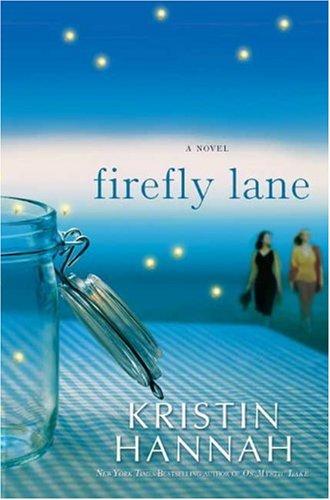
Firefly Lane by Kristin Hannah is a 2008 contemporary fiction book about female friendship, identity and ambition, grief and loss. The novel argues that female friendship is a kind of love as demanding and as sustaining as any other, and that it deserves to be treated as central rather than peripheral in a woman's life story.
Summary
Tully Hart and Kate Mularkey meet in the summer of 1974 as fourteen-year-olds on Firefly Lane in rural Washington State, and their friendship spans three decades — through high school, college, careers in television journalism, marriages, and heartbreak. Tully is glamorous, driven, and emotionally defended; Kate is the quieter, steadier half of the pair. Hannah tracks how each woman becomes who she is, and how their friendship both holds and strains under the weight of the people they become.
The novel is working in an older and more durable tradition than Hannah's later books — the female friendship epic, somewhere between Beaches and Steel Magnolias — and it's comfortable in that tradition rather than struggling against it. The structure jumps between decades in a pattern that can frustrate readers who want linear narrative but rewards the kind of reader who enjoys watching two lives accumulate meaning backward and forward simultaneously. Hannah is particularly good at the 1970s and 1980s sections, which she renders with affectionate period detail.
Tully's ambition and its costs are the novel's most interesting thread. She becomes a national television personality, which in Hannah's treatment is a kind of wound as much as an achievement — she gets what she wanted and is less certain about wanting it than she expected. Kate's more conventional trajectory (marriage, children, suburban life) is treated with equal seriousness; Hannah is not in the business of ranking one life over another.
The ending takes the novel somewhere unexpected, and readers divide sharply on whether it earns its emotional payoff or whether it deploys tragedy as a shortcut to feeling. Either way, the final section is what most readers remember. Firefly Lane is not the most sophisticated novel Hannah has written — The Nightingale and The Great Alone are more ambitious — but it may be the one most readers will feel most.
Talk to Firefly Lane like its author wrote you back.
Get the ideas that fit your life — not generic summaries.
- Chat with the book
- Audiobook-style main ideas
- Adapts to your life and goals
- Helps you take action
Key takeaways
- 1.
The novel argues that female friendship is a kind of love as demanding and as sustaining as any other, and that it deserves to be treated as central rather than peripheral in a woman's life story.
- 2.
Tully's success doesn't protect her. Fame and professional achievement are shown to be compatible with a persistent private loneliness — which Hannah renders honestly rather than moralistically.
- 3.
Kate's domestic choices are taken seriously. The novel doesn't frame marriage and children as default or failure; it frames them as chosen, with their own costs and rewards.
- 4.
The non-linear structure makes the ending more powerful than it would be read linearly — because you've seen the future and the past simultaneously, loss carries the weight of both.
- 5.
Tully's traumatic childhood is handled carefully. Hannah shows how early damage shapes adult behavior without making it deterministic.
- 6.
The period detail — specific to the Pacific Northwest, 1970s through 2000s — grounds the novel in a regional reality that helps prevent it from becoming generic.
- 7.
The friendship between Tully and Kate is tested by jealousy, distance, and the different shapes their lives take, but the novel is committed to showing why they keep choosing each other.
- 8.
The novel's emotional architecture works because Hannah establishes the friendship's value before she puts it under strain — you believe in what's being threatened.
Discussion questions
Use these on your own, with a book club, or as chat starters in Superbook. Book club version, ready to copy or print →
- 1.
Tully and Kate are drawn to each other partly because they're each what the other isn't. Is that a good basis for a lifelong friendship — or does the novel complicate that dynamic?
- 2.
Tully's childhood is far more damaging than Kate's. How does the novel trace the way that damage follows her into adulthood, and does it do so with fairness to Tully?
- 3.
Kate chooses a quieter life than Tully. Does the novel treat that choice with full seriousness — or does Tully's ambition get the more interesting narrative attention?
- 4.
The novel skips across decades. Which period felt most alive to you? Were there eras the novel rushed past that you wanted more of?
- 5.
The ending is something many readers feel as a gut punch. Does it earn that response, or does it use tragedy as an emotional shortcut?
- 6.
The friendship has a significant rupture late in the novel. When you look back at what caused it, does the break feel fair to both characters?
- 7.
Tully becomes famous. Hannah doesn't romanticize that fame. What is the novel saying about the relationship between ambition and happiness?
- 8.
Kate's marriage is shown in real complexity — the friction and the love coexisting. Did you find that portrayal convincing?
- 9.
The male characters in Firefly Lane are mostly supporting figures. Is that an honest reflection of the novel's focus, or does it flatten the story?
- 10.
If you've seen the Netflix adaptation, how does it compare to the book? What did the show change, and were those changes improvements?
- 11.
Firefly Lane is about what two women mean to each other across a whole lifetime. Did the novel change how you think about your own long-term friendships?
Themes
Frequently asked questions
-
Is Firefly Lane a tearjerker?
Yes. Hannah writes to produce emotion directly, and the ending of Firefly Lane is designed to be devastating. Most readers report crying. If you're looking for a book that affects you emotionally without disguising itself as something else, this delivers.
-
How does the Netflix series compare to the book?
The show extends the story across two seasons and adds plotlines the book doesn't contain. Katherine Heigl and Sarah Chalke are well-cast. Most readers find the book's more compressed structure more effective — the adaptation works better as comfort television than as drama.
-
Is Firefly Lane part of a series?
Yes. Fly Away (2013) continues the story. Both books stand alone, but Fly Away is Tully's story after the events of Firefly Lane and requires having read the first book.
-
Is this a good gift for someone who loved The Nightingale?
Yes, with a caveat: Firefly Lane is a warmer book, set mostly in America, without historical drama. It's less dark than The Nightingale and more focused on friendship than on courage under historical pressure. Readers who loved one will usually love the other, but they're doing different things.
-
Who shouldn't read this?
Readers who dislike non-linear structure, or who find female-friendship epic fiction sentimental by definition. Also readers who want narrative restraint — Hannah is open about emotion in ways that can feel manipulative to readers who prefer their emotional effects earned more indirectly.