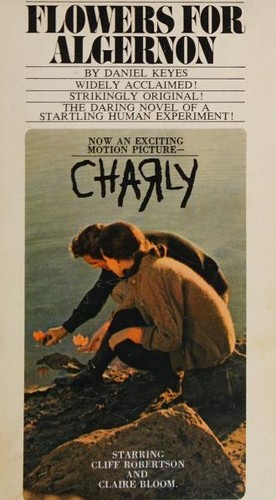
Flowers for Algernon by Daniel Keyes is a 1966 science fiction book about intelligence and identity, loneliness, medical ethics. Charlie's arc from intellectual disability to genius and back is also an arc of emotional damage and partial repair — the surgery changes what he can know but not the wounds from how he was treated before and during the experiment.
Summary
Flowers for Algernon is narrated through progress reports written by Charlie Gordon, a 32-year-old man with an intellectual disability who becomes the first human subject in an experimental surgery designed to dramatically increase intelligence. The novel opens with Charlie's reports spelled phonetically and syntactically fractured — he is genuinely trying his best, and the warmth and effort in those early pages are devastating precisely because we know what's coming. The surgery works.
As Charlie's intelligence climbs past average, past genius, past anything previously recorded, the narrative transforms with him. The spelling corrects, the sentences lengthen, the references multiply. He reads voraciously, learns languages, contributes to academic journals, and begins to understand the world with a clarity that most people will never experience. And then he begins to understand himself: that the people he thought of as friends were laughing at him, that the scientists who treated him as a subject were not treating him as a person, that emotional intelligence and intellectual intelligence are different capabilities and he has gained only one.
What Keyes does with the ascent is not celebrate it. The IQ curve is also a loneliness curve. Charlie rising becomes Charlie isolated — too intelligent to relate to his previous social world, too emotionally immature and damaged to build a new one. He falls in love. He begins to understand his childhood. He also begins to see flaws in his own experiment that the researchers missed. The novel's middle section, when he is at peak intelligence and most alone, is its hardest.
The arc was always going to end with decline — the structure announces it early — but Keyes doesn't make the decline a tragedy in the conventional sense. Charlie's final reports, as his language degrades back toward the beginning, carry a different kind of dignity. He knows what he has lost, or he does until he doesn't. Flowers for Algernon has been on school reading lists for sixty years because it operates at exactly the intersection of accessibility and genuine difficulty that makes literature last.
Talk to Flowers for Algernon like its author wrote you back.
Get the ideas that fit your life — not generic summaries.
- Chat with the book
- Audiobook-style main ideas
- Adapts to your life and goals
- Helps you take action
Key takeaways
- 1.
Charlie's arc from intellectual disability to genius and back is also an arc of emotional damage and partial repair — the surgery changes what he can know but not the wounds from how he was treated before and during the experiment.
- 2.
The progress-report format is a structural masterstroke: we watch a mind developing through the very medium of its development, and the form's degradation at the end is the most economical way Keyes could have represented decline.
- 3.
The scientists treat Charlie as a subject before and after, not as a person — and Charlie's growing intelligence allows him to see this clearly, which is among the most painful things the novel does.
- 4.
Intelligence is shown as neither redemptive nor damning in itself: Charlie's suffering at peak intelligence is different from his suffering at baseline, but it is still suffering, and the sources are largely the same.
- 5.
The relationship between Charlie and Alice Kinnian, his teacher turned love interest, is complicated by the power dynamics the novel refuses to flatten. The surgery makes those dynamics visible rather than creating them.
- 6.
Algernon, the mouse who undergoes the same experiment before Charlie, is the novel's moral register: his fate tells us Charlie's fate before any human character does, and Keyes makes us care about the mouse as a way of caring about what intelligence means.
- 7.
The ethics of the experiment are indicted throughout — the consent is problematic, the haste is obvious, the researchers' motives mix genuine care and ambition in unstable proportions — but Keyes doesn't simplify the condemnation.
- 8.
The final pages are among the most studied endings in American fiction for good reason: Charlie's last coherent request, and his request that someone tend Algernon's grave, is a form of moral clarity that survives the loss of everything else.
Discussion questions
Use these on your own, with a book club, or as chat starters in Superbook. Book club version, ready to copy or print →
- 1.
Charlie before the surgery is happy in ways he won't be after. Does the surgery help him or harm him on balance? Is that even a coherent question given how different he becomes?
- 2.
The scientists who run the experiment clearly care about Charlie while also treating him instrumentally. Is that contradiction unique to science, or is it something the novel is saying about how institutions relate to individuals?
- 3.
Charlie's intelligence increases dramatically but his emotional development lags — he understands more but is not more capable of love or connection. Does the novel suggest these capabilities are genuinely separate, or that intelligence without emotional repair is simply incomplete?
- 4.
How does the novel treat the people who laughed at Charlie before the surgery? Are they villains, ordinary humans, or something more complicated?
- 5.
Alice is both Charlie's teacher and, later, his love interest. The power imbalance is obvious. Does the novel treat this ethically, paper over it, or deliberately use it as part of its argument?
- 6.
The form — progress reports that mirror Charlie's cognitive state — is unusual and deliberate. Did you find yourself registering the prose shift as you read, or did you absorb it without noticing?
- 7.
Algernon's fate precedes and prefigures Charlie's. What does Keyes gain by making Charlie's story also about a mouse? Is the animal's fate more or less affecting to you than Charlie's?
- 8.
The novel ends with Charlie's intelligence degrading. Is the ending tragic, dignified, both, or neither? What does your reading reveal about your assumptions about what makes a life meaningful?
- 9.
Charlie at peak intelligence understands things about his own experiment that the researchers missed. Is this vindication, irony, or something more ambiguous — what does Keyes do with that reversal?
- 10.
Flowers for Algernon is often assigned to middle and high school students. Is it appropriate for that context, and does reading it at school change what it means?
- 11.
What does the novel suggest we owe to people with intellectual disabilities — before, during, and after any intervention aimed at 'improvement'?
- 12.
If you had the option of Charlie's surgery — certain improvement, possible (or certain) decline — would you take it? What does your answer reveal?
Themes
Frequently asked questions
-
Is Flowers for Algernon appropriate for adults or just young readers?
It's fully appropriate for adults and more complex than its reputation as a school text suggests. The medical ethics questions, the treatment of Charlie's sexual awakening, and the final section's philosophical weight are genuinely challenging at any age. Adults reading it after school often find it considerably darker than they remembered.
-
Is Flowers for Algernon sad?
Yes, but not in a manipulative way. Keyes earns the sadness through structure and form rather than sentiment. The ending is devastating but also, in a specific way, dignified. Most readers describe it as one of the few genuinely affecting endings in science fiction.
-
What is the difference between the short story and the novel?
The short story is a tight 6,000-word version of the same arc, written in the same progress-report format. The novel expands Charlie's emotional life, the romance with Alice, the relationship with his parents, and the science considerably. Both work; the novel is richer.
-
Who shouldn't read Flowers for Algernon?
Readers who find decline narratives unbearable, and readers who want their protagonists to achieve permanent transformation. The arc is circular by design — Charlie ends where he began, plus memory, plus loss. If that structure doesn't work for you, neither will the book.
-
Is there a film adaptation?
Yes — Charly (1968), directed by Ralph Nelson, won Cliff Robertson the Academy Award for Best Actor. It's dated in some respects but captures the core arc. There was also a TV film in 2000. Neither is considered fully equal to the novel.
Similar books
The Man Who Mistook His Wife for a Hat
Oliver Sacks
The Immortal Life of Henrietta Lacks
Rebecca Skloot
Being Mortal: Medicine and What Matters in the End
Atul Gawande
When Breath Becomes Air
Paul Kalanithi
