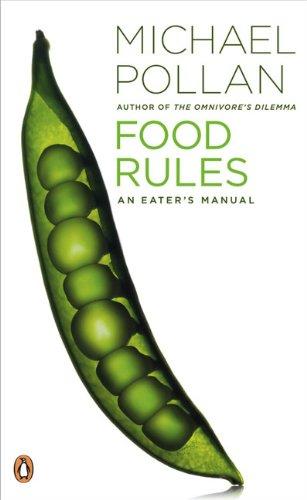
Food Rules by Michael Pollan is a 2009 health book about nutrition, food culture, eating habits. Eat food, not too much, mostly plants. Pollan's seven-word summary replaces virtually all complex nutritional advice with three principles derived from traditional food cultures.
Summary
Food Rules is Michael Pollan's shortest and most direct book: sixty-four simple rules for eating, distilled from his longer works and from the accumulated wisdom of food cultures around the world. The entire book is organized around the seven-word manifesto he introduced in In Defense of Food: eat food, not too much, mostly plants. Everything else is elaboration.
The rules are organized in three parts matching those seven words. Eating food means eating things your great-grandmother would recognize as food — not the engineered products of industrial food science. Pollan offers rules of thumb for identifying real food: if it contains more than five ingredients, if it contains ingredients a third-grader can't pronounce, if it makes a health claim on the packaging, it probably isn't food in the sense he means. Not too much involves rules about when, how, and how much to eat — stop eating before you're full, eat at the table, cook your own food, treat treats as treats. Mostly plants speaks for itself, but Pollan nuances it: eat a variety of plants, eat plants with leaves rather than just seeds, and regard meat as a flavoring more than a centerpiece.
The book's obvious limitation is brevity. Nothing is argued at length — each rule gets a paragraph or two of explanation at most. Pollan explicitly positions this as a companion to his longer work rather than a standalone case. Readers unfamiliar with In Defense of Food or The Omnivore's Dilemma will want to read those alongside it. The rules also reflect Pollan's cultural position: they assume access to fresh food, time to cook, and a certain class standing that not everyone has.
What works is the format. Most nutrition advice drowns in caveats and data. Pollan's rules are memorable precisely because they're blunt. Eat food. Mostly plants. Not too much. These aren't scientific claims — they're practical heuristics drawn from food cultures that have produced healthy people for generations, before the modern diet arrived and disrupted everything.
Talk to Food Rules like its author wrote you back.
Get the ideas that fit your life — not generic summaries.
- Chat with the book
- Audiobook-style main ideas
- Adapts to your life and goals
- Helps you take action
Key takeaways
- 1.
Eat food, not too much, mostly plants. Pollan's seven-word summary replaces virtually all complex nutritional advice with three principles derived from traditional food cultures.
- 2.
The Western diet — high in processed food, refined carbohydrates, added sugars, and industrial seed oils — is associated with a cluster of chronic diseases almost unknown in cultures that don't eat it.
- 3.
If a product makes a health claim on the packaging, be skeptical. Real food doesn't need to advertise its nutritional value.
- 4.
Five ingredients is a useful threshold: beyond five, food products tend to contain additives, stabilizers, and flavorings that move them away from what food traditionally was.
- 5.
Eating with others, at a table, without screens, and stopping before you're full are cultural practices that regulate intake better than calorie counting.
- 6.
Meat can be part of a healthy diet but functions better as a flavoring or occasional centerpiece than as the main event of every meal — which is a modern industrial pattern, not a traditional one.
- 7.
Traditional food cultures are reliable guides. Any cuisine that has sustained people in good health across generations is probably doing something right, regardless of what current nutritional science says about specific nutrients.
Discussion questions
Use these on your own, with a book club, or as chat starters in Superbook. Book club version, ready to copy or print →
- 1.
Pollan's core heuristic is to eat what your great-grandmother would recognize as food. Is that a useful guide in your actual food environment, or does it break down quickly?
- 2.
Which of the sixty-four rules do you already follow instinctively? Which ones conflict with how you actually eat?
- 3.
The book assumes access to fresh produce and time to cook. Does that assumption limit its usefulness, and how should advice about eating change to account for economic and logistical constraints?
- 4.
Pollan argues that health claims on packaging are a warning sign rather than a feature. How do you respond to food marketing in practice?
- 5.
The five-ingredient rule is a shortcut, not a scientific principle. How do you feel about using heuristics rather than data to make food decisions?
- 6.
Pollan treats traditional food cultures as reliable guides. Which traditional eating practices from your own culture or background do you think are genuinely worth preserving?
- 7.
Not too much is harder to operationalize than eat food or mostly plants. What practices have you found actually help you moderate intake?
- 8.
The book is short enough to read in an hour. Does that brevity make you trust it more or less?
- 9.
Pollan writes primarily from a Western perspective and about food culture as it existed before industrialization. How well does his framework translate to diverse global food traditions?
- 10.
What one rule from the book do you think would make the biggest practical difference if widely followed?
- 11.
Pollan's previous books (In Defense of Food, The Omnivore's Dilemma) make longer arguments for many of these rules. After reading Food Rules, are you interested in those books, or does this feel complete enough?
Themes
Frequently asked questions
-
What is Food Rules about?
Sixty-four simple heuristics for eating well, organized around Pollan's seven-word summary: eat food, not too much, mostly plants. Each rule is explained briefly with a paragraph or two. The book is a distillation of his longer arguments in In Defense of Food.
-
Is Food Rules worth reading?
Yes, especially as a quick companion to Pollan's longer books. Alone, it is a useful list of memorable rules. Without the longer context, some rules may feel arbitrary. It reads in under an hour and is good to revisit.
-
How long is Food Rules?
Around 80 pages, readable in one to two hours. It is designed as a reference more than a read-through — a book to keep in the kitchen.
-
Who should read Food Rules?
Anyone who wants simple, memorable guidelines for eating without getting lost in nutritional science. It works well for people who find The Omnivore's Dilemma overwhelming but want Pollan's practical conclusions.
-
What is the most useful rule in Food Rules?
Eat food, not too much, mostly plants — the overarching principle. As a specific rule, many readers find "Don't eat anything your great-grandmother wouldn't recognize as food" or "Avoid food products that make health claims" the most practically useful.