Health · Book club
Full Catastrophe Living book club questions
Here are 12 book club questions for Full Catastrophe Living by Jon Kabat-Zinn, ordered to open easily and end somewhere worth arguing about. Copy them, print them, or bring them up one at a time.
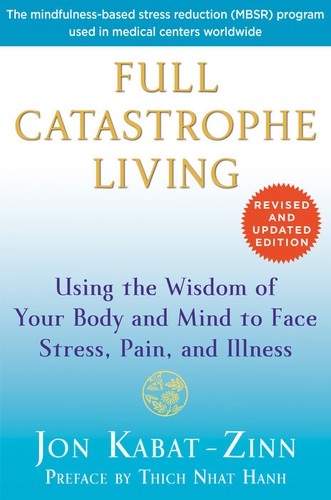
Full Catastrophe Living is Jon Kabat-Zinn's foundational text on Mindfulness-Based Stress Reduction (MBSR), the eight-week clinical program he developed at the University of Massachusetts Medical School in 1979.
Jon Kabat-Zinn · 1990 · 10h 0m
Full summary and key takeaways →The 12 questions
- 1.
Kabat-Zinn describes mindfulness as paying attention in a particular way — on purpose, in the present moment, nonjudgmentally. How much of your daily experience qualifies as mindful by that definition?
- 2.
He argues that chronic pain is often amplified by the mental relationship we have with pain rather than by the pain signal itself. Does that distinction — between pain and suffering — resonate with your experience?
- 3.
MBSR was designed for people with serious health conditions. How does the clinical origin of the practice compare to the wellness context in which mindfulness is now typically promoted?
- 4.
The body scan is the first formal practice he introduces. Have you tried a body scan? What was the experience, and how did it compare to his description?
- 5.
Kabat-Zinn is careful to distinguish mindfulness from religion while acknowledging its Buddhist origins. How do you navigate a practice that was developed in a religious context and presented in a secular one?
- 6.
Automatic pilot is his term for our habitual, unreflective mode of functioning. What are your most significant automatic pilot behaviors, and what would interrupting them look like?
- 7.
He argues that thoughts are not facts — observing them as mental events rather than truths. Have you experienced that shift in relationship to a thought that was causing you suffering? How did it happen?
- 8.
The book is long and detailed. Is it better suited to someone who wants to practice MBSR seriously or to someone exploring mindfulness conceptually? What kind of reader were you when you approached it?
- 9.
Kabat-Zinn covers the evidence for MBSR's clinical effectiveness. Does scientific validation change how you approach a contemplative practice, or does it feel irrelevant to whether you benefit?
- 10.
He argues the mind and body are inseparable. How does that claim challenge or confirm what you've experienced in your own health?
- 11.
The book was first published in 1990. Mindfulness is now ubiquitous in popular culture. Has its mainstreaming diluted what Kabat-Zinn describes here?
- 12.
If you were to commit to the eight-week MBSR program, what would be the practical challenges? What would need to change in your daily schedule?
How to run the discussion
- Pick six to eight, not all of them. An hour of real discussion covers fewer questions than anyone expects, and racing the list is what makes a book club feel like homework.
- Open with what people noticed, not what they concluded. Asking for a verdict first hardens opinions before anyone has heard each other.
- Let the disagreement run. The questions below that split a room are the ones worth the time; the ones everyone answers the same way can be skipped.
- Ask the quiet person a specific question. A direct, narrow question is far easier to answer than an open invitation to contribute.
Themes worth steering toward
If the conversation stalls, these are the threads that usually restart it.
Common questions
What are good book club questions for Full Catastrophe Living?
Here are 12 book club questions for Full Catastrophe Living by Jon Kabat-Zinn, ordered to open easily and end somewhere worth arguing about. The strongest openers ask what each reader noticed rather than what they concluded, and the discussion usually turns on mindfulness, stress reduction, chronic pain.
How long should a book club discussion of Full Catastrophe Living last?
Most groups run 60 to 90 minutes of actual discussion. That is roughly six to eight questions, not all of them, so pick the ones that suit your group rather than working down the list in order.
What are the main themes in Full Catastrophe Living?
Mindfulness, Stress reduction, Chronic pain, Meditation, Mind-body medicine. Those are the threads most likely to divide a room, which makes them the useful places to steer a discussion that has gone quiet.
Picking the next one? See books like Full Catastrophe Living or questions for other book club picks.
