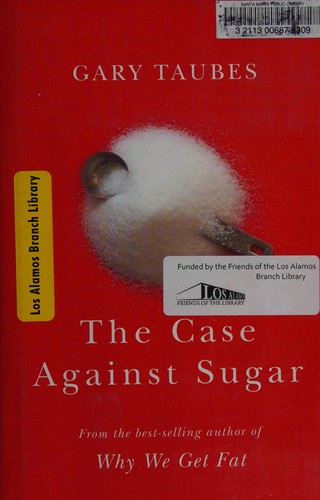
The Case Against Sugar by Gary Taubes is a 2016 health book about sugar, obesity, food industry. Sugar — sucrose and high-fructose corn syrup — is Taubes's prime suspect for the obesity and diabetes epidemics that have tracked rising sugar consumption across the Western world.
Summary
The Case Against Sugar is Gary Taubes's focused argument that sugar — sucrose and high-fructose corn syrup specifically — is the primary cause of the obesity and diabetes epidemics, and the likely driver of the cluster of diseases, from heart disease to Alzheimer's, that researchers now associate with insulin resistance and metabolic syndrome. Where Good Calories, Bad Calories mounted a broad scientific and historical argument, this book trains its focus on a single substance and makes the case against it as precisely as Taubes can.
The historical argument is compelling. Taubes traces sugar consumption in Western countries from a luxury commodity to a dietary staple, documenting the parallel rise of obesity, diabetes, and associated chronic diseases wherever Western diets, anchored by sugar, spread. Indigenous populations that had little history of sugar consumption developed obesity and diabetes at dramatic rates within a generation of adopting Western diets. Taubes argues this is the natural experiment that most clearly indicts sugar rather than fat, sedentary behavior, or total calories.
The metabolic mechanism Taubes proposes centers on fructose, the half of sucrose that is metabolized by the liver rather than by peripheral cells. Unlike glucose, fructose does not trigger insulin secretion directly, but chronic fructose consumption produces fatty liver, insulin resistance, and elevated uric acid — all components of the metabolic syndrome that precedes type 2 diabetes and cardiovascular disease. Taubes argues this is how sugar uniquely drives disease in a way that other calorie sources do not.
The book also covers the sugar industry's decades-long effort to shift blame for health problems onto dietary fat and to fund research designed to exculpate sugar. The parallels to the tobacco industry are explicit and documented. Taubes does not claim to have definitive proof — he is careful to distinguish his causal hypothesis from the correlational evidence available — but he argues that the precautionary principle should apply: sugar is suspect enough that reducing consumption makes sense without waiting for complete proof.
Talk to The Case Against Sugar like its author wrote you back.
Get the ideas that fit your life — not generic summaries.
- Chat with the book
- Audiobook-style main ideas
- Adapts to your life and goals
- Helps you take action
Key takeaways
- 1.
Sugar — sucrose and high-fructose corn syrup — is Taubes's prime suspect for the obesity and diabetes epidemics that have tracked rising sugar consumption across the Western world.
- 2.
Fructose is metabolized primarily in the liver and, in large chronic quantities, produces fatty liver disease, insulin resistance, and elevated uric acid — a cluster of conditions preceding metabolic syndrome.
- 3.
Indigenous populations with no history of sugar consumption developed obesity and diabetes at high rates within a generation of adopting Western diets, suggesting a specific culprit rather than general overeating.
- 4.
The sugar industry funded research in the 1960s that deliberately shifted scientific attention toward dietary fat as the cause of heart disease, and away from sugar.
- 5.
Chronic sugar consumption may cause insulin resistance not just in liver cells but throughout the body, explaining how it links obesity, type 2 diabetes, and cardiovascular disease in a single mechanism.
- 6.
Even moderate amounts of sugar, consumed chronically over years, may be sufficient to produce insulin resistance — meaning the harm is less about acute overconsumption than about steady daily exposure.
- 7.
The dose of sugar in the modern diet is historically unprecedented; humans evolved in environments where sugar was rare and seasonal.
- 8.
Reducing sugar does not require counting calories or complex dietary rules; removing sugar and foods that convert quickly to sugar (refined grains) is Taubes's practical prescription.
Discussion questions
Use these on your own, with a book club, or as chat starters in Superbook. Book club version, ready to copy or print →
- 1.
Taubes argues sugar is uniquely harmful in a way that other calorie sources are not. How does that change how you think about the idea that 'a calorie is a calorie'?
- 2.
He cites the sugar industry's deliberate funding of misleading research as a reason to distrust the public health consensus on fat. How much should industry-funded research discount your confidence in dietary guidelines?
- 3.
Chronic, moderate sugar consumption — not occasional binges — is the behavior Taubes indicts. How does your own daily sugar intake compare to historical averages?
- 4.
The book draws a parallel to tobacco: the industry knew the product was harmful and actively funded confusion. Is that comparison fair? What are the disanalogies?
- 5.
Taubes is careful to say he is making a causal hypothesis rather than proving causation. Is that epistemic honesty reassuring or does it undermine the book's prescriptive value?
- 6.
Fructose from whole fruit comes with fiber, vitamins, and phytochemicals that likely modulate its metabolic effects. Does the book adequately distinguish whole-fruit sugar from added sugar?
- 7.
If you significantly reduced added sugar in your diet, what would be the hardest thing to give up? What would that tell you about your relationship with sugar?
- 8.
Sugar is in most processed foods, including bread, sauces, and foods not perceived as sweet. How practical is Taubes's prescription for people who rely on processed food for convenience or cost?
- 9.
He covers the physiological addiction potential of sugar. How does that change your understanding of why reducing sugar is difficult?
- 10.
Public health campaigns have focused on obesity and calories while largely ignoring sugar as a specific toxin. If Taubes is right, what should a better public health campaign look like?
- 11.
Taubes argues that the advice to eat less and exercise more has failed because it doesn't address sugar's metabolic effects. Does that explain the failure of weight loss efforts you've observed?
- 12.
After reading the book, have you changed your view on any specific food or drink? What would it take to act on that change?
Themes
Frequently asked questions
-
What is the main argument of The Case Against Sugar?
That sugar — specifically sucrose and high-fructose corn syrup — is the primary driver of obesity, type 2 diabetes, and the cluster of metabolic diseases that precede them, and that the sugar industry has actively distorted research to prevent this conclusion from becoming mainstream.
-
Is The Case Against Sugar scientifically sound?
The historical and institutional arguments are well-documented. The causal metabolic hypothesis is plausible and consistent with much of the evidence, but Taubes acknowledges it is not yet proven by the gold-standard evidence he himself has called for. It is a compelling case, not a closed one.
-
How does The Case Against Sugar compare to Good Calories, Bad Calories?
The Case Against Sugar is shorter, more focused, and more accessible. Good Calories, Bad Calories is a comprehensive dismantling of nutritional science; The Case Against Sugar focuses the same argument on one substance. Most readers are better served by starting here.
-
Should I give up all sugar after reading this?
Taubes argues for dramatically reducing added sugar, particularly from sugar-sweetened beverages, processed foods, and refined grains. He is not claiming that a piece of fruit or occasional dessert causes disease. The concern is chronic, daily consumption of the modern amounts embedded in a processed food diet.
-
Is fruit included in Taubes's indictment of sugar?
Not primarily. Taubes distinguishes between sugar naturally occurring in whole food with fiber and nutrients, which humans have consumed for millennia, and the concentrated, isolated sugar added to processed food at historically unprecedented amounts. His argument is about added sugar, not whole fruit.