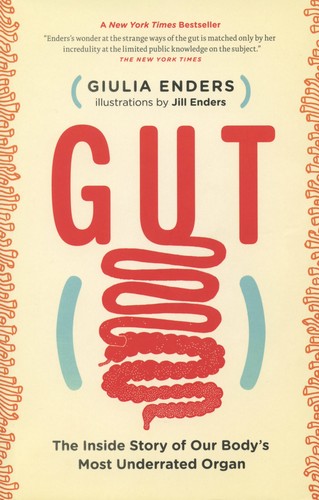
Gut by Giulia Enders is a 2015 science book about digestion, microbiome, gut-brain connection. The gut has its own nervous system — the enteric nervous system — with more nerve cells than the spinal cord. It communicates with the brain bidirectionally, which helps explain why gut health and mental health are linked.
Summary
Giulia Enders wrote Gut while studying medicine, and the book shows: it is both scientifically informed and written with an enthusiasm that has clearly not yet been worn down by clinical routine. The subject is digestion — how food moves through the body, what the gut actually does, and why the thirty feet of tubing we carry around deserve more attention than they typically get.
Enders covers the mechanics of digestion in satisfying detail: the two-sphincter system, the enteric nervous system (the "second brain" that allows the gut to operate largely independently of the central nervous system), and the complex orchestration of hormones, nerves, and bacteria that govern how nutrients are absorbed and waste is expelled. She is particularly good at defamiliarizing things the reader thinks they understand — explaining, for instance, why constipation and diarrhea are not opposite problems requiring opposite solutions, or why the angle at which one sits on a toilet actually matters.
The second half of the book turns to the microbiome. Enders explains what is known and unknown about the trillions of bacteria in the gut, their relationship to immune function, mental health, and weight. She is careful here not to overstate — she distinguishes well-established findings from early-stage research — though the field has moved quickly enough that some sections now feel dated. The gut-brain axis, meaning the bidirectional communication between gut bacteria and brain chemistry, is given real attention and presented honestly as a developing area rather than settled science.
The book works best as a popularization: approachable, occasionally funny, and more rigorous than most gut-health content that reaches general audiences. Readers who come to it hoping for a specific protocol or dietary intervention will not find one. What they will find is a thorough and engagingly written explanation of why the gut is interesting, and a foundation for evaluating the often-breathless health claims that have surrounded microbiome science in recent years.
Talk to Gut like its author wrote you back.
Get the ideas that fit your life — not generic summaries.
- Chat with the book
- Audiobook-style main ideas
- Adapts to your life and goals
- Helps you take action
Key takeaways
- 1.
The gut has its own nervous system — the enteric nervous system — with more nerve cells than the spinal cord. It communicates with the brain bidirectionally, which helps explain why gut health and mental health are linked.
- 2.
The microbiome is individual: the specific community of bacteria in your gut is shaped by your birth, early diet, antibiotic history, and environment, and no two people's are the same.
- 3.
Digestion begins in the mouth and is far more chemically complex than the simple acid-bath story taught in school. Different sections of the gut specialize in different phases of the process.
- 4.
The two-sphincter system explains the difference between voluntary and involuntary control of defecation, and understanding it helps explain many common digestive problems.
- 5.
Antibiotics affect the microbiome significantly and sometimes durably. Their use, especially in early childhood, is associated with downstream changes in immune function and metabolic health.
- 6.
Many common digestive complaints — bloating, irregularity, food sensitivities — are poorly understood and frequently misattributed. The mechanisms are more complex than most dietary advice implies.
- 7.
The gut microbiome plays a role in immune development: early exposure to microbes shapes how the immune system learns to distinguish self from threat.
- 8.
Research on the gut-brain axis is promising but early. Claims that specific probiotics treat depression or anxiety outrun the evidence, though the underlying biology is real.
Discussion questions
Use these on your own, with a book club, or as chat starters in Superbook. Book club version, ready to copy or print →
- 1.
Enders argues the gut is a neglected organ given its central role in health. Had you ever thought about digestion in any detail before reading this book?
- 2.
The book describes the microbiome as highly individual and shaped by early life. What does that suggest about universal dietary advice?
- 3.
Enders distinguishes what is established from what is speculative throughout the book. How well do you think popular media handles that distinction when reporting on gut health?
- 4.
The gut-brain axis suggests that mental health and gut health are linked. How does that change how you think about either anxiety or digestive problems you've experienced?
- 5.
What surprised you most about how digestion actually works? Was there anything that made you feel differently about your own body?
- 6.
The book raises questions about antibiotic overuse. How do you weigh the benefits of antibiotics for acute illness against their effects on the microbiome?
- 7.
Enders describes the enteric nervous system as a kind of second brain. Does that framing feel useful or is it more metaphorical than literal?
- 8.
If the microbiome is so individual, what should we make of the probiotics and prebiotic supplements now marketed widely? Did the book change how you evaluate those claims?
- 9.
The book was written while Enders was a medical student. Does that origin affect how you read it — as a strength, a limitation, or both?
- 10.
Enders is German and the book was translated from German. Do you notice any difference in how Continental European health writing approaches the body compared to American or British?
- 11.
Some of the microbiome research Enders discusses has advanced since 2015. How do you approach a science book that may be partially dated?
- 12.
Which section of the book did you find most practically useful, if any?
Themes
Frequently asked questions
-
What is Gut by Giulia Enders about?
It is an accessible explanation of digestion and the microbiome — how food moves through the body, what the gut's nervous system does, and what is currently known about the trillions of bacteria that live there. It's written for a general audience by someone with medical training.
-
Is Gut worth reading?
Yes, for readers who want a well-explained, lightly humorous introduction to digestive biology. It is more rigorous than most gut-health content aimed at consumers, though some sections on the microbiome have aged as the science has moved quickly since 2015.
-
How long is Gut?
Around 270 pages, roughly four to five hours of reading. The short chapters make it easy to read in sessions, and the writing moves quickly.
-
Does Gut give dietary advice?
Not specifically. Enders explains the science but does not prescribe a particular eating plan. The book builds context for evaluating dietary claims more than it makes them.
-
Who should read Gut?
Anyone curious about digestion, interested in the microbiome, or trying to make sense of the large amount of gut-health content now circulating in popular media. It is especially useful as a foundation before reading more specialized books on the microbiome.