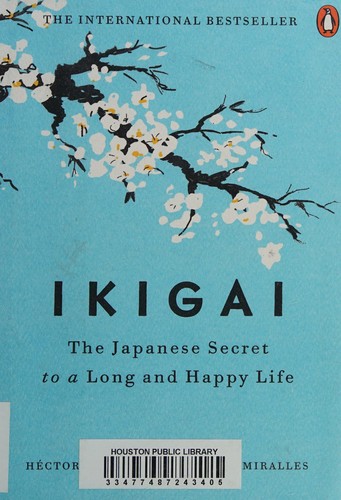
Ikigai by Héctor García is a 2016 philosophy book about purpose, longevity, japanese culture. Ikigai is the Japanese concept of a reason for being — the overlap of what you love, what you're good at, what the world needs, and what you can be paid for.
Summary
Ikigai is a short, accessible book by Héctor García and Francesc Miralles that explores the Japanese concept of a reason for being — the intersection of what you love, what you are good at, what the world needs, and what you can be paid for. García, a Spanish author based in Japan, draws on interviews with elderly residents of Okinawa, a region with one of the highest concentrations of centenarians in the world, to illustrate what living with ikigai looks like in practice.
The book moves through several related ideas: the role of purpose in longevity, the Okinawan diet and lifestyle, the psychology of flow states, the benefits of gentle daily movement (the Okinawan practice of radio taiso, walking, and gardening), and the value of maintaining social connections well into old age. The authors present ikigai not as a grand calling but as something smaller and more durable — a reason to get out of bed each morning that doesn't depend on external achievement or recognition.
García and Miralles draw on the work of Mihaly Csikszentmihalyi on flow, Viktor Frankl on meaning, and Japanese philosophy and practice. The combination is readable and warmly written. The book doesn't make ambitious claims or challenge established ideas; it synthesizes evidence and cultural observation into a simple framework for thinking about how to orient a life.
The limitations are real. Ikigai is light on depth. Much of what it covers — flow, social connection, diet, movement, purpose — is discussed more rigorously elsewhere. Readers looking for a scientific treatment of longevity will find it thin; readers looking for a gentle philosophical reframe of what makes life worth living will find it useful and pleasant. It is most effective read slowly rather than mined for tactics.
Talk to Ikigai like its author wrote you back.
Get the ideas that fit your life — not generic summaries.
- Chat with the book
- Audiobook-style main ideas
- Adapts to your life and goals
- Helps you take action
Key takeaways
- 1.
Ikigai is the Japanese concept of a reason for being — the overlap of what you love, what you're good at, what the world needs, and what you can be paid for.
- 2.
The residents of Okinawa, many of whom live past 100, typically have a strong sense of ikigai, close social networks, and low stress. None of them describe having retired from life.
- 3.
Flow states — periods of total absorption in challenging work — are closely related to ikigai. Both require matching skill to difficulty and finding the work intrinsically rewarding.
- 4.
The authors argue that having a purpose, even a modest one, is more important to longevity than diet or exercise alone. The will to get up and engage with the world sustains the body.
- 5.
Morita therapy, a Japanese psychological approach, emphasizes accepting feelings without fighting them and focusing attention on what needs to be done. It parallels the Western concept of behavioral activation.
- 6.
Logotherapy, developed by Viktor Frankl, holds that the primary human motivation is the search for meaning, not pleasure or power. Ikigai is the Japanese parallel to this idea.
- 7.
Small pleasures, regular social contact, and daily movement appear more consistently across Okinawan centenarians than any specific dietary protocol.
Discussion questions
Use these on your own, with a book club, or as chat starters in Superbook. Book club version, ready to copy or print →
- 1.
What is your current ikigai, if you have one? If you don't have a clear answer, what does the absence tell you?
- 2.
The book distinguishes between a grand life purpose and a small daily reason to get up. Which do you think matters more to quality of life in practice?
- 3.
Okinawan centenarians didn't plan for retirement — they kept doing what gave their lives meaning. How does that compare to how you think about your own working years and what comes after?
- 4.
Flow requires matching skill to challenge. Where in your life do you experience it, and where have you lost it by either outgrowing the challenge or being overwhelmed by it?
- 5.
The book suggests that social connection is a more consistent predictor of longevity than diet. How much of your current social life is genuinely sustaining versus merely habitual?
- 6.
Which of the four ikigai quadrants — what you love, what you're good at, what the world needs, what pays — feels most out of alignment in your own life right now?
- 7.
García argues that retirement, as currently practiced in Western cultures, can be damaging to health and purpose. Do you agree? What would a healthy transition out of full-time work look like?
- 8.
The Okinawan approach to aging emphasizes staying useful rather than comfortable. How does that land for you culturally, and does the idea challenge or confirm your own assumptions?
- 9.
Morita therapy asks patients to act despite their feelings rather than wait until they feel ready. When has that principle worked or failed for you?
- 10.
The book is optimistic and non-confrontational. Does that make it more readable or less useful? What would you have wanted it to challenge more directly?
- 11.
Which of the habits covered in the book — movement, diet, community, purpose, flow — is most absent from your current life, and what is the most realistic first step toward adding it?
Themes
Frequently asked questions
-
What does ikigai mean?
Ikigai is a Japanese word combining 'iki' (life) and 'gai' (worth or value). It describes a reason for living — the thing that makes getting up in the morning feel worthwhile. It is not a single grand purpose but often a collection of small pleasures and meaningful activities.
-
Is Ikigai a good book for finding purpose?
It is accessible and encouraging rather than rigorous. If you want a gentle introduction to Japanese concepts of meaning and longevity with practical habits attached, it works well. If you want a deep philosophical or psychological treatment of purpose, you'll need to go elsewhere.
-
How long is Ikigai?
Around 200 pages and approximately 40,000 words. Most readers finish it in two to three hours. It reads more like a long essay than a structured self-help book.
-
Who should read Ikigai?
People going through a transition — career change, retirement, or a period of feeling that something is missing — often find it useful as a framework for reflection. It's also a reasonable introduction to Okinawan culture and the science of longevity.
-
Is the ikigai diagram accurate to Japanese culture?
The four-circle Venn diagram popular in Western self-help is largely a Western adaptation. In Japan, ikigai is simpler — it's a reason to get up and engage with life, not a formal framework for career alignment. The book acknowledges this distinction.
Similar books
The Power of Now
Eckhart Tolle
The Subtle Art of Not Giving a F*ck
Mark Manson
A New Earth: Awakening to Your Life's Purpose
Eckhart Tolle
When Breath Becomes Air
Paul Kalanithi
