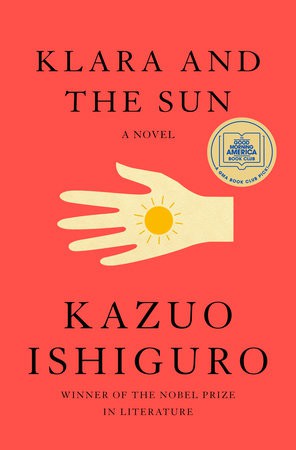
Klara and the Sun by Kazuo Ishiguro is a 2021 literary fiction book about artificial consciousness, love and devotion, human obsolescence. Klara's solar devotion — her quasi-religious relationship with the Sun as a source of life and goodness — is used to examine how consciousness generates meaning-making, sometimes mistakenly.
Summary
Klara and the Sun is narrated by Klara, an Artificial Friend — a solar-powered robot companion sold to children in a near-future society where genetic enhancement and economic stratification have created a new class system. Klara is perceptive, devoted to the teenager Josie who buys her, and deeply dependent on sunlight in ways that shade into something like faith. The novel is Ishiguro's exploration of consciousness, love, and what we mean when we talk about what makes a person irreplaceable.
The world Ishiguro builds is recognizable but quietly dystopian: children from unenhanced families are excluded from elite institutions and social circles; humans are being displaced from work by automation and accept it with varying degrees of equanimity; the emotional labor of children is outsourced to AFs who are then discarded when the child grows up. Klara notices all of this without quite understanding it, which is the novel's central formal strategy — an observer intelligent enough to describe but not fully equipped to judge.
The book's emotional core is a question that Josie's mother eventually poses explicitly: can a person be fully substituted by a perfect copy of them? Ishiguro approaches this through Klara's perspective, through grief, through what the people around Josie actually believe about love and uniqueness. The novel doesn't resolve the question so much as render it in full — show what it costs to answer yes and what it costs to answer no.
Ishiguro writes in the clean, restrained mode of Never Let Me Go and The Remains of the Day — prose that creates maximum emotional impact through understatement. Klara and the Sun is less devastating than those books on first read, but its questions accumulate after you finish it. Readers looking for science-fictional worldbuilding or fast-moving plot will bounce off this. Readers who want a novel that makes them sit with an uncomfortable question about love and personhood will find it rewards the time.
Talk to Klara and the Sun like its author wrote you back.
Get the ideas that fit your life — not generic summaries.
- Chat with the book
- Audiobook-style main ideas
- Adapts to your life and goals
- Helps you take action
Key takeaways
- 1.
Klara's solar devotion — her quasi-religious relationship with the Sun as a source of life and goodness — is used to examine how consciousness generates meaning-making, sometimes mistakenly.
- 2.
The 'substitution' question at the novel's center is not resolved: Ishiguro presents it as genuinely open and shows that different characters' answers reveal something about how they understand love.
- 3.
Ishiguro uses Klara's limited perspective as a formal device: she sees clearly and judges minimally, which allows the reader to see what the human characters can't or won't.
- 4.
Genetic enhancement as a class marker — 'lifted' versus 'unlifted' children — gives the novel's dystopia a specific, recognizable shape rooted in existing anxieties about meritocracy.
- 5.
The novel treats artificial consciousness with unusual respect: Klara's inner life is rendered as real rather than as performance, which creates the ethical problem it's exploring.
- 6.
Love is shown as requiring a kind of willful blindness — an insistence on uniqueness that the facts may not support — and the novel asks whether that insistence is delusion or the thing itself.
- 7.
The AFs' obsolescence and disposal mirrors the experience of human workers being automated out — the novel lets that parallel develop without underlining it.
- 8.
Klara's narration is unreliable in a specific way: she doesn't lie, but her interpretive frameworks are limited by her design, and the reader can see the gaps she can't.
Discussion questions
Use these on your own, with a book club, or as chat starters in Superbook. Book club version, ready to copy or print →
- 1.
Josie's mother asks Klara to study Josie in order to 'continue' her. What does this request reveal about how the mother understands love — and do you think she's right?
- 2.
Klara's faith in the Sun — her belief that it can heal, that it is benevolent — is treated neither as clearly delusional nor as clearly correct. How did you read it?
- 3.
The 'lifted' / 'unlifted' distinction maps onto existing anxieties about genetic advantage, elite schooling, and meritocracy. Does Ishiguro push that analogy far enough, or is it background dressing?
- 4.
Klara observes everything without the social anxiety most characters have about what they're seeing. What does her perspective reveal that a human narrator would have suppressed?
- 5.
At the end of the novel, Klara is placed somewhere specific. Did you find that ending earned? What does Ishiguro seem to be saying with it?
- 6.
The question of whether Klara is conscious — whether she has genuine inner experience — is never answered. Does the novel need to answer it to make its point?
- 7.
Rickie, Josie's unlifted friend, is excluded from the futures available to Josie. His story is peripheral but persistent. What is Ishiguro doing with his presence?
- 8.
Klara frequently misreads human situations despite being perceptive. Is this a limitation of her design, or does Ishiguro suggest humans are equally prone to misreading each other?
- 9.
Compared to Never Let Me Go — also Ishiguro on what it means to be human and expendable — where does Klara and the Sun land differently for you?
- 10.
Klara's love for Josie is not in question. But is it reciprocated — really? How does Josie treat Klara over the course of the novel?
- 11.
The novel's pacing is slow and the worldbuilding is sparse. Did that restraint feel like artistic discipline or like evasion?
- 12.
If Klara were replaced by a version with identical memories and behaviors, would it be the same Klara? Does the novel think so?
Themes
Frequently asked questions
-
Is Klara and the Sun science fiction?
It's set in the near future and involves AIs, but Ishiguro is not doing science fiction in the genre sense. There's no worldbuilding detail for its own sake, no speculation on technology. It's literary fiction that uses a science-fictional premise as a lens for questions about consciousness and love.
-
Is Klara and the Sun as good as Never Let Me Go?
Most critics find Never Let Me Go more devastating, but Klara and the Sun is more philosophically explicit about its central question. They're companion pieces. If you loved one, you'll want to read the other; Klara won't feel redundant.
-
What is the novel actually about, without spoilers?
A solar-powered robot companion observes the life of the teenager she's paired with, and witnesses a family grappling with loss, love, and the question of whether a person can be replaced by a perfect facsimile of them.
-
Is Klara a reliable narrator?
Klara doesn't lie, but she interprets through a limited framework that the reader can see around. Ishiguro makes her misreadings legible without making her seem stupid — she's just differently equipped than we are.
-
Who might not enjoy this?
Readers who want plot momentum, dense worldbuilding, or emotional directness. Ishiguro writes with deliberate restraint and the novel moves slowly. Its impact is cumulative rather than immediate.