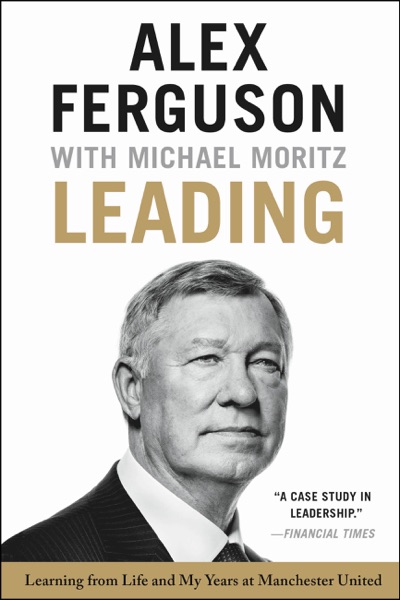
Leading by Alex Ferguson & Michael Moritz is a 2015 business book about leadership, team building, management. Winning is a habit that must be constantly renewed. Ferguson's approach to each new season treated the previous success as context, not collateral — the pressure to maintain standards never diminished.
Summary
Leading is Sir Alex Ferguson's account of what he learned managing Manchester United for twenty-seven years, written with Silicon Valley investor Michael Moritz. Ferguson won thirteen Premier League titles, five FA Cups, and two Champions League trophies in that tenure — a record of sustained excellence without parallel in elite professional football. The book attempts to systematize what that record required.
Ferguson's central argument is that leadership is not primarily a matter of tactics or technical expertise but of people management: understanding individuals, building relationships, maintaining standards, and preserving the kind of culture in which high performance becomes self-sustaining. He is particularly good on the difficulty of maintaining standards as a team succeeds — the constant pressure to let discipline slip when things are going well, and the need to rebuild teams before they decay rather than after they have already fallen.
The book covers recruiting (prioritizing character alongside ability, being suspicious of players who prioritize money over competition), maintaining team cohesion across large egos, handling the transition from player to manager mentality, and managing up — his relationships with the club's ownership and board. Ferguson is frank about failures: the players he let go too late, the signings that didn't work, the moments when he got the dressing room dynamic wrong.
Moritz's contribution — structured interviews and an organizing framework — occasionally imposes a business-book structure that feels slightly foreign to Ferguson's voice, and some sections are more anecdotal than analytical. The book is at its best when it is specific: Ferguson on Roy Keane's leadership, on the Cantona situation, on rebuilding after 1995. Where it drifts into general management principles it sometimes says what every management book says. But Ferguson's authority on sustained high performance over a quarter-century is unmatched, and the specific examples he draws on carry genuine weight.
Talk to Leading like its author wrote you back.
Get the ideas that fit your life — not generic summaries.
- Chat with the book
- Audiobook-style main ideas
- Adapts to your life and goals
- Helps you take action
Key takeaways
- 1.
Winning is a habit that must be constantly renewed. Ferguson's approach to each new season treated the previous success as context, not collateral — the pressure to maintain standards never diminished.
- 2.
Recruit for character first, ability second. Technically exceptional players who erode team culture are more destructive than less talented players who reinforce it.
- 3.
Discipline must be consistent and non-negotiable to be credible. Exceptions made for star players undermine the entire standard.
- 4.
Great teams require rebuilding before they visibly decline. Ferguson's repeated willingness to sell players at peak value rather than waiting until decline set in was a structural advantage.
- 5.
Youth development creates loyalty and cultural transmission that external recruitment cannot replicate. Ferguson's investment in the youth academy at United produced multiple championship cycles.
- 6.
Observation is the primary management skill. Ferguson spent significant time watching, listening, and tracking individual players' states — mood, form, personal circumstances — before making decisions.
- 7.
Managing the transition from playing to leadership is a distinct challenge. Most players who become managers underestimate how different the cognitive requirements are.
- 8.
Preparation reduces in-game anxiety and frees attention for real-time response. Ferguson's legendary attention to opponent analysis was not paranoia but a system for converting preparation into performance.
Discussion questions
Use these on your own, with a book club, or as chat starters in Superbook. Book club version, ready to copy or print →
- 1.
Ferguson argues that the desire to win matters more than technical skill in the very long run. Do you agree, and does that claim apply outside football?
- 2.
He rebuilt Manchester United's squad repeatedly rather than allowing aging teams to decline naturally. What prevented other clubs from making the same moves? What made it possible for him to do it?
- 3.
Ferguson's treatment of Roy Keane — eventually releasing a captain who was no longer serving the team's culture — is a central case study in the book. What is the equivalent decision in your context, and how do you make it?
- 4.
He is frank about not being a natural people manager early in his career and learning the skill over time. What specific management capability have you consciously developed, and how did you develop it?
- 5.
The consistency of standards is a recurring theme. Where in your experience does consistency of expectation drive performance, and where does it become rigidity?
- 6.
Ferguson describes the pressure that comes with sustained success — expectations that make sustained improvement harder. How do you maintain the motivation to keep improving when good is already good enough?
- 7.
Moritz structured this book to draw lessons applicable beyond football. Do you think sports leadership translates usefully to business leadership, or are the contexts too different?
- 8.
He talks about the importance of reading a room — knowing when players need encouragement and when they need challenge. How do you develop that contextual sensitivity?
- 9.
Ferguson managed players across five decades whose personalities, motivations, and media environments were very different. Which change in the external environment do you think created the most significant shift in what the job required?
- 10.
The book was co-written with an investor from a completely different context. Does that collaboration strengthen or weaken the argument? What do you gain and lose when experience is filtered through a second author?
- 11.
Ferguson explicitly says he never let friendship override performance standards. Do you think that is achievable or desirable in the leadership contexts you work in?
- 12.
What is one principle from Leading that you think would change something specific in how you currently manage or lead?
Themes
Frequently asked questions
-
Is Leading worth reading if you are not interested in football?
Yes, with caveats. The football context is often specific and detailed, but the management and leadership principles are consistently interesting and grounded in a twenty-seven-year record that is unusual in any field. Readers with no interest in football should be prepared for detailed match and player references.
-
How does Leading compare to other sports leadership books like Legacy?
Legacy by James Kerr is about the All Blacks culture and is more lyrical and philosophical. Leading is more practical and more focused on a single manager's decisions and reasoning. Both are worth reading; Leading is more immediately applicable to day-to-day management situations.
-
What is the most useful management lesson in Leading?
Ferguson's consistent emphasis on rebuilding teams proactively — selling players before decline becomes obvious and investing in successors — is counterintuitive and consistently undervalued. The instinct to hold on to what is working too long is one of the most common leadership failures.
-
How does Ferguson's management style apply outside professional sport?
Most directly in contexts where culture, standards, and team composition are more important than individual talent: building and managing teams, maintaining quality standards under success, and navigating the tension between loyalty and performance expectations.
-
Does the book cover Ferguson's later years or his time before Manchester United?
The book draws on the full arc of his career including his time at Aberdeen and his early years at United, though the majority of examples come from the period of greatest success at Old Trafford. The final years before his retirement are covered including the transition to David Moyes.
Similar books
High Output Management
Andrew S. Grove
The Score Takes Care of Itself
Bill Walsh
Trillion Dollar Coach
Eric Schmidt, Jonathan Rosenberg, and Alan Eagle
First, Break All the Rules
Marcus Buckingham and Curt Coffman
