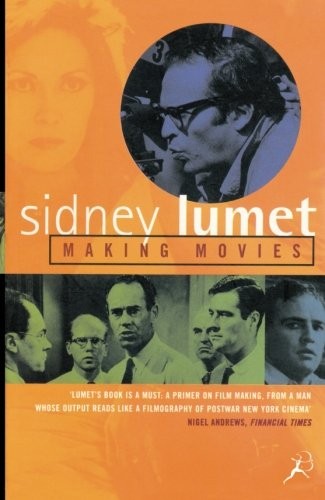
Making Movies by Sidney Lumet is a 1995 biography book about filmmaking, craft and process, storytelling. Every stylistic decision in a film should grow from the material — the story, its themes, its emotional core. Style imposed from outside the story produces work that is decorative rather than expressive.
Summary
Making Movies is Sidney Lumet's account of how films get made, written by a director who spent fifty years making them. It is not a memoir or a theory of cinema — it is a practical examination of the decisions that shape a movie, told from inside the process by someone who made Network, Dog Day Afternoon, 12 Angry Men, Serpico, and before the book was published, thirty-odd more. Lumet was not interested in auteur theory. What he cared about was whether the work was honest.
The book moves through the filmmaking process roughly in order: the script, the style, working with actors, the camera, the editor. But Lumet's organizing principle is not procedure — it is the question of what every decision is in service of. He calls this the "why" of every choice, and his consistent argument is that style should grow from content rather than be imposed on it. His chapter on choosing the visual style of a film is among the clearest accounts of how directors translate emotional intent into camera language that exists in print.
Lumet's relationship with actors is a recurring subject. He trained as an actor before becoming a director and his respect for the craft is evident throughout. He describes the rehearsal process he developed, his belief that actors reveal rather than perform, and the specific techniques he used to create the conditions in which truthful work could happen. His accounts of working with Al Pacino on Serpico and with Henry Fonda on 12 Angry Men are both instructive and human.
The book is short, conversational, and entirely lacking in self-promotion. Lumet includes failures alongside successes and is honest about what he does not know. It has become a standard text in film schools not because it is theoretical or comprehensive but because it transmits hard-won experience in a form a working filmmaker can actually use. For anyone interested in how films are made from the inside — not the mythology of Hollywood but the daily craft of it — Making Movies is the right book.
Talk to Making Movies like its author wrote you back.
Get the ideas that fit your life — not generic summaries.
- Chat with the book
- Audiobook-style main ideas
- Adapts to your life and goals
- Helps you take action
Key takeaways
- 1.
Every stylistic decision in a film should grow from the material — the story, its themes, its emotional core. Style imposed from outside the story produces work that is decorative rather than expressive.
- 2.
The director's primary job before production begins is to know what the film is about, not just what happens in it. That clarity shapes every subsequent decision.
- 3.
Working with actors requires creating conditions for truth rather than managing performances. Directors who treat actors as instruments get different results from directors who treat them as collaborators.
- 4.
Rehearsal is not about fixing performances in advance — it is about exploration. The discoveries that happen in rehearsal, including the ones that contradict the director's original vision, are often the most valuable.
- 5.
The camera is a moral instrument: where it points, how close it gets, whether it moves — all of these communicate attitudes about characters and events that the audience absorbs whether or not they notice them.
- 6.
Editing is the discovery of the film that was actually shot, not the execution of the plan that was written. The material tells you things in the edit that you could not know before shooting.
- 7.
Commercial constraints and artistic ambition are not always in conflict. Lumet made network-commissioned films and personal films on similar budgets; the quality came from the same discipline in both.
- 8.
The most common failure in filmmaking is not incompetence but dishonesty — the compromises made to please someone, to play it safe, or to be liked rather than to be true.
Discussion questions
Use these on your own, with a book club, or as chat starters in Superbook. Book club version, ready to copy or print →
- 1.
Lumet's central principle is that style should come from content. Can you think of films — or other creative work — where the opposite happened, and what did it cost them?
- 2.
He argues the director must know what the film is about before production. How does that compare to creative processes you've experienced where the work's meaning emerged during making?
- 3.
Lumet trained as an actor first. How do you think a background in performance changes how a director sees their role on set?
- 4.
The book describes rehearsal as exploration, not preparation. What is the difference, and how does that apply to other kinds of collaborative work?
- 5.
Lumet says the camera has moral implications — where it looks, how close it gets. Does that idea extend to other choices in visual communication: photography, design, journalism?
- 6.
He is honest about failures in the book. Why do you think so few creative practitioners are? What does the reluctance cost them and the people who learn from them?
- 7.
Lumet's films tend to be about institutional failure and individual conscience: police corruption, courtroom justice, media manipulation. Do you see his personal ethic reflected in his choice of material?
- 8.
He describes editing as discovery rather than execution. Have you had experiences in any creative discipline where the final work differed substantially from the plan in ways that improved it?
- 9.
Making Movies was published in 1995. Which of Lumet's craft principles still hold in a world of digital production, on-location shooting, and streaming distribution? Which have been superseded?
- 10.
The book is notably free of the mythology of directorial genius. Do you think that demystification helps or hurts how we understand creative achievement?
- 11.
Lumet worked with many of the great American screen actors of the twentieth century. What does his description of those working relationships tell you about what he valued in performance?
- 12.
If you were to apply Lumet's 'what is this about?' discipline to a creative project you're currently working on, how would you answer the question?
Themes
Frequently asked questions
-
Is Making Movies worth reading if you're not a filmmaker?
Yes. The book's core argument — that every decision in a creative work should grow from the material's emotional and thematic content — applies to writing, design, music, and most other disciplines. The filmmaking specifics are accessible, and the discipline Lumet describes transfers.
-
How long is Making Movies?
About 220 pages — a four-hour read at average pace. The writing is direct and the chapters are short; it goes quickly. Most readers report finishing it in a sitting or two.
-
What makes Lumet's approach different from other books about filmmaking?
The absence of mythology. Lumet writes about craft as a practical problem — how do you get a performance, how do you choose a lens, how do you cut a scene — without invoking genius or inspiration. He also includes failures honestly, which most filmmaking books do not.
-
Which of Lumet's films should I watch before or after reading?
12 Angry Men and Network are the most frequently referenced in the book and reward watching alongside the text. Dog Day Afternoon and Serpico are essential Lumet and illuminate what he says about working with actors under pressure.
-
What is Lumet's view of the director's relationship to the script?
He sees the script as the foundation that everything else must serve. A director who imposes visual style on a story without understanding what the story is really about is working backward. The script tells you what the film should look like — not in camera terms, but emotionally.
Similar books
Outliers: The Story of Success
Malcolm Gladwell
Range: Why Generalists Triumph in a Specialized World
David Epstein
Deep Work
Cal Newport
Grit: The Power of Passion and Perseverance
Angela Duckworth
