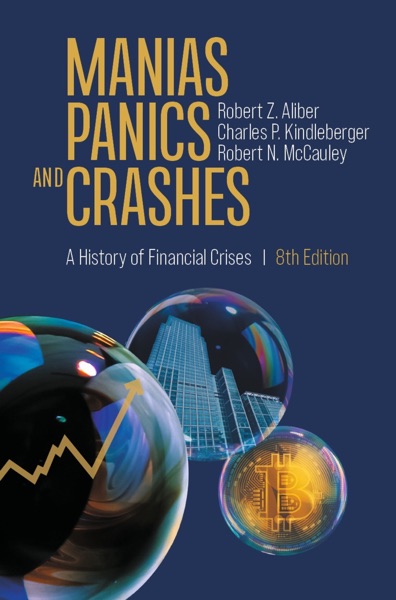
Manias, Panics, and Crashes by Charles P. Kindleberger is a 1978 economics book about financial crises, economic history, speculation. Financial crises follow a recognizable five-stage pattern — displacement, expansion, overtrading, euphoria, revulsion — that recurs across different assets, countries, and centuries. The specific trigger varies; the structure does not.
Summary
Manias, Panics, and Crashes is Charles Kindleberger's analysis of financial crises across five centuries of history, first published in 1978 and updated in several subsequent editions. Kindleberger, an economic historian at MIT, argues that speculative manias follow a recognizable pattern regardless of the specific asset being speculated on — tulips, South Sea Company shares, railroad bonds, real estate, technology stocks — and that this pattern can be understood using a model developed by Hyman Minsky.
The Minsky model describes a five-stage cycle. It begins with a displacement — an external shock that changes profit opportunities, typically a new technology or a policy change. Credit expands as investors rush in. Overtrading follows as expectations become self-reinforcing. Euphoria sets in, and at the peak, the market becomes detached from any fundamental valuation. Then a reversal occurs — often triggered by a specific event that, in retrospect, seems insignificant — and the crash follows. Kindleberger applies this framework to crises from the seventeenth century through the 1970s (and later editions extend it through the dot-com crash and 2008), demonstrating its descriptive consistency across very different economic environments.
Kindleberger is particularly interested in the international dimensions of financial crises: how capital flows across borders during manias, how currency mismatches amplify crashes, and what role a lender of last resort — a Bagehot-style central bank willing to lend freely against good collateral at a penalty rate — can play in arresting panics. His argument is that the absence of an international lender of last resort was a key factor in the severity of 1930s depression, and that coordinating central bank responses to crises is one of the most important functions of international financial architecture.
The book is scholarly rather than journalistic, and it assumes some familiarity with economic history and financial terminology. It is not a page-turner. But its central contribution — demonstrating that financial crises are not anomalies caused by unusual greed or stupidity but recurring features of market systems with a predictable structure — is one of the most important frameworks in economics for understanding why crashes keep happening. Every major crisis since 1978, including the 2008 financial crisis, has been analyzed through the Kindleberger-Minsky framework, which has only grown in influence.
Talk to Manias, Panics, and Crashes like its author wrote you back.
Get the ideas that fit your life — not generic summaries.
- Chat with the book
- Audiobook-style main ideas
- Adapts to your life and goals
- Helps you take action
Key takeaways
- 1.
Financial crises follow a recognizable five-stage pattern — displacement, expansion, overtrading, euphoria, revulsion — that recurs across different assets, countries, and centuries. The specific trigger varies; the structure does not.
- 2.
The Minsky model provides the theoretical foundation: as an expansion continues, financial actors take on progressively more fragile positions, moving from hedge finance (cash-flow covers debt) to speculative (rollover required) to Ponzi (dependent on rising asset prices).
- 3.
Credit expansion is both the fuel of speculative manias and the mechanism that makes them self-reinforcing. When credit contracts, it contracts precisely when debtors most need it.
- 4.
Contagion — the spread of crises across asset classes and national borders — is a structural feature of integrated financial markets, not an unusual accident. What starts in tulips ends in currencies.
- 5.
A lender of last resort — a central bank or international institution willing to provide emergency liquidity against good collateral — can arrest a panic before it becomes a depression. The debate is always about how to do it without creating moral hazard.
- 6.
The 1930s depression was worse than previous crises partly because no international lender of last resort existed, and the major powers could not coordinate their responses. The lesson shaped postwar financial architecture.
- 7.
Kindleberger is skeptical that rational expectations models can explain financial crises. Crises require actors who extrapolate past trends indefinitely and who are susceptible to herd behavior — neither assumption fits the rational actor model.
- 8.
The phrase 'this time is different' reliably appears before every major crash. The arguments change; the confidence in them does not.
Discussion questions
Use these on your own, with a book club, or as chat starters in Superbook. Book club version, ready to copy or print →
- 1.
Kindleberger argues that manias follow a recognizable pattern. Did that pattern apply to the 2008 financial crisis, the dot-com crash, or any more recent episode you've observed?
- 2.
The displacement that starts a mania — a new technology, a policy change — often represents a genuine opportunity. How do you distinguish between rational enthusiasm for a new development and the beginning of a mania?
- 3.
Kindleberger is skeptical of rational expectations models. Does the history he presents convince you that financial actors behave irrationally in ways that models need to capture, or are there rational explanations for the behavior he documents?
- 4.
The lender of last resort debate is about balancing crisis arrest against moral hazard. If you know you'll be bailed out, you take more risk. How should that tradeoff be resolved in practice?
- 5.
The 1930s depression was amplified by the absence of international financial coordination. What is the contemporary equivalent of the coordination problem Kindleberger identifies?
- 6.
Each chapter demonstrates the Minsky pattern in a different historical episode. After reading several examples, does the framework feel illuminating or does it start to feel like retrofitting a story to a model?
- 7.
Kindleberger writes that 'this time is different' is the most dangerous phrase in finance. Can you think of genuine cases where things actually were different — where the usual pattern didn't apply because something structural had changed?
- 8.
The book deals with crises in commodity markets, real estate, equities, currencies, and sovereign debt. Is the same analytical framework genuinely useful for all these types, or does each require different treatment?
- 9.
If the Minsky model is correct, are financial crises preventable, or are they inevitable features of any market system that allows credit expansion?
- 10.
The book was first published in 1978. How does reading its historical analysis of earlier crises change how you think about the 2008 financial crisis — does it seem more or less preventable with this framework?
- 11.
Kindleberger's prescription for the international monetary system involves a lender of last resort. Is the IMF, as currently constituted, an adequate version of this institution? What would an adequate version look like?
- 12.
Every crisis in the book was eventually followed by recovery. Does the historical pattern provide reassurance, or does the recurrence of crises itself suggest that the recovery doesn't address underlying causes?
Themes
Frequently asked questions
-
Is Manias, Panics, and Crashes accessible to non-economists?
With effort. Kindleberger assumes some familiarity with economic history and financial terminology. Non-specialist readers will need to pause occasionally to look up concepts, but the core argument is accessible and the historical examples do much of the explanatory work.
-
Which edition should I read?
The seventh edition (2015), updated by Robert Aliber, extends the analysis through the 2008 financial crisis and more recent episodes. Later editions are more useful for contemporary readers; the original 1978 edition is a historical document as much as a reference text.
-
How does the book relate to Hyman Minsky's work?
Kindleberger explicitly uses Minsky's financial instability hypothesis as the theoretical framework for his historical analysis. Minsky himself wrote Stabilizing an Unstable Economy, which provides the theoretical foundation. The two books complement each other well.
-
What's the most important single idea in the book?
The predictability of the mania pattern. If you can identify where in the Minsky cycle a market currently sits, you have a framework for evaluating whether current prices reflect fundamental value or self-reinforcing expectations. That's not a trading system, but it is a useful reality check.
-
Did the book predict the 2008 financial crisis?
Not specifically, but the framework it provides was widely used to analyze 2008 in real time and after the fact. The Minsky moment — the point at which Ponzi finance collapses — became one of the most-cited concepts in the crisis coverage. The book's framework proved robust.
Similar books
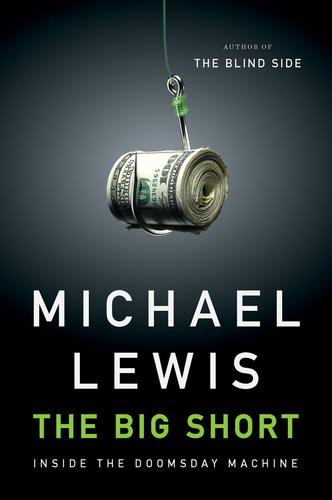
The Big Short: Inside the Doomsday Machine
Michael Lewis
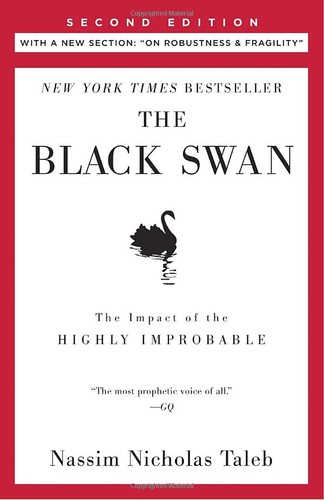
The Black Swan: The Impact of the Highly Improbable
Nassim Nicholas Taleb
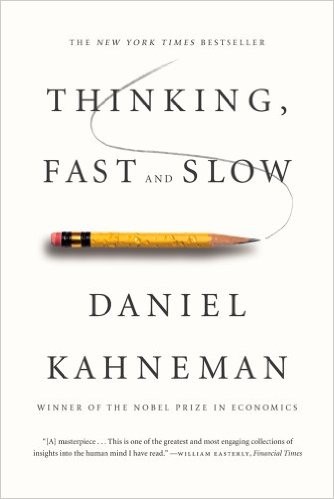
Thinking, Fast and Slow
Daniel Kahneman
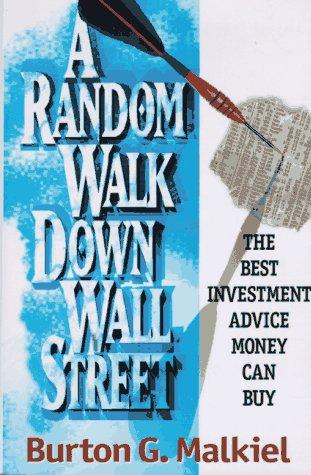
A Random Walk Down Wall Street
Burton G. Malkiel
