Business · Book club
Never Split the Difference book club questions
Here are 12 book club questions for Never Split the Difference by Chris Voss, ordered to open easily and end somewhere worth arguing about. Copy them, print them, or bring them up one at a time.
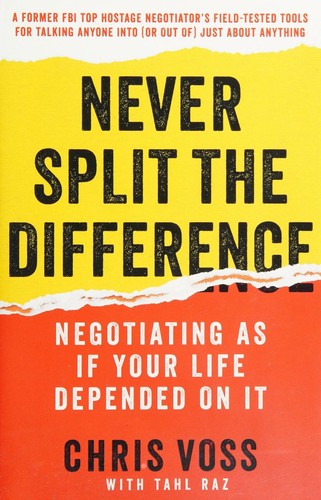
Never Split the Difference is Chris Voss's argument that the rational, compromise-based negotiation frameworks taught in business schools miss something fundamental about how people actually make decisions.
Chris Voss · 2016 · 5h 0m
Full summary and key takeaways →The 12 questions
- 1.
Voss claims emotion drives every negotiation, even ones that look purely rational. Can you think of a recent disagreement where the emotional dynamic was actually doing more work than the stated facts?
- 2.
Tactical empathy requires accurately perceiving the other side's perspective, not just performing sympathy. What's the difference, and how would you know when you're doing one versus the other?
- 3.
When was the last time someone made you feel truly heard in a disagreement? What specifically did they do, and what effect did it have on your willingness to move?
- 4.
Voss is suspicious of 'yes' and thinks 'no' is often a healthier place to start. Does this match your experience in professional or personal negotiations?
- 5.
Think of a negotiation you handled badly. Which of Voss's techniques — mirroring, labeling, calibrated questions — might have changed the outcome, and how?
- 6.
The Ackerman model requires discipline: specific numbers, specific percentages, a deliberately odd final offer. Does following a rigid script feel manipulative to you, or just prepared?
- 7.
Voss argues that most people are either accommodators, asserters, or analysts in negotiation style. Which are you, and what does your style cost you?
- 8.
Many of the book's examples come from high-stakes hostage situations. How well do those lessons translate to the lower-stakes negotiations in your life — salary talks, contractor disputes, household decisions?
- 9.
Voss says skilled negotiators are primarily skilled listeners. What would change in your next difficult conversation if listening were the primary goal rather than making your case?
- 10.
The book argues against splitting the difference as a solution. Think of a past compromise you made. Was there an alternative that would have served both sides' underlying needs better?
- 11.
Calibrated questions are designed to make the other side solve your problem without feeling directed. Is there a situation in your professional life where that technique would be more useful than a direct request?
- 12.
Voss advocates being hard-nosed in ways that can feel uncomfortable for people who prize politeness or consensus. How do you think about the line between skilled negotiation and manipulation?
How to run the discussion
- Pick six to eight, not all of them. An hour of real discussion covers fewer questions than anyone expects, and racing the list is what makes a book club feel like homework.
- Open with what people noticed, not what they concluded. Asking for a verdict first hardens opinions before anyone has heard each other.
- Let the disagreement run. The questions below that split a room are the ones worth the time; the ones everyone answers the same way can be skipped.
- Ask the quiet person a specific question. A direct, narrow question is far easier to answer than an open invitation to contribute.
Themes worth steering toward
If the conversation stalls, these are the threads that usually restart it.
Common questions
What are good book club questions for Never Split the Difference?
Here are 12 book club questions for Never Split the Difference by Chris Voss, ordered to open easily and end somewhere worth arguing about. The strongest openers ask what each reader noticed rather than what they concluded, and the discussion usually turns on negotiation, persuasion, communication.
How long should a book club discussion of Never Split the Difference last?
Most groups run 60 to 90 minutes of actual discussion. That is roughly six to eight questions, not all of them, so pick the ones that suit your group rather than working down the list in order.
What are the main themes in Never Split the Difference?
Negotiation, Persuasion, Communication, Psychology, Influence. Those are the threads most likely to divide a room, which makes them the useful places to steer a discussion that has gone quiet.
Picking the next one? See books like Never Split the Difference or questions for other book club picks.
