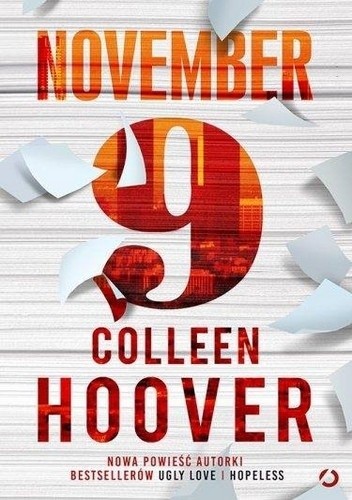
November 9 by Colleen Hoover is a 2015 contemporary fiction book about identity, obsession, first love. The annual-meeting structure compresses a relationship into its most concentrated moments, revealing how much of love is constructed from performed versions of ourselves.
Summary
Fallon and Ben meet in a diner on November 9th, the day Fallon is leaving Los Angeles to move across the country. Rather than exchange numbers, they make a pact: they'll spend this one day together, and then meet again on November 9th each year for the next five years. No contact in between. The structure gives the book an unusual shape — each chapter is a different November 9th — and allows Hoover to compress a multi-year relationship into a series of single-day snapshots.
The book is in many ways a structural experiment: what does love look like when you only see someone one day a year? What does it mean to know someone through a handful of concentrated encounters rather than continuous daily accumulation? Fallon is an actress who suffered facial burns from a fire, and Ben is a writer. The tension between what they present to each other on their assigned days and who they actually are the other 364 days runs through the whole novel. When the secret at the center of Ben's character is revealed, it reframes the relationship's entire architecture.
Hoover's prose here is lighter than in It Ends with Us or Verity — the novel is more playful, more concerned with romantic banter and less with psychological weight. The premise does more work than the execution in places, and the reveal about Ben's secret is more melodramatic than emotionally convincing. But the structural conceit is genuinely clever, and the time compression forces both characters to present their best (and most performative) selves in ways that are sharply observed.
November 9 works best as an undemanding but clever romance that happens to have an interesting formal shape. The big secret feels engineered, and the resolution comes too easily, but readers looking for something emotionally engaging without the darkness of Hoover's heavier books will find this a good entry point. It's more interested in romantic fantasy than in the friction of real relationships.
Talk to November 9 like its author wrote you back.
Get the ideas that fit your life — not generic summaries.
- Chat with the book
- Audiobook-style main ideas
- Adapts to your life and goals
- Helps you take action
Key takeaways
- 1.
The annual-meeting structure compresses a relationship into its most concentrated moments, revealing how much of love is constructed from performed versions of ourselves.
- 2.
Fallon's physical scars are handled with more care than most romance novels manage — the book doesn't use them as pure metaphor and doesn't resolve them as a barrier to be overcome.
- 3.
Ben's secret reframes not just the relationship but the reader's entire understanding of how the novel was constructed — a structural move that pays off if you accept its emotional logic.
- 4.
The absence of daily contact between meetings creates an idealization problem the novel is partly aware of: both characters fall for versions of each other that only exist one day a year.
- 5.
Fallon's decision to leave her career and her relationship with her father sits mostly in the background but shapes who she is when she shows up each November.
- 6.
The novel is interested in how writers construct narratives around real people — Ben's project raises questions the book doesn't fully pursue.
- 7.
The romantic fantasy here is more dominant than in Hoover's other work; this is a novel that prioritizes feel-good over realistic, which is a legitimate choice that some readers will prefer.
- 8.
The pact structure works as a romantic device partly because it mirrors how memory actually operates — we remember relationships in highlight reels, not as continuous experience.
Discussion questions
Use these on your own, with a book club, or as chat starters in Superbook. Book club version, ready to copy or print →
- 1.
The annual-meeting pact means Fallon and Ben only know each other through their best, most prepared selves. Is the love they develop real, or is it a love for curated versions of each other?
- 2.
Ben's secret is revealed late in the novel. When it lands, does it feel like a betrayal the novel has earned, or does it feel manufactured to create drama?
- 3.
Fallon's scars and her relationship to her appearance are threaded through the book. How does the novel handle them — as symbol, as realistic detail, or as something else?
- 4.
The absence of contact between November 9ths is a feature of the plot, but in a real relationship it would be a red flag. Does the novel acknowledge that, or does it ask you not to think too hard about it?
- 5.
Both characters are performing for each other more than they'd perform in a continuous relationship. What does the novel say about how we construct identity in romantic contexts?
- 6.
Ben is a writer whose project involves Fallon without her knowledge. What does that make him? Is the novel critical of him, or does it require you not to be?
- 7.
Compare the structural device here — annual one-day meetings — to the dual timeline structure in Ugly Love. Which one does more narrative work?
- 8.
The resolution requires forgiving Ben for a significant deception. Does the book do enough to make that forgiveness feel earned?
- 9.
Fallon's father is a secondary character who nonetheless shapes most of her major decisions. What is the novel saying about fathers and daughters through their relationship?
- 10.
If you could only see someone you loved one day a year for five years, what do you think that relationship would actually look like by year five?
- 11.
November 9 is lighter in tone than Hoover's other books. Is that a strength or does it mean the emotional stakes don't feel real?
- 12.
The pact requires both people to agree to a constraint that might not be in their interest. What does their willingness to accept it tell us about where they are in their lives at the outset?
Themes
Frequently asked questions
-
Is November 9 a good Colleen Hoover book to start with?
It's a gentler entry point than It Ends with Us or Verity. The novel is more playful and less emotionally demanding, which makes it accessible, though also less resonant for readers who want her harder-hitting work.
-
Is November 9 standalone or part of a series?
Standalone. The five-year structure is self-contained, and there's no sequel.
-
What's the big twist in November 9?
Without spoiling specifics: Ben has been keeping a secret about his connection to Fallon that predates their first meeting, which retroactively complicates everything that came before. Whether it works as a plot device divides readers.
-
Who shouldn't read November 9?
Readers who find the emotionally unavailable or secretly-compromised male lead trope tiresome will not be won over. The novel is also lighter on psychological realism than Hoover's other books — if you need the darkness, this isn't the one.
-
Is there an adaptation?
As of this writing, no film or television adaptation has been released, though it has been optioned.