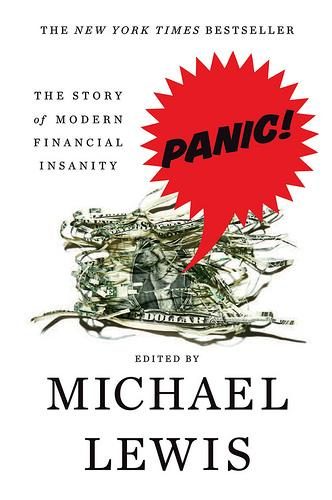
Panic: The Story of Modern Financial Insanity by ed. Michael Lewis is a 2008 economics book about financial crises, market psychology, panic. Financial crises follow a recognizable pattern: new instruments create the illusion that risk has been eliminated, leverage builds, the assumption fails, and the collapse is larger than anyone expected because the exposure was invisible.
Summary
Panic is an anthology edited by Michael Lewis, collecting journalism, essays, and firsthand accounts about five major financial crises from 1987 to 2007: the Black Monday crash, the emerging markets panics of the 1990s, the Long-Term Capital Management collapse, the dot-com bust, and the early signals of the subprime mortgage crisis. Lewis is not merely a compiler; he provides brief but sharp introductions to each section that frame the pattern he sees repeating. The book was published in November 2008, weeks after Lehman Brothers failed, which gave it an urgency its prefaces didn't anticipate.
The anthology's value is precisely its breadth. Reading accounts of five separate crises in sequence forces a recognition of recurrence that any single account would obscure. The mechanism is consistent: a new financial instrument or market opportunity creates the impression that risk has been eliminated or transformed into opportunity; sophisticated participants compete to take on more of what seems like costless return; leverage builds; the underlying assumption is revealed as false; collapse is sudden and far larger than anyone expected because the complexity of the system made the actual exposure invisible.
The contributors include journalists, economists, and participants: Richard Bernstein on the 1987 crash, Michael Lewis himself on the currency crises of the 1990s, Roger Lowenstein on LTCM, and various observers on the dot-com period. The writing quality is uneven, as anthology writing tends to be, but the best pieces — Lewis's own pieces and Lowenstein's LTCM section — are as clear and readable as financial journalism gets. The emotional texture of a panic, the way rational individuals can make decisions that are collectively irrational, is the recurring subject.
Lewis's editorial frame emphasizes the human and psychological dimensions over the technical ones: the self-serving belief in one's own sophistication, the social dynamics of herding behavior, the way proximity to money and prestige distorts judgment. The book does not offer solutions to the problem of financial panic — it is not that kind of book — but it does offer something more useful: a trained awareness of the patterns that precede collapse, written by people who were there.
Talk to Panic: The Story of Modern Financial Insanity like its author wrote you back.
Get the ideas that fit your life — not generic summaries.
- Chat with the book
- Audiobook-style main ideas
- Adapts to your life and goals
- Helps you take action
Key takeaways
- 1.
Financial crises follow a recognizable pattern: new instruments create the illusion that risk has been eliminated, leverage builds, the assumption fails, and the collapse is larger than anyone expected because the exposure was invisible.
- 2.
Complexity in financial systems is not neutral — it conceals risk by making it impossible to trace where exposure actually sits, which allows it to build past any safe threshold.
- 3.
Herding behavior in markets is not irrational at the individual level; each participant has good reasons to follow the crowd. The collective result is still catastrophic.
- 4.
The belief that 'this time is different' recurs in every crisis and is always wrong in the same way: the new instrument or market does not eliminate risk, it relocates and concentrates it.
- 5.
The people closest to the money are often the least able to see the system clearly, because their compensation structure rewards participation, not skepticism.
- 6.
Speed of collapse is characteristic of highly leveraged systems: when the margin call comes, deleveraging is simultaneous and the market for the distressed assets disappears instantly.
- 7.
LTCM's failure demonstrated that quantitative risk models can be correct on average and catastrophically wrong at the tail, which is the only time the model actually matters.
- 8.
The same financial conditions that produce the boom — cheap credit, the appearance of eliminated risk, competitive pressure to participate — are the conditions that make the subsequent panic inevitable.
Discussion questions
Use these on your own, with a book club, or as chat starters in Superbook. Book club version, ready to copy or print →
- 1.
Lewis frames five crises as the same story told five times with minor variations. Do you find that framing persuasive, or does it understate the distinctive features of each crisis?
- 2.
The anthology was published weeks after Lehman failed. How does reading it in 2026 — nearly twenty years later — change which sections feel most prescient?
- 3.
The recurring figure in these accounts is someone who sees the bubble but participates anyway because the cost of standing aside is immediate and certain while the cost of participating is deferred and uncertain. Would you have done the same?
- 4.
LTCM employed some of the most sophisticated financial mathematicians in the world, including Nobel laureates. What does their failure say about the limits of quantitative models in financial markets?
- 5.
Lewis argues that the complexity of modern financial instruments is itself a kind of fraud — not because anyone intended to deceive, but because no one fully understood the exposure they were accumulating. Is that a reasonable charge?
- 6.
Several contributors describe watching a crisis build for months before it collapsed, without being able to act on that knowledge effectively. What does that immobility tell you about the incentive structures involved?
- 7.
The currency crises of the 1990s devastated developing economies while the wealthy countries that created the financial conditions for them were largely insulated. What does that asymmetry imply for how we should regulate global finance?
- 8.
Herding behavior is consistently described as understandable at the individual level. Does that explanation actually reduce the moral responsibility of the participants?
- 9.
Lewis includes himself as a writer-participant in some sections. Does his presence as narrator add or reduce credibility?
- 10.
The dot-com section captures the peculiar psychology of a period when implausible valuations were widely accepted. Do any aspects of that psychology seem familiar in markets today?
- 11.
The book does not offer regulatory prescriptions. Is that restraint appropriate or a missed opportunity?
- 12.
After reading five crises in sequence, what single change to how financial markets are structured or regulated would you make?
Themes
Frequently asked questions
-
Do I need financial background to read Panic?
No. Lewis selected pieces for narrative accessibility rather than technical complexity, and his introductions provide enough context to follow even unfamiliar crises. Readers who already know these events in detail will still find the juxtaposition of five crises in sequence revealing.
-
How long does it take to read Panic?
Four to five hours for the 300-page anthology. The quality varies by contributor, so some sections read faster than others. Lewis's own pieces and the Lowenstein LTCM section are the densest and most rewarding.
-
Is this book still relevant given subsequent financial events?
The 2008 financial crisis happened just as the book was published, so it is not covered. But the patterns Lewis identifies in the five crises he does cover appear again in 2008, which makes the anthology more rather than less relevant as a framework for understanding later events.
-
Is Panic better or worse than reading the individual books on each crisis?
Different. The anthology's purpose is comparison and pattern recognition. Readers who want depth on any individual crisis should read the dedicated books — When Genius Failed for LTCM, The Big Short for subprime. Panic is best read as the distillation that makes the pattern visible.
-
Who should read Panic?
Anyone who wants a fast survey of modern financial crises without committing to multiple full-length books, and anyone who found The Big Short's premise about recurring financial folly persuasive and wants to see the same pattern in earlier events.