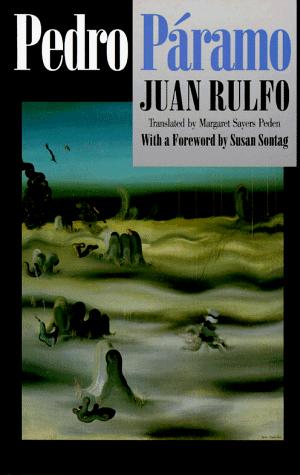
Pedro Páramo by Juan Rulfo is a 1955 literary fiction book about death and memory, power and tyranny, rural mexico and violence. Rulfo's formal achievement is a narrative composed entirely of fragments — shifting voices, reversed chronology, unmarked transitions — that enacts how memory and death actually work rather than how stories pretend to.
Summary
Juan Rulfo's Pedro Páramo is a short novel of extraordinary intensity, barely 120 pages, that many writers — Gabriel García Márquez among them — cite as among the most influential fiction ever written in Spanish. A man named Juan Preciado travels to the ghost town of Comala to find his father, Pedro Páramo, whose name his dying mother gave him as a final request. When he arrives, Comala is populated entirely by the dead — their voices drifting up from the earth, their histories layering over each other — and Juan Preciado realizes he has been dead since not long after he arrived.
The narrative structure is deliberately disorienting: voices shift without announcement, time moves in all directions, characters appear and disappear mid-sentence, and the reader gradually assembles the story of Pedro Páramo — a cacique, a landowner, a tyrant who loved one woman his entire life and destroyed everything else — from fragments. This is not experimental difficulty for its own sake but a formal argument: memory does not narrate; it surfaces. The dead remember in pieces, and Rulfo reproduces that fragmentation with total control.
Pedro Páramo himself is a portrait of the Mexican rural strongman — cruel, total, genuinely feeling in one direction only. His obsessive love for Susana San Juan, whom he acquires only after she is already lost to madness and grief, is the novel's emotional center. The cacique's power is absolute in every domain except the one that matters to him, and this irony Rulfo renders without sentiment.
García Márquez said he read Pedro Páramo and then read it again, and then began One Hundred Years of Solitude. That lineage is visible. But Rulfo's novel is smaller, colder, and more formally pure. It does not comfort with its magic; it uses it to intensify absence. An extraordinary novel that takes two hours to read and weeks to stop thinking about.
Talk to Pedro Páramo like its author wrote you back.
Get the ideas that fit your life — not generic summaries.
- Chat with the book
- Audiobook-style main ideas
- Adapts to your life and goals
- Helps you take action
Key takeaways
- 1.
Rulfo's formal achievement is a narrative composed entirely of fragments — shifting voices, reversed chronology, unmarked transitions — that enacts how memory and death actually work rather than how stories pretend to.
- 2.
Pedro Páramo is the archetype of the Latin American cacique: total power, absolute impunity, capable of genuine feeling in one direction, and genuinely indifferent to human life in every other.
- 3.
Comala is established as a dead town within the first pages, but the revelation that Juan Preciado is also dead reframes the entire novel as a space where the distinction between the living and the dead has dissolved.
- 4.
Rulfo's love story — Pedro's lifelong obsession with Susana San Juan — is deliberately frustrating: he wins every battle and loses the only thing he wanted, which is the novel's structural irony.
- 5.
The novel's voices — Miguel Páramo, Eduviges, Dorotea, the village women — are not supporting characters but the deposit of what power destroys: ordinary lives reduced to fragments of speech underground.
- 6.
García Márquez cited Pedro Páramo as the primary influence on One Hundred Years of Solitude and magical realism broadly. Reading Rulfo is reading the source code.
- 7.
At 120 pages, the novel is a masterclass in compression — every sentence carries more weight than a conventional novel's paragraph, and the apparent gaps between sections are as meaningful as the text.
- 8.
Rulfo wrote only one other major work of fiction — the story collection El Llano en Llamas — and then stopped entirely. Pedro Páramo's standing in the canon is despite, or perhaps because of, his near-silence afterward.
Discussion questions
Use these on your own, with a book club, or as chat starters in Superbook. Book club version, ready to copy or print →
- 1.
The narrative structure shifts voices and time without warning. Did you find this disorienting in a way that pulled you out, or did it create the effect you think Rulfo intended? When did you realize what the novel was doing?
- 2.
Juan Preciado dies without fully understanding what happened to him. Is his death a consequence of something, or is it simply what happens when you enter Comala? What does the novel suggest about inheriting a father's history?
- 3.
Pedro Páramo is a tyrant who is also, in a limited way, capable of love. Does that capacity change the moral weight of what he does, or is Rulfo using it to deepen the indictment?
- 4.
Susana San Juan is the novel's most opaque figure — she is there and not there, sane and mad, beloved and unreachable. Is she a person or a symbol? Does the distinction matter?
- 5.
The dead in Comala remember their lives in fragments and cannot stop remembering. Is this Rulfo's version of hell, purgatory, or simply a description of how traumatic history works?
- 6.
García Márquez said Pedro Páramo taught him everything. Looking at One Hundred Years of Solitude in light of Rulfo's novel, what specifically do you think he borrowed, transformed, or invented in response?
- 7.
Rulfo wrote in a period of Mexican literature that was grappling with the aftermath of the Revolution. How much of Pedro Páramo's violence and power feel specifically Mexican, and how much feel universal?
- 8.
The novel is very short. Does its brevity feel like compression or withholding? Are there things you wanted to know that Rulfo refuses to tell you, and is that refusal a flaw or a feature?
- 9.
Pedro Páramo ultimately loses interest in life after Susana dies. Is this a kind of love story, or is it a portrait of obsession that Rulfo is not endorsing?
- 10.
The title gives the novel to Pedro Páramo, but the narrative is primarily made up of the people he destroyed. Who is the novel actually about?
- 11.
How does reading a novel about the dead told by the dead change the emotional register of what you're reading? Does death flatten affect, or does it intensify it?
- 12.
Rulfo stopped writing after El Llano en Llamas and Pedro Páramo. Various explanations have been offered — perfectionism, trauma, the impossibility of surpassing himself. Does the novel feel like it contains its own completion, or like an opening that was never continued?
Themes
Frequently asked questions
-
Is Pedro Páramo worth reading?
Yes. It is one of the most perfectly constructed short novels in any language, and its influence on Latin American fiction — and on magical realism broadly — cannot be overstated. At 120 pages it asks very little time and rewards an enormous amount of thought.
-
Is Pedro Páramo confusing?
Yes, deliberately. The shifting voices and non-chronological structure require active reconstruction by the reader. Most readers benefit from reading it twice — the first time to assemble the chronology, the second to understand what Rulfo is doing with the fragments.
-
What is Pedro Páramo about, briefly?
A man travels to a ghost town to find his dead father. The town is populated by voices of the dead, and their fragments gradually reveal the life of Pedro Páramo — a rural tyrant — and the devastation he left behind. The narrator himself dies not long after arriving.
-
Why is Pedro Páramo so influential?
Because it found a form — fragmentary, voice-shifting, temporally dislocated — adequate to the subject of traumatic rural history in a way that realistic narrative couldn't manage. García Márquez, Fuentes, and most of the subsequent generation of Latin American writers acknowledged it as foundational.
-
Who shouldn't read Pedro Páramo?
Readers who need narrative coherence and a clear chronology. The novel's difficulty is structural rather than linguistic — the sentences are spare and clear, but assembling them into a story is left to the reader. If you need the novel to do that work for you, this will frustrate rather than reward.