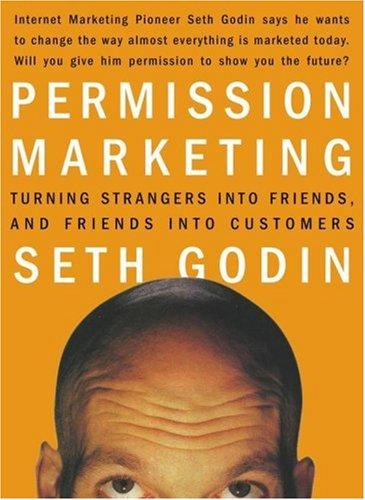
Permission Marketing by Seth Godin is a 1999 business book about marketing, customer relationships, strategy. Interruption marketing is dying because attention is increasingly scarce and people have developed effective defenses against unwanted marketing messages.
Summary
Permission Marketing is Seth Godin's 1999 manifesto arguing that the dominant marketing model — interruption, buying attention, broadcasting to audiences who didn't ask — is fundamentally broken and becoming more broken. Published before social media and before the full rise of email marketing, the book anticipated the attention scarcity problem that would define digital marketing over the next two decades.
The core contrast is between interruption marketing — the model of traditional advertising, which interrupts people with messages they didn't ask for — and permission marketing, which earns the right to communicate with people who have opted in. Permission marketing is anticipated, personal, and relevant: customers expect to hear from you, the message is specific to them, and it is relevant to their current situation. Interruption marketing is unanticipated, impersonal, and often irrelevant.
Godin argues that building a permission asset — an audience that has consented to hear from you — is one of the most valuable things a business can do, because it creates a direct channel to customers that doesn't require buying attention every time you have something to say. The permission asset is also durable: it survives changes in advertising platforms and media environments. But permission is fragile — it can be revoked when you send something irrelevant or unexpected, and it must be maintained through consistent delivery of genuine value.
Published in 1999, the book is sometimes labeled as the intellectual foundation for email marketing. That framing undersells it. The permission framework applies to any channel where customer consent creates the relationship: email, push notifications, content subscriptions, community membership. Read in 2026, the book feels both prescient — the attention scarcity Godin identified has only intensified — and in some ways superseded by the practical mechanics of modern permission marketing, which have become far more sophisticated than the book describes.
Talk to Permission Marketing like its author wrote you back.
Get the ideas that fit your life — not generic summaries.
- Chat with the book
- Audiobook-style main ideas
- Adapts to your life and goals
- Helps you take action
Key takeaways
- 1.
Interruption marketing is dying because attention is increasingly scarce and people have developed effective defenses against unwanted marketing messages.
- 2.
Permission marketing earns the right to communicate with customers who have opted in. The messages are anticipated, personal, and relevant — the opposite of broadcast advertising.
- 3.
A permission asset — an audience that has consented to hear from you — is one of the most durable competitive advantages a business can build, because it doesn't depend on buying attention every time.
- 4.
Permission exists on a spectrum. True permission (an explicit opt-in) is more valuable than inferred permission (someone bought from you once). Managing the permission level determines whether your communications add or destroy value.
- 5.
The goal of a permission marketing program is to convert strangers into friends and friends into customers. Each message should either deepen the permission or exchange it for a transaction.
- 6.
Permission can be revoked. Sending irrelevant, too-frequent, or unexpected messages erodes the trust that permission is built on, and re-earning it is harder than maintaining it.
- 7.
Every marketing channel has permission economics. Even traditional advertising can be permission-based if it consistently delivers value to an audience that seeks it out.
- 8.
The biggest mistake in permission marketing is treating permission as free. Acquired permission has economic value; sending low-quality messages to a high-quality list is destruction of that value.
Discussion questions
Use these on your own, with a book club, or as chat starters in Superbook. Book club version, ready to copy or print →
- 1.
Godin wrote this in 1999, before social media, smartphones, and modern email marketing. What aspects of his argument have been vindicated by what has happened since, and what has he gotten wrong?
- 2.
What is the permission asset of a business you admire? How do they maintain and expand it without exploiting it?
- 3.
Godin distinguishes anticipated, personal, and relevant as the three characteristics of permission marketing. Which of these is hardest to achieve at scale, and why?
- 4.
Where in your own life have you granted permission to a business that has violated it? What did they do, and what did you do in response?
- 5.
How does the permission framework apply to social media, where platforms can algorithmically reach people who haven't opted in to your specific messages?
- 6.
What is the difference between a customer who opted in to your email list and one who bought from you once? How should you treat them differently?
- 7.
Godin says the goal is to turn strangers into friends and friends into customers. What does 'friend' mean in a business context, and what are the limits of that metaphor?
- 8.
What would a permission-first marketing budget look like? How would it be allocated differently from a typical interruption-based budget?
- 9.
The attention economy has intensified since 1999. Does the increasing scarcity of attention make Godin's argument more compelling or does it change the nature of the problem?
- 10.
When is interruption marketing still rational? What conditions make buying unwanted attention worthwhile despite the declining effectiveness Godin describes?
- 11.
How does content marketing relate to permission marketing? Is content marketing permission marketing, or is it a form of interruption that earns permission?
Themes
Frequently asked questions
-
Is Permission Marketing still worth reading?
Yes, as a foundational text for understanding why email lists, content subscribers, and community members are more valuable than paid audience reach. The specific mechanics are outdated, but the conceptual framework is the foundation for most modern content marketing thinking.
-
What is the main argument of Permission Marketing?
That buying attention through interruption advertising is becoming increasingly expensive and ineffective, and that the alternative — earning the right to communicate with customers who have opted in — creates more durable, efficient marketing relationships.
-
How does Permission Marketing relate to Godin's later work?
Permission Marketing introduced the concept of earning rather than buying attention. This Is Marketing (2018) is the mature elaboration of the same theme, with more nuance and updated examples. Purple Cow and Tribes extend related ideas about remarkability and community. Permission Marketing is the foundational text that all the others build on.
-
Is permission marketing the same as email marketing?
Email is the most obvious channel for permission marketing, but the concept is broader. Any channel where the customer has consented to receive communications — app notifications, content subscriptions, community membership — is permission marketing. Godin's framework predates much of modern email marketing but anticipated its dynamics.
-
Does Permission Marketing apply to B2B?
Yes. B2B permission assets — thought leadership content, newsletter subscribers, event communities — work exactly as Godin describes. Many B2B companies have built substantial competitive advantages through permission assets that make outbound sales less necessary.
Similar books
This Is Marketing: You Can't Be Seen Until You Learn to See
Seth Godin
Purple Cow: Transform Your Business by Being Remarkable
Seth Godin

Contagious: Why Things Catch On
Jonah Berger
Building a StoryBrand
Donald Miller
