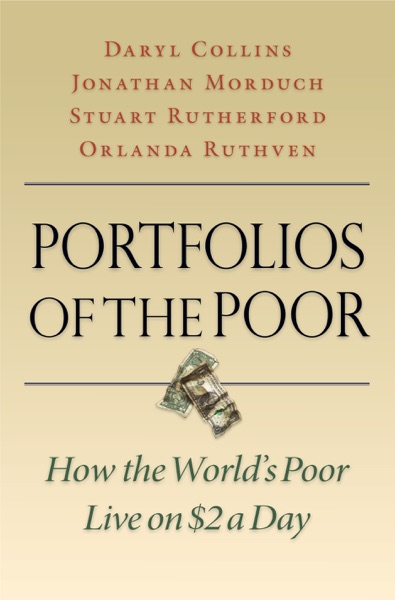
Portfolios of the Poor by Daryl Collins, Jonathan Morduch, Stuart Rutherford, and Orlanda Ruthven is a 2009 economics book about poverty and finance, financial behavior, microfinance. Poor households manage complex financial portfolios using informal instruments — savings clubs, moneylenders, informal insurance arrangements — not from necessity alone but from active financial management.
Summary
Portfolios of the Poor is one of the most methodologically unusual books in development economics. Rather than modeling the finances of poor households from national statistics, the authors spent a year working with 250 households in Bangladesh, India, and South Africa, collecting detailed financial diaries — records of every financial transaction, week by week, for twelve months. The result is a portrait of financial life among people living on roughly two dollars a day that contradicts most of what casual observers assume.
The central finding is that poor households are not financially passive or simple. They manage complex portfolios of informal instruments — saving with neighbors, borrowing from moneylenders, participating in rotating savings clubs, taking insurance-like arrangements with relatives — and they do so with considerable sophistication and at significant cost. The challenge is not that they don't engage with finance but that the instruments available to them are unreliable, expensive, and calibrated to needs that don't match their actual situation.
The financial diaries reveal a fundamental mismatch: the income of poor households is irregular and unpredictable, but their financial needs — school fees, medical emergencies, marriages, funerals — arrive at specific times in specific amounts. Managing that mismatch is the core financial problem of poverty, and the existing tools are poorly suited to it. A poor household might simultaneously owe money at high interest to a moneylender while holding savings in a rotating club — not from irrationality but because each instrument serves a different timing need.
The policy implications are significant and cut against the prevailing microfinance consensus of the time. Microcredit — small loans for small enterprise — was the dominant development finance intervention. The diaries suggested that poor households' primary need was not credit but reliable, flexible savings and insurance instruments that could absorb the volatility of irregular income. The book did not reject microfinance but reframed what the tools should actually be designed to do. It remains one of the most careful and surprising accounts of how financial life actually works for the majority of the world's population.
Talk to Portfolios of the Poor like its author wrote you back.
Get the ideas that fit your life — not generic summaries.
- Chat with the book
- Audiobook-style main ideas
- Adapts to your life and goals
- Helps you take action
Key takeaways
- 1.
Poor households manage complex financial portfolios using informal instruments — savings clubs, moneylenders, informal insurance arrangements — not from necessity alone but from active financial management.
- 2.
The core financial problem of poverty is volatility, not just low average income. Managing unpredictable income against predictable, timed obligations requires sophisticated financial instruments.
- 3.
Poor households simultaneously borrow at high interest and hold low-return savings — a pattern that looks irrational from the outside but reflects the different timing functions each instrument serves.
- 4.
The financial instruments available to poor households are expensive, unreliable, and badly calibrated to their actual needs — particularly for savings and insurance.
- 5.
Microcredit's emphasis on small business loans missed the most pressing financial need revealed by the diaries: reliable, flexible savings instruments to manage cash flow.
- 6.
Informal finance — rotating savings clubs, neighborhood money-keepers — provides real value, but is fragile. The failure of informal instruments can be catastrophic at the household level.
- 7.
Understanding what financial services poor households actually need requires close observation of behavior, not modeling based on assumptions about what they should want.
- 8.
Financial diaries as a methodology — tracking all transactions week by week for a year — revealed patterns that neither surveys nor one-time interviews could have shown.
Discussion questions
Use these on your own, with a book club, or as chat starters in Superbook. Book club version, ready to copy or print →
- 1.
The authors find that poor households are sophisticated financial managers. Does that finding change your prior assumptions about the relationship between poverty and financial behavior?
- 2.
The core problem is volatility, not just low income. How does that reframe what useful financial services for low-income households should look like?
- 3.
Many of the informal instruments described — rotating savings clubs, neighborhood money-keepers — exist in some form in wealthy countries too. What formal instruments replaced them for most people, and why haven't those replacements reached everyone?
- 4.
The simultaneous saving and borrowing pattern looks irrational by simple financial logic. What does it reveal about the limits of financial models that optimize for a single variable?
- 5.
The financial diaries methodology involves deep relationships with participants and year-long data collection. What research questions require that level of commitment, and what are the tradeoffs?
- 6.
The book was critical of the microcredit orthodoxy without dismissing microfinance entirely. Is that kind of empirically-grounded critique of a widely accepted development intervention common, and why or why not?
- 7.
Poor households pay high rates for unreliable financial services. How much of that cost reflects genuine market failure and how much reflects something else?
- 8.
The South African, Bangladeshi, and Indian households in the study face different formal financial environments. What would be lost by generalizing from any one to a universal picture?
- 9.
What would formal financial services designed around volatility management rather than credit access actually look like?
- 10.
The authors note that informal instruments provide real value but are fragile. What conditions determine whether informal institutions are complementary to or undermined by formal ones?
- 11.
How does the financial diary methodology change what is knowable, compared to surveys, interviews, or administrative data?
- 12.
The policy window for acting on findings like these is narrow. What happens to careful empirical development research when the policy environment has moved on?
Themes
Frequently asked questions
-
What is Portfolios of the Poor about?
It's a study of how very poor households in Bangladesh, India, and South Africa actually manage their money, based on detailed financial diaries collected week by week for a year. The central finding is that poor households manage complex financial portfolios and that their primary need is reliable savings and insurance tools, not credit.
-
Is this book only relevant to development economists?
No. The financial diaries methodology and the core findings about how people manage cash flow volatility are relevant to anyone thinking about consumer finance, financial product design, or the relationship between income volatility and financial behavior. The lessons apply in wealthy countries too.
-
How long is Portfolios of the Poor?
About 300 pages — roughly six hours. The methodological appendix is worth reading if you're interested in the diary approach.
-
What did the book reveal about microcredit?
That small business loans — the dominant form of microfinance at the time — addressed a real but narrower need than proponents claimed. Poor households' most pressing financial challenge was managing cash flow volatility, which required savings and insurance instruments more than credit.
-
Who should read Portfolios of the Poor?
Development economists, anyone designing financial products for low- or middle-income consumers, policymakers in financial inclusion, and readers interested in how careful empirical research can overturn well-meaning assumptions about what poor people need.
Similar books
Dead Aid: Why Aid Is Not Working and How There Is a Better Way for Africa
Dambisa Moyo
Poverty, by America
Matthew Desmond
The Wealth and Poverty of Nations
David S. Landes
Basic Economics: A Common Sense Guide to the Economy
Thomas Sowell
