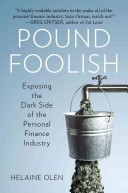
Pound Foolish by Helaine Olen is a 2012 economics book about personal finance industry, financial media, consumer behavior. Personal finance advice systematically attributes financial insecurity to individual behavior while downplaying structural factors: stagnant wages, healthcare costs, housing, and financial system complexity.
Summary
Helaine Olen's Pound Foolish is a sustained critique of the personal finance industry — its bestselling authors, its television personalities, its seminars, and the underlying ideology that suggests individual financial decisions are primarily responsible for financial security or its absence. Olen, a journalist who had previously written a personal finance column herself, turned against the genre after interviewing its gurus and examining the evidence behind their claims.
The book targets specific figures, most prominently Suze Orman and David Bach, analyzing their advice against the actual financial outcomes of the people who follow it. Olen's core argument is that personal finance advice systematically overstates how much individual behavior can compensate for structural problems — stagnant wages, rising housing costs, healthcare costs, and a financial system that extracted enormous value from ordinary people through complex products and hidden fees. The latte factor, for instance, suggests that giving up small daily luxuries can produce significant wealth. Olen shows that the math works only if you ignore that the savings are too small to matter against the scale of the real financial problems most Americans face.
The middle sections cover specific industries: the seminar circuit, the retirement industry, and financial television. The retirement chapters are particularly pointed. Olen documents how the shift from defined benefit pensions to 401(k) plans transferred investment risk from employers and professional fund managers to individuals, who were then sold mutual funds with high fees and educated about their choices through marketing rather than independent research. The result was a system that generated enormous profits for financial services firms while producing worse retirement outcomes for most workers.
The book is a work of journalism and advocacy rather than a balanced academic analysis. Olen is clearly angry, and her case sometimes flattens nuance. The critique of individual behavior as a driver of outcomes is compelling when applied to people in genuine financial difficulty; it's less persuasive as a blanket dismissal of all financial self-improvement. Still, as a corrective to an industry that rarely examines its own claims, Pound Foolish is useful and well-researched.
Talk to Pound Foolish like its author wrote you back.
Get the ideas that fit your life — not generic summaries.
- Chat with the book
- Audiobook-style main ideas
- Adapts to your life and goals
- Helps you take action
Key takeaways
- 1.
Personal finance advice systematically attributes financial insecurity to individual behavior while downplaying structural factors: stagnant wages, healthcare costs, housing, and financial system complexity.
- 2.
The 'latte factor' and similar advice is mathematically trivial against the scale of real financial problems. Small savings compound only if the underlying income and expense structure permits accumulation.
- 3.
The shift from defined benefit pensions to 401(k) plans transferred investment risk to individuals while creating a lucrative fee structure for financial services firms.
- 4.
Many personal finance celebrities have faced regulatory actions, bankruptcy proceedings, or conflicts of interest that receive little coverage in the same media that amplifies their advice.
- 5.
Financial products marketed to middle-class investors — complex annuities, whole life insurance, loaded mutual funds — often serve the seller's interests more clearly than the buyer's.
- 6.
Investing literacy among individual Americans is poor, and financial services firms benefit from that gap rather than working to close it.
- 7.
The seminar industry — real estate workshops, wealth creation events — generates revenue primarily by selling hope and follow-on products rather than producing verifiable financial outcomes for attendees.
- 8.
Most personal finance advice implicitly assumes the reader has disposable income to redirect. For the majority of Americans living close to the financial edge, the advice assumes away the actual problem.
Discussion questions
Use these on your own, with a book club, or as chat starters in Superbook. Book club version, ready to copy or print →
- 1.
Olen argues that individual financial behavior matters less than structural factors. Is that a reason to disengage from personal financial decision-making, or does it change what you should focus on?
- 2.
The latte factor has become widely cited as good advice. After reading Olen's critique, do you find the math convincing, unconvincing, or somewhere in between?
- 3.
She argues that 401(k) plans were a net negative for most workers compared to defined benefit pensions. Is there a version of the 401(k) system that you think could work better?
- 4.
Olen is a journalist who used to write personal finance columns. How does that history affect your confidence in her critique? Does someone need to be a former believer to effectively critique an industry?
- 5.
The book targets specific figures like Suze Orman and David Bach. Is it fair to hold popular authors to the standard of financial research, or are they offering inspiration rather than analysis?
- 6.
Most personal finance advice focuses on what individuals should do. What would financial advice that took structural factors seriously look like in practice?
- 7.
Financial literacy programs in schools are widely advocated. Olen is skeptical of their effectiveness. What evidence would convince you either way?
- 8.
The book implies that high mutual fund fees are a form of extraction. How do you determine whether a financial product's fees are proportionate to its value?
- 9.
Olen critiques financial television for generating conflict and excitement rather than useful advice. How much of your financial information comes from media, and how do you evaluate it?
- 10.
She describes attending wealth-creation seminars. What would make a consumer vulnerable to those environments, and what would protect them?
- 11.
If personal finance advice is largely ineffective against structural financial problems, what should individuals actually do with their energy and attention?
- 12.
Olen's argument is most persuasive for people with limited resources. Does the critique apply differently to people with above-average incomes?
Themes
Frequently asked questions
-
Is Pound Foolish worth reading if you follow personal finance advice?
Yes, specifically because of that. The book doesn't argue that all personal financial decisions are irrelevant, but it does force you to examine which claims are backed by evidence and which are repeated because they sell books. Readers who finish it skeptical of easy promises have gotten the main benefit.
-
Does Olen offer alternative financial advice?
Only implicitly. She advocates for structural changes — stronger retirement system regulation, fiduciary standards for financial advisors, caps on mutual fund fees — rather than individual strategies. Readers looking for a personal action plan will need to look elsewhere. The book is a critique, not a replacement.
-
How long does it take to read?
Around four to five hours. It's journalistic in style and moves through specific case studies, so the pace is relatively quick. The most substantive chapters are those on the retirement industry and the financial crisis, which reward slower reading.
-
Who should read this book?
Anyone who has felt vaguely uncomfortable with personal finance advice but couldn't articulate why. Also useful for financial advisors who want to understand how their industry looks from a critical outside perspective. It's not for readers looking for investment strategies.
-
Is the book politically biased?
Olen's analysis is sympathetic to structural and systemic explanations for financial difficulty, which aligns with center-left political economy. Readers who believe individual responsibility is the primary driver of financial outcomes will find her framing reductive. The factual claims about specific products and individuals are generally well-sourced regardless of where readers fall politically.