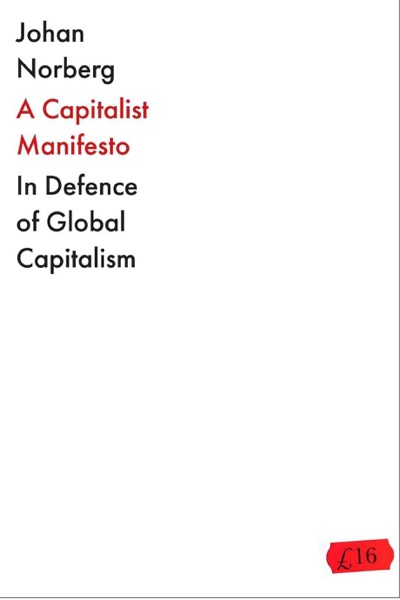
The Capitalist Manifesto: Why the Global Free Market Will Save the World by Johan Norberg is a 2023 economics book about free markets, global trade, poverty reduction. Global extreme poverty has fallen from roughly 90% of humanity two centuries ago to under 10% today, a reduction driven primarily by market-led growth.
Summary
Johan Norberg has made a career of making the case that open markets have lifted more people out of poverty than any other force in human history, and The Capitalist Manifesto is his most direct statement of that argument. Writing against a tide of popular disillusionment with globalization and corporate power, Norberg argues that the critics of capitalism are largely criticizing the deviations from free markets — cronyism, rent-seeking, regulatory capture — rather than markets themselves. His target is the conflation of capitalism with the failings of political economy.
The book moves through a series of empirical claims: that global poverty has fallen dramatically over the past two centuries in direct proportion to the spread of market exchange; that innovation and entrepreneurship require decentralized price signals that no planning authority can replicate; that trade creates positive-sum outcomes by allowing specialization; and that the material improvements of ordinary life — longer lives, cheaper food, more varied goods — are products of the market system. Norberg draws on data from the World Bank, Hans Rosling's work, and economic historians like Deirdre McCloskey to build the picture.
Critics of the book argue that Norberg downplays the role of state investment in generating the conditions for growth, understates inequality within countries even as cross-country inequality falls, and is too quick to attribute progress solely to markets rather than to mixed economies with strong public institutions. The distributional question — who gains, who loses, and on what timeline — receives less attention than the aggregate story. Readers should hold both the headline numbers and the distribution simultaneously.
What Norberg offers that more polemical defenses of capitalism often lack is a willingness to engage with the data rather than retreat to first principles. Whether his interpretation of that data is fully persuasive is a legitimate debate, but the empirical grounding lifts the book above most entries in the genre. For readers who have absorbed critiques of capitalism and want to encounter the strongest counter-case, this is a reasonable starting point.
Talk to The Capitalist Manifesto: Why the Global Free Market Will Save the World like its author wrote you back.
Get the ideas that fit your life — not generic summaries.
- Chat with the book
- Audiobook-style main ideas
- Adapts to your life and goals
- Helps you take action
Key takeaways
- 1.
Global extreme poverty has fallen from roughly 90% of humanity two centuries ago to under 10% today, a reduction driven primarily by market-led growth.
- 2.
Critics who attack capitalism are often attacking cronyism and state-granted monopolies — forms of market interference — rather than competitive free exchange.
- 3.
Prices are information. Decentralized markets aggregate and communicate knowledge that no central authority can collect, making them more adaptive than planning.
- 4.
Trade is positive-sum: specialization allows countries and individuals to produce what they do relatively better, raising total output for all parties.
- 5.
Innovation requires risk, failure, and decentralized experimentation. Economies that allow failure as well as reward success generate more progress than those that protect incumbents.
- 6.
The dramatic improvements in human material life — from life expectancy to caloric intake — track closely with the spread of open markets and global trade.
- 7.
Inequality in income within countries is a real concern, but inequality across countries has fallen sharply as poor nations have grown faster than rich ones.
- 8.
The alternative to imperfect markets is not perfect planning but imperfect politics. Norberg argues the comparison must be realistic on both sides.
Discussion questions
Use these on your own, with a book club, or as chat starters in Superbook. Book club version, ready to copy or print →
- 1.
Norberg distinguishes cronyism from capitalism. In practice, how separable are those two things in democratic systems where business interests fund politics?
- 2.
The book documents aggregate poverty reduction. How much should distributional outcomes — who specifically benefits and who is left behind — shape how we evaluate a system?
- 3.
Which pieces of evidence in Norberg's empirical case did you find most persuasive? Which felt most like selection or framing?
- 4.
If markets require property rights, contract enforcement, and rule of law to function, what does that imply about market outcomes in states that lack those institutions?
- 5.
Norberg argues innovation requires allowing failure. What industries or sectors in your own country seem most insulated from competitive failure, and what are the consequences?
- 6.
How do you weigh Norberg's aggregate-growth story against the experience of communities that were disrupted by trade and did not share equally in the gains?
- 7.
Is there a version of the anti-capitalism critique that Norberg takes most seriously? Do you think he addresses it adequately?
- 8.
The book draws heavily on economic historians. How much does it matter whether historical causal claims about markets and growth are contested by other historians?
- 9.
Norberg compares market outcomes to political alternatives. Is 'realistic alternatives' the right benchmark, or should we judge a system against some achievable ideal?
- 10.
Which aspects of global progress do you believe are attributable to markets, and which to other forces — scientific advancement, public health infrastructure, political stability?
- 11.
How does the book's argument hold up in sectors where markets have historically failed — public health, climate, financial stability?
- 12.
Norberg is Swedish, writing in a tradition of pro-market Nordic authors. Does the Swedish context of strong social institutions alongside open markets complicate or support his argument?
Themes
Frequently asked questions
-
What is The Capitalist Manifesto about?
It is Norberg's argument that free markets, not government planning or political intervention, are responsible for the dramatic reduction in global poverty and the improvements in human welfare over the past two centuries. He defends capitalism while distinguishing it from cronyism and corporate privilege.
-
Is The Capitalist Manifesto worth reading?
Yes, if you want the strongest contemporary empirical case for open markets assembled in one place. It is more data-driven than ideological, though readers should also seek out critiques of its framing — particularly on distribution and the role of public institutions.
-
What is the main criticism of this book?
That Norberg attributes too much of global progress to markets alone, understates inequality within countries, and does not adequately grapple with market failures in areas like climate change and financial systems. Critics argue mixed economies with strong public sectors deserve more credit.
-
Who should read The Capitalist Manifesto?
People who are skeptical of capitalism and want to engage with its best defense, economists and students looking for a synthesis of the empirical case for markets, and readers who enjoyed Hans Rosling's Factfulness and want to explore the economic argument behind the progress data.
-
How does this compare to Norberg's earlier book Progress?
Progress covers similar empirical ground about human improvement but is broader in scope. The Capitalist Manifesto is more focused on making the explicit economic and political argument that markets drive that progress, and is more directly polemical in engaging with capitalism's critics.
Similar books
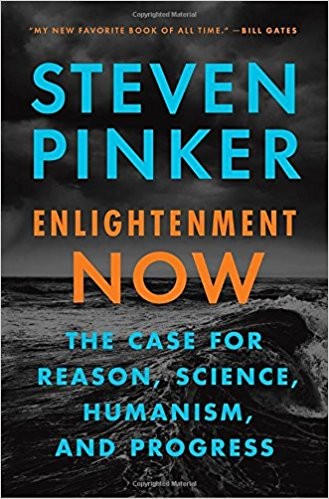
Enlightenment Now
Steven Pinker
Why Nations Fail: The Origins of Power, Prosperity, and Poverty
Daron Acemoglu and James A. Robinson
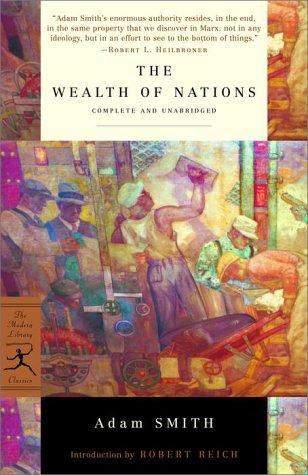
The Wealth of Nations
Adam Smith

Guns, Germs, and Steel
Jared Diamond
