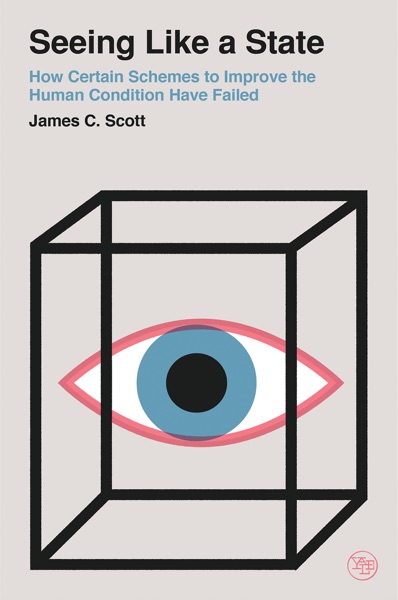
Seeing Like a State by James C. Scott is a 1998 politics book about legibility, state power, modernism and planning. States simplify complex realities to make them legible — measurable, taxable, administrable. This simplification is not just descriptive; it actively reshapes the world it describes, often destroying functional complexity.
Summary
James C. Scott's 1998 book asks a simple question: why have so many ambitious state-led improvement schemes — collectivized agriculture in the Soviet Union, rational urban planning in Brasilia, scientific forestry in Prussia, villagization in Tanzania — failed so catastrophically? His answer centers on a single concept: legibility. States survive and function by making their territories and populations readable — measurable, taxable, conscriptable, manageable. The drive to make the world legible to central planners systematically destroys the local, informal, complex knowledge that made it work in the first place.
Scott illustrates this with cases that are individually compelling and collectively devastating. The Prussian scientific forestry movement of the eighteenth century replaced diverse, complex forest ecosystems with monoculture timber plantations. The forests were legible — uniform rows, measurable yields — and initially highly productive. A generation later, the Waldsterben (forest death) arrived: pests, soil degradation, and the collapse of the ecological complexity the monoculture had eliminated. The same pattern recurs in urban planning: Haussmann's Paris and Le Corbusier's designs eliminated the "illegible" complexity of organic cities and replaced it with rational, imposing, human-scale-destroying order that has been largely rejected wherever it was implemented.
The second half of the book turns to high modernism's most violent expressions: the collectivization campaigns in the Soviet Union, Julius Nyerere's villagization program in Tanzania, and the "scientific agriculture" campaigns that destroyed traditional farming knowledge across the developing world. Scott introduces the concept of metis — the Greek term for practical, experiential knowledge accumulated over generations — to describe what planners cannot see and therefore systematically destroy. Metis is irreducibly local, context-dependent, and resistant to codification. The tragedy of high modernist planning is that it confidently replaces functioning metis with untested theory.
Scott is not arguing against states or planning. His prescriptions are modest: that planners should build in feedback, maintain reversibility, preserve local knowledge and agency, and distrust schemes that require eliminating diversity to implement. The book's most enduring concept — "legibility" as a lens for understanding institutional behavior — has been adopted far beyond political science, into urban planning, software engineering, and organizational theory.
Talk to Seeing Like a State like its author wrote you back.
Get the ideas that fit your life — not generic summaries.
- Chat with the book
- Audiobook-style main ideas
- Adapts to your life and goals
- Helps you take action
Key takeaways
- 1.
States simplify complex realities to make them legible — measurable, taxable, administrable. This simplification is not just descriptive; it actively reshapes the world it describes, often destroying functional complexity.
- 2.
High modernism is the ideology that confident application of scientific knowledge and rational planning can redesign human settlements, agriculture, and society for the better. It has a consistent record of failure at scale.
- 3.
Metis is practical, local, experiential knowledge that cannot be easily codified or transferred. It is systematically devalued and destroyed by planning processes that privilege formal, scientific knowledge.
- 4.
Monoculture — in forestry, agriculture, or urban design — appears efficient and rational but is fragile. Diversity, even when apparently wasteful, provides resilience that monocultures lack.
- 5.
Top-down plans fail not because planners are stupid but because the information required to make them work is distributed, local, and tacit. No central authority can gather it.
- 6.
Authoritarian high modernism — combining state power, the ideology of progress, and a prostrate civil society — produces the worst outcomes. Any two of the three can be managed; all three together is catastrophic.
- 7.
The legibility demands of states have shaped not just landscapes but language, law, and personal identity. Surnames, cadastral surveys, and standardized weights and measures all arose from state legibility needs.
- 8.
Feedback and reversibility are the most important features of any large-scale intervention. The failure of high modernist schemes is often locked in because the interventions destroy the ability to return to what preceded them.
Discussion questions
Use these on your own, with a book club, or as chat starters in Superbook. Book club version, ready to copy or print →
- 1.
Scott argues that the drive to make things legible is an intrinsic feature of state power. Where in your professional life do you experience the simplifications that institutions impose to make things manageable?
- 2.
Metis — local, tacit, experiential knowledge — is systematically destroyed by top-down planning. Think of a domain where you hold metis. How would you describe it to someone who had to make a policy about it?
- 3.
The high modernist cities — Brasilia, Chandigarh — were designed rationally but often feel dead. What makes a city or neighborhood feel alive, and how does Scott's framework explain it?
- 4.
Scott says monocultures appear efficient but are fragile. Can you think of professional, organizational, or social equivalents of monoculture, and what the equivalent of the Waldsterben might look like?
- 5.
The book's most disturbing cases involve states destroying the practical knowledge of farmers and communities with no malice, just overconfidence. What institutional checks would slow that process?
- 6.
Scott distinguishes between the formal economy and the informal practical order that underlies it. What informal practical orders make your workplace or community function that would survive badly if bureaucratized?
- 7.
High modernism required civil societies too weak to resist. What does a civil society strong enough to resist well-intentioned bad planning actually look like in practice?
- 8.
The concept of legibility has been applied to software systems, management, and urban design. Where do you see the legibility-versus-complexity tradeoff playing out in a domain you know well?
- 9.
Scott is broadly sympathetic to anarchism in his conclusions. Does that sympathy seem like an honest intellectual conclusion or a motivated one?
- 10.
The Tanzanian villagization example was driven by genuine concern for rural welfare. At what point does good intention stop being an excuse for catastrophic policy?
- 11.
Scott's prescriptions are modest — build in feedback, maintain reversibility, preserve local knowledge. Are those prescriptions enough, or do they just slow the failure?
- 12.
Which of Scott's cases do you find most relevant to something going on in public policy or organizational life right now?
Themes
Frequently asked questions
-
Is Seeing Like a State worth reading?
Yes — it is one of those books whose central concept (legibility) is so useful that readers apply it immediately to things they already know. It is long and somewhat academic in places, but the case studies are individually gripping and the core argument is genuinely illuminating.
-
How long does it take to read Seeing Like a State?
About nine to ten hours at average reading pace. The book is dense and rewards slow reading. The early chapters on scientific forestry and urban planning are more accessible; the chapters on agricultural collectivization are heavier.
-
What is the main argument of Seeing Like a State?
That the state's need to make its territory and population legible — measurable and manageable — leads it to systematically simplify complex realities, and that this simplification destroys the local, informal, practical knowledge (metis) that made those realities function.
-
Who should read this book?
Policy makers, urban planners, organizational designers, software architects, and anyone interested in why large-scale top-down plans so consistently fail. Also for readers interested in political science, anarchism, and the unintended consequences of institutional power.
-
Is the book politically biased?
Scott draws examples from both left and right state failures — Soviet collectivization and Le Corbusier-influenced urban renewal in Western cities both appear. His sympathies lean anarchist but the empirical argument is not partisan. Readers across the political spectrum have found it useful.
Similar books
Antifragile: Things That Gain from Disorder
Nassim Nicholas Taleb
Thinking in Systems
Donella H. Meadows

The Death of Ivan Ilyich
Leo Tolstoy
Why Nations Fail: The Origins of Power, Prosperity, and Poverty
Daron Acemoglu and James A. Robinson
