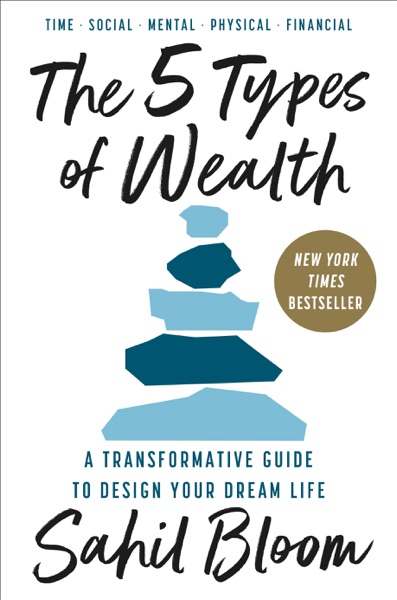
The 5 Types of Wealth by Sahil Bloom is a 2025 self-help book about wealth, life design, time. Financial wealth is one of five types of wealth. The others — time, social, mental, and physical — are equally real and often more important to daily quality of life.
Summary
The 5 Types of Wealth is Sahil Bloom's argument that financial wealth is one of five forms of wealth that actually matter, and that pursuing financial wealth at the expense of the other four produces a life that looks successful from the outside but feels hollow from the inside. The five types Bloom identifies are financial, time, social, mental, and physical — and his central claim is that most people optimize aggressively for one (usually financial) while neglecting the others, and then wonder why they don't feel as rich as their bank account suggests.
Bloom writes from personal experience. He spent years in private equity working long hours for high compensation before a conversation with his dying grandfather made him reconsider what he was building. His grandfather had material comfort but had spent decades prioritizing work over presence, and the regret was visible. That story runs through the book as a recurring anchor: wealth that you can't spend on anything that actually matters isn't wealth.
The book is structured around each type of wealth in turn, with practical frameworks for auditing and improving each. Time wealth is about protecting non-negotiable blocks of unscheduled time. Social wealth is about identifying the people who matter most and investing in those relationships deliberately rather than managing a large, thin network. Mental wealth is about psychological security — the freedom from fear and anxiety that comes from knowing who you are and what you value. Physical wealth is health as a foundation, not a vanity project.
Bloom has a large social media following and the book shows that influence. The writing is accessible, warm, and personal. It doesn't make original arguments so much as synthesize existing wisdom — Stoic philosophy, modern psychology, and life advice from successful people — into a framework that works as a practical guide. Readers who have already absorbed the personal finance canon will find some sections familiar. Those coming to these ideas for the first time will find the integration unusually readable.
Talk to The 5 Types of Wealth like its author wrote you back.
Get the ideas that fit your life — not generic summaries.
- Chat with the book
- Audiobook-style main ideas
- Adapts to your life and goals
- Helps you take action
Key takeaways
- 1.
Financial wealth is one of five types of wealth. The others — time, social, mental, and physical — are equally real and often more important to daily quality of life.
- 2.
Optimizing aggressively for financial wealth while neglecting the other four produces the 'success trap': a life that looks rich from the outside and feels poor from the inside.
- 3.
Time wealth requires protecting non-negotiable unscheduled blocks. Filling every hour is a form of poverty regardless of what you're being paid for the hours.
- 4.
Social wealth comes from depth, not breadth: a small number of deeply invested relationships outweighs a large, shallow network for both happiness and practical support.
- 5.
Mental wealth is psychological security — knowing your values and being free from the anxiety of seeking external validation. It compounds when you stop optimizing for other people's approval.
- 6.
Physical wealth is the foundation that makes the other four sustainable. Neglecting health doesn't save time; it borrows from the future at high interest.
- 7.
Most people's financial plans have no answer to the question 'how much is enough?' Without a target, the accumulation continues past the point of diminishing returns.
- 8.
Deathbed regret inventories — studies on what people wish they'd done differently — consistently point to the same categories: more time with family, less time working, more presence.
Discussion questions
Use these on your own, with a book club, or as chat starters in Superbook. Book club version, ready to copy or print →
- 1.
Bloom's framework has five types of wealth. If you had to rank them by how much you currently invest in each, what does that ranking reveal?
- 2.
The 'success trap' describes achieving financial goals while feeling unfulfilled. Have you seen this in people you know, and what produced it?
- 3.
Time wealth requires saying no to things that seem valuable but consume unscheduled time. What would you need to decline to create genuine time wealth in your life?
- 4.
Bloom argues social wealth comes from depth rather than breadth. Which of your relationships deserve significantly more investment than you're currently making?
- 5.
Mental wealth is described as freedom from the anxiety of seeking approval. What approval are you currently seeking that isn't actually yours to want?
- 6.
The book anchors in a story about regret — Bloom's grandfather with financial comfort and relational regret. What do you think you'll regret if you don't change something now?
- 7.
Physical health is framed as foundational. What health habit, if you built it now, would have the greatest downstream effect on your other types of wealth?
- 8.
Bloom synthesizes ideas from Stoicism, psychology, and personal finance. Does the synthesis add something, or does it smooth out the edges of ideas that need their edges?
- 9.
The question 'how much is enough?' doesn't have a universal answer, but Bloom argues most people haven't thought about their own answer. What's yours?
- 10.
The book is built partly on social media content that Bloom developed over years. Does knowing that change how you read it?
- 11.
Which of the five types of wealth is hardest to measure, and does that make it harder to prioritize?
- 12.
Bloom is relatively young and writing partly from personal transformation rather than decades of accumulated wisdom. Does that limit the authority of the book, or does it make it more credible?
Themes
Frequently asked questions
-
What is The 5 Types of Wealth about?
It argues that financial wealth is one of five forms of wealth that matter — alongside time, social, mental, and physical — and that most people over-optimize for financial wealth at the expense of the others, producing a life that looks successful but feels hollow.
-
Is The 5 Types of Wealth worth reading?
Yes, especially if you're early in your career or at a moment of reassessment. The integration of multiple frameworks into one readable system is the book's primary value. Readers already familiar with Stoicism, personal finance, and psychology will find the ideas familiar but the synthesis useful.
-
How does this compare to other life design books?
It sits close to Die With Zero and Four Thousand Weeks in theme. Bloom is more actionable and warmer in tone than either; less philosophically rigorous than Burkeman, less quantitative than Perkins. It's the most accessible of the three.
-
Is this a personal finance book?
Partly, but the financial sections are brief. Bloom's argument is that personal finance frameworks that ignore the other four types of wealth are incomplete. Readers looking specifically for financial planning guidance should look elsewhere.
-
Who should read this book?
People feeling successful on conventional metrics but dissatisfied in ways they can't articulate. Also useful for anyone early in their career who wants to build a life design framework before the default one gets locked in. Less useful for readers who've already done significant work on life values and purpose.
Similar books
Four Thousand Weeks: Time Management for Mortals
Oliver Burkeman
Die with Zero
Bill Perkins
Essentialism: The Disciplined Pursuit of Less
Greg McKeown
Your Money or Your Life
Vicki Robin
