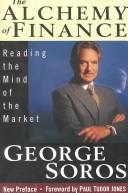
The Alchemy of Finance by George Soros is a 1987 economics book about financial markets, reflexivity, speculation. Reflexivity means market participants' beliefs influence the reality they observe, creating self-reinforcing feedback loops that drive boom-and-bust cycles rather than equilibrium.
Summary
The Alchemy of Finance is George Soros's attempt to explain both the theory behind his investment decisions and the practice of applying it during the years he ran the Quantum Fund. The book is famous for introducing the concept of reflexivity — the idea that market participants' beliefs about a situation affect the situation itself, which in turn changes those beliefs, creating feedback loops that standard economic theory ignores entirely.
Classical economics assumes that markets tend toward equilibrium, that prices reflect fundamentals, and that investors are rational. Soros argues this is wrong at a structural level. Participants don't observe market reality objectively; they participate in it. Their perceptions are partial, biased, and self-interested, and their decisions based on those perceptions alter the very reality they're trying to observe. This is the reflexive loop: perception shapes action, action shapes reality, reality shapes perception again. Boom-and-bust cycles aren't aberrations from an otherwise efficient market — they're the natural result of reflexivity operating without any corrective mechanism.
The second half of the book is a real-time experiment. Soros kept a diary during 1985–1986 and published it as a test of his theory. He makes predictions, explains his reasoning, and tracks how events unfolded. The result is messy and honest. Some calls were prescient, others were wrong, and Soros spends time explaining the cognitive failures as well as the successes. The Plaza Accord period and the dollar's devaluation are treated as case studies for reflexive theory in action. This section is demanding and rewards readers with some background in macroeconomics.
The book is not an easy read. Soros is a philosopher writing about finance, not a writing craftsman, and the prose in the theoretical sections is dense. But for readers willing to engage with it seriously, the payoff is a framework for thinking about markets that is genuinely different from what most finance books offer. The ideas about reflexivity — that markets amplify rather than correct biases, and that trend-following is rational precisely because trends are self-reinforcing up to the point of collapse — have influenced a generation of macro traders. It is most useful as a complement to behavioral economics texts, not a replacement for them.
Talk to The Alchemy of Finance like its author wrote you back.
Get the ideas that fit your life — not generic summaries.
- Chat with the book
- Audiobook-style main ideas
- Adapts to your life and goals
- Helps you take action
Key takeaways
- 1.
Reflexivity means market participants' beliefs influence the reality they observe, creating self-reinforcing feedback loops that drive boom-and-bust cycles rather than equilibrium.
- 2.
Classical economic theory assumes a world of rational agents moving toward equilibrium. Soros argues this model misses the most important dynamics of real markets.
- 3.
All market participants operate with partial, biased knowledge. There is no God's-eye view of fundamentals, only competing interpretations that themselves become market-moving forces.
- 4.
Trend-following is often rational: because beliefs are self-fulfilling up to a point, riding a trend is a valid strategy, but the reversal comes without warning and is typically sharp.
- 5.
The Quantum Fund's real-time diary shows how a theoretical framework gets applied and tested against messy reality — including cases where the theory failed to predict outcomes.
- 6.
Boom-bust cycles in credit markets, currencies, and equities follow a predictable reflexive arc: a self-reinforcing phase, followed by a tipping point, followed by collapse in the opposite direction.
- 7.
Economic policy, not just markets, is subject to reflexivity. Government interventions change the environment, which changes behavior, which requires further intervention.
- 8.
Soros distinguishes near-equilibrium conditions (where classical theory roughly applies) from far-from-equilibrium conditions (where reflexivity dominates and standard tools fail).
Discussion questions
Use these on your own, with a book club, or as chat starters in Superbook. Book club version, ready to copy or print →
- 1.
Soros argues that all market participants operate with fundamentally biased perceptions. Do you accept this premise? What would it mean for how you make financial decisions?
- 2.
The reflexivity concept challenges the idea that prices reflect fundamentals. What would it mean for investment strategy if prices are always distorted by participant psychology?
- 3.
Soros kept a real-time diary as a public test of his theory. What does that kind of intellectual honesty reveal about how to think rigorously about one's own frameworks?
- 4.
The boom-bust cycle Soros describes is self-reinforcing upward before it collapses. Where do you see that pattern operating right now in any market you follow?
- 5.
Soros argues trend-following is rational because trends are self-reinforcing. At what point does it stop being rational, and how would you know?
- 6.
How does reflexivity theory compare to behavioral economics as a way of explaining market irrationality? What does each framework capture that the other misses?
- 7.
The book was written in 1987, before the rise of algorithmic trading, index funds, and passive investing at scale. Does reflexivity apply differently in a market dominated by passive flows?
- 8.
Soros describes near-equilibrium versus far-from-equilibrium market conditions. How would you know which regime you're in, and does it matter for how you invest?
- 9.
The real-time trading diary is the most concrete part of the book. What does it tell you about the gap between having a good theory and actually profiting from it?
- 10.
Soros argues that economic policy itself is reflexive — interventions change behavior, which requires more intervention. Where do you see that dynamic playing out in today's economy?
- 11.
The book's title invokes alchemy — the pretense of turning base metals into gold. Is Soros saying his own method is somewhat illusory, or is he claiming genuine insight?
Themes
Frequently asked questions
-
What is the main idea of The Alchemy of Finance?
The book argues that markets are shaped by the reflexive interaction between participants' beliefs and market reality — each influences the other in a continuous feedback loop. This reflexivity produces boom-bust cycles that standard equilibrium economics cannot explain or predict.
-
Is The Alchemy of Finance worth reading for non-traders?
Yes, but selectively. The theoretical chapters on reflexivity are accessible and genuinely thought-provoking for anyone who thinks about economics or social systems. The real-time trading diary in the middle section requires comfort with macroeconomic concepts and is probably less useful for general readers.
-
How hard is The Alchemy of Finance to read?
Harder than most business books. Soros is writing as a philosopher, and the theoretical sections are dense. The prose is not especially fluent. Readers who push through are rewarded with a framework that has real explanatory power, but it takes effort.
-
How does this book relate to Nassim Taleb's work?
Both Soros and Taleb argue that mainstream financial economics systematically underestimates instability and fat-tail risk. Soros explains the feedback mechanism (reflexivity); Taleb focuses on the statistical properties of extreme events. Together they form a strong critique of the efficient market hypothesis.
-
Who should read The Alchemy of Finance?
Macro investors, students of financial history, and readers interested in how philosophical frameworks translate into real trading decisions. It's less useful as a how-to guide than as a lens on why markets behave the way they do at turning points.
Similar books
Fooled by Randomness
Nassim Nicholas Taleb
Thinking, Fast and Slow
Daniel Kahneman
The Big Short: Inside the Doomsday Machine
Michael Lewis
Antifragile: Things That Gain from Disorder
Nassim Nicholas Taleb
