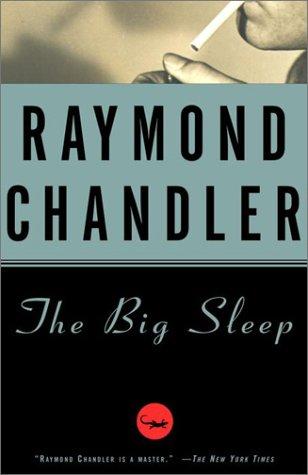
The Big Sleep by Raymond Chandler is a 1939 thriller book about corruption and power, chivalry in a corrupt world, money and moral decay. Chandler's similes are not stylistic tics but moral commentary — each one re-describes familiar Los Angeles in terms that strip away its glamour.
Summary
Philip Marlowe is hired by a very old, very rich man to deal with a blackmail situation involving his younger daughter. Within a day, there are two bodies. The case multiplies — pornography, gambling, missing persons, mob connections — and never fully resolves into a tidy solution. Chandler famously could not explain who killed the chauffeur, and when Howard Hawks and the screenwriters asked him, he admitted he didn't know either. This does not matter, and understanding why it doesn't matter is the key to understanding what The Big Sleep actually is.
The novel is not primarily interested in the solution to the murder. It is interested in Los Angeles, in money, in what corruption looks like when it extends from the street level up through the wealthiest families in the city. The Sternwood family — the paralyzed patriarch, the predatory younger daughter, the reckless older one — functions as a portrait of how American wealth accumulates and what it eventually becomes. Marlowe moves through this world not as a solver but as a witness, a man with a code in a place that has none.
Chandler's prose is the argument. The similes — among the most quoted in American fiction — are not decoration but analysis: they describe the Los Angeles of 1939 with the precision of someone who found it both beautiful and rotten. The hardboiled style that Chandler refined (and Hammett pioneered) is as much a moral position as a literary technique: the clipped, unsentimental voice refuses to glamorize what it describes, which is itself a kind of integrity.
Readers who need plot resolution will struggle. Readers who want to know what makes the hard-boiled style foundational — why Raymond Chandler got into the Library of America and most crime writers don't — will find this essential. The Big Sleep reads quickly, and the pleasures are largely in the sentences and the atmosphere rather than the mechanics of the mystery. It is as much a novel about Los Angeles as it is a detective story.
Talk to The Big Sleep like its author wrote you back.
Get the ideas that fit your life — not generic summaries.
- Chat with the book
- Audiobook-style main ideas
- Adapts to your life and goals
- Helps you take action
Key takeaways
- 1.
Chandler's similes are not stylistic tics but moral commentary — each one re-describes familiar Los Angeles in terms that strip away its glamour.
- 2.
Marlowe operates on a personal code in a world that has none: he is not naive about corruption but refuses to participate in it, which is the novel's definition of integrity.
- 3.
The plot is deliberately complex and partially unresolved — Chandler's subject is not the solution to the murder but the texture of a corrupt world.
- 4.
Los Angeles in The Big Sleep is a city built on money from uncertain origins, populated by people performing respectability while engaged in pornography, gambling, and murder.
- 5.
The Sternwood family represents the endpoint of American wealth accumulation: the patriarch earned it, the daughters are consuming it, and the institution of the family is collapsing under its own corruption.
- 6.
Hard-boiled prose is a moral stance. The flat, unsentimental voice refuses to romanticize violence or glamorize crime; its effect is to make the reader feel the reality of what it describes.
- 7.
Chandler borrowed heavily from his earlier pulp magazine stories — the novel is partly assembled from previously published short fiction — which gives it an episodic quality that is both a weakness and a source of density.
- 8.
Marlowe is chivalric in the medieval sense: he protects the weak and the innocent not because it pays but because the code demands it, even when the people he protects are neither weak nor innocent.
Discussion questions
Use these on your own, with a book club, or as chat starters in Superbook. Book club version, ready to copy or print →
- 1.
Chandler couldn't say who killed the chauffeur. Does the unresolved plot feel like a failure or an honest statement about how crime and corruption actually work?
- 2.
Marlowe is hired by an old man who knows the situation is probably unsolvable but wants dignity in its management. Is that a realistic idea of what detectives are actually for?
- 3.
The Sternwood daughters are drawn with considerable contempt. Is Chandler's characterization of women a product of the era, or is it a structural problem with the novel?
- 4.
The hardboiled style — clipped, unsentimental, full of memorable similes — is as much a moral position as a literary style. What is Chandler arguing about the relationship between how you describe a thing and what you think of it?
- 5.
Los Angeles in 1939 is already the city that American mythology was building toward. Does Chandler love it, hate it, or hold it in more complex regard?
- 6.
Marlowe has a code, but it is entirely personal — he decides case by case what he will and won't do. Is that admirable, or is it simply a romanticization of personal discretion dressed up as ethics?
- 7.
Compared to Christie's Poirot, who solves everything and delivers tidy justice, what does Chandler's refusal to tidy up say about the genre — and about America?
- 8.
The novel's title, The Big Sleep, is slang for death. How does that frame — that everyone in this world is either moving toward death or has made peace with moral death — change how you read the action?
- 9.
The pornography subplot connects Hollywood glamour to the underworld. In 1939, that connection was shocking. Does it still feel transgressive, or has it become simply historical?
- 10.
Marlowe's chivalry — he protects Carmen Sternwood even though she is dangerous — costs him almost nothing here but costs other people a great deal. Is his code generous or self-indulgent?
- 11.
The prose is full of one-liners that became so famous they now feel like parody. How do you read sentences you've heard quoted for decades? Does familiarity diminish them?
- 12.
Hard-boiled fiction defined American crime writing for decades. What does The Big Sleep tell you about why it was so influential — and what do you think got lost in its many imitators?
Themes
Frequently asked questions
-
Is The Big Sleep worth reading?
Yes, especially if you want to understand where American crime fiction came from. The plot is famously confusing, but the prose and the atmosphere are the point. If you read it expecting a puzzle mystery with a clean solution, you'll be frustrated. If you read it as a novel about a city and a moral code, it delivers.
-
Is the plot really that confusing?
Yes, genuinely. Multiple plotlines intersect without fully resolving, and Chandler himself couldn't account for one of the murders. Most readers stop trying to track every thread by the third act and that's probably the right approach — the texture matters more than the solution.
-
Do I need to read Dashiell Hammett first?
Not required, but helpful context. Hammett's The Maltese Falcon established many of the hard-boiled conventions that Chandler refined. If you want to understand the tradition, start with Hammett and come to Chandler second. If you just want Chandler, start here.
-
Is there a good film adaptation?
Howard Hawks's 1946 film with Humphrey Bogart and Lauren Bacall is a classic, but it departs significantly from the novel. It's better as a film than as an adaptation — watch it as a companion piece rather than a substitute.
-
Who shouldn't read this?
Readers who need clean plot resolution and satisfying justice. Chandler doesn't deliver either. His world is too corrupt for tidy endings, and that's the argument. If you need Poirot's certainty, stay with Christie.
Similar books
In Cold Blood
Truman Capote
The Spy and the Traitor: The Greatest Espionage Story of the Cold War
Ben Macintyre
The Confidence Game: Why We Fall for It Every Time
Maria Konnikova
The Devil in the White City
Erik Larson
