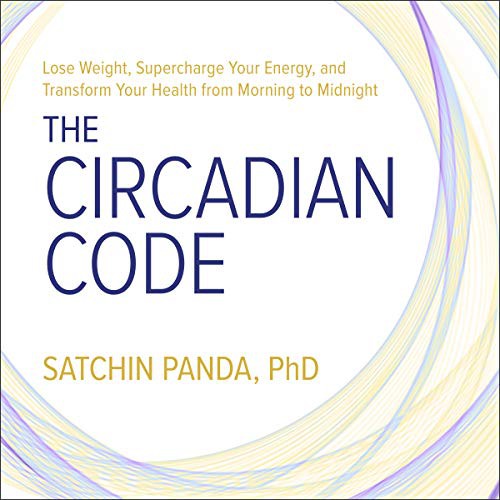
The Circadian Code by Satchin Panda is a 2019 health book about circadian rhythm, time-restricted eating, sleep. Every cell in the body runs on a roughly 24-hour clock. When eating, light, and sleep patterns become irregular or misaligned, these clocks fall out of sync and metabolic disease risk increases.
Summary
Satchin Panda is a professor at the Salk Institute and one of the leading researchers in circadian biology — the science of how biological processes in every cell follow a roughly 24-hour clock. The Circadian Code translates his lab's findings into a practical framework for using the timing of food, light, exercise, and sleep to improve health. The central argument is that the timing of what you do matters almost as much as what you do, and that modern life has systematically disrupted the timing signals that regulate metabolism, immunity, and brain function.
The book's most distinctive contribution is the case for time-restricted eating. Panda's research, including mouse studies and human trials, shows that confining eating to a consistent 8-to-12-hour window each day — without changing what or how much is eaten — produces improvements in weight, blood sugar, blood pressure, and sleep quality. The mechanism involves the feeding-fasting cycle that all cells use to switch between repair mode and growth mode. When people eat across 14-16 hours as many Americans do, cells never fully enter repair mode. The window doesn't have to start early, but consistency matters enormously.
Beyond eating, Panda covers light as the primary clock-setter for the circadian system. Morning light exposure anchors the rhythm and improves sleep onset at night. Evening artificial light, especially from screens, delays melatonin production and pushes the sleep window later in ways that accumulate over time. He discusses the role of exercise timing, shift work as a major health risk, and the particular vulnerabilities of teenagers whose circadian clocks naturally run late but who are forced by school schedules to operate against their biology.
The practical sections are detailed and realistic. Panda acknowledges that many people can't dramatically restructure their schedules, and he offers phased approaches for compressing eating windows gradually. The science is grounded but accessible, and Panda writes without the evangelism that can make wellness books exhausting. This is a book that earns its recommendations by showing the research behind them.
Talk to The Circadian Code like its author wrote you back.
Get the ideas that fit your life — not generic summaries.
- Chat with the book
- Audiobook-style main ideas
- Adapts to your life and goals
- Helps you take action
Key takeaways
- 1.
Every cell in the body runs on a roughly 24-hour clock. When eating, light, and sleep patterns become irregular or misaligned, these clocks fall out of sync and metabolic disease risk increases.
- 2.
Time-restricted eating — confining all food to an 8-12 hour window — can improve metabolic health without changing diet composition or calorie count, based on Panda's human trial data.
- 3.
The feeding-fasting cycle is essential. Cells switch between growth mode (when fed) and repair mode (when fasted). Eating across 14+ hours prevents adequate repair time.
- 4.
Morning light is the most powerful circadian cue. Even a short period of bright outdoor light within an hour of waking anchors the internal clock and improves sleep quality that night.
- 5.
Artificial light after sunset, especially blue-wavelength screen light, suppresses melatonin and delays sleep onset. The effect accumulates over chronic exposure.
- 6.
Teenagers have a biologically later circadian phase than adults. Early school start times force them to operate chronically out of phase with their biology, impairing learning and mood.
- 7.
Shift work is one of the most significant lifestyle risk factors for metabolic disease, cancer, and cardiovascular disease — a consequence of systematic circadian disruption.
- 8.
Consistency of timing matters as much as the window itself. Eating at the same times each day keeps peripheral organ clocks synchronized with the master clock in the brain.
Discussion questions
Use these on your own, with a book club, or as chat starters in Superbook. Book club version, ready to copy or print →
- 1.
Panda argues that when you eat matters as much as what you eat. How does that shift the framing of nutrition advice you've received or given?
- 2.
The research on time-restricted eating used windows as wide as 12 hours. How far from that is your current eating pattern on a typical weekday? On weekends?
- 3.
What changes to morning light exposure would be realistic for you, given where you live and how your mornings are structured?
- 4.
Panda's lab data shows metabolic benefits even without dietary changes. Does that finding change how you'd think about recommending this to someone resistant to changing their diet?
- 5.
Shift workers face the highest circadian disruption. What practical interventions does Panda suggest for them, and how feasible do those seem?
- 6.
Teenagers' late circadian phase is biological, not behavioral. How has your perspective on adolescent sleep habits changed after reading this?
- 7.
Panda recommends no food for two to three hours before bed. What social or cultural norms in your life work against that recommendation?
- 8.
The book presents circadian disruption as a mechanism for cancer, metabolic disease, and cardiovascular disease. How do you weigh that evidence against the inconvenience of changing behavior?
- 9.
What surprised you most about which organs and cell types have their own independent clocks?
- 10.
Panda suggests that social jetlag — the misalignment between weekday and weekend sleep schedules — has measurable metabolic effects. How large is your own social jetlag?
- 11.
How does the framing of timing versus composition change the practical advice for someone trying to improve their metabolic health?
- 12.
What's the smallest circadian change you could make this week that would be both sustainable and evidence-backed?
Themes
Frequently asked questions
-
What is time-restricted eating and does it work?
Time-restricted eating means confining all caloric intake to a consistent daily window, typically 8-12 hours. Panda's human trials show improvements in weight, blood pressure, and blood sugar in overweight adults without asking them to change what they eat, only when. The effect size varies and the research is ongoing, but the current evidence is promising.
-
How long does The Circadian Code take to read?
Around four hours at average reading pace. The book is about 280 pages and is written accessibly. The first third covers the science; the remaining two-thirds are organized around practical applications for different life domains.
-
Do I need to start my eating window early in the morning?
Not necessarily, according to Panda. The most important factor is consistency, not start time. Starting earlier aligns better with morning cortisol rhythms, but a consistent 10am-8pm window still captures the fasting benefits. Aligning the window with daylight hours is beneficial but not mandatory.
-
Who should read The Circadian Code?
Anyone interested in metabolic health, sleep improvement, or weight management who wants a biologically grounded approach. Also valuable for healthcare providers looking for evidence-based behavioral interventions. People already familiar with intermittent fasting will find the circadian framing adds significant scientific context.
-
Is The Circadian Code different from Why We Sleep?
Yes. Why We Sleep focuses almost entirely on sleep science. The Circadian Code covers the broader circadian system — eating timing, light exposure, exercise, and sleep together — and is more practically oriented toward making behavioral changes. They complement each other well.
Similar books
Why We Sleep
Matthew Walker
The Sleep Revolution
Arianna Huffington
Lifespan: Why We Age—and Why We Don't Have To
David A. Sinclair
Outlive: The Science and Art of Longevity
Peter Attia
