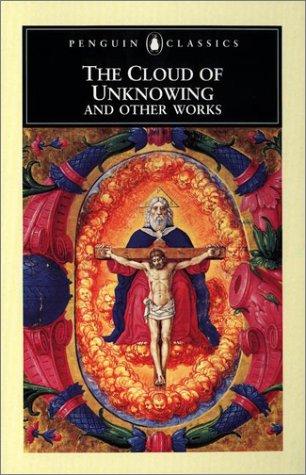
The Cloud of Unknowing by Anonymous is a 1472 religion & spirituality book about contemplation, apophatic theology, prayer. God cannot be known by the intellect. The cloud of unknowing separates the soul from God, and no amount of thinking or reasoning can penetrate it.
Summary
The Cloud of Unknowing is an anonymous English mystical treatise written in the latter half of the fourteenth century. The author — almost certainly a contemplative priest or monk, writing in the East Midlands dialect of Middle English — addresses the book to a young disciple who has asked for guidance in contemplative prayer. It is one of the finest examples of apophatic mysticism in the English language: the tradition that holds that God cannot be grasped by the intellect but only approached through love, and that the path forward requires letting go of concepts as well as consolations.
The central image is a cloud of unknowing that separates the soul from God — not a cloud of absence but one of incomprehensibility. No matter how much the intellect strives, God remains above and beyond its grasp. The author's instruction is radical: forget everything you know, let it sink into a "cloud of forgetting" beneath you, and direct a "naked intent" — a simple, undivided act of love — toward the cloud above. This is not meditation in the sense of dwelling on ideas about God, but a letting go of all ideas in favor of a direct, wordless orientation.
The author is practical and occasionally dry-witted. He warns his reader about the kinds of people who are not ready for this practice, describes the errors beginners make (straining physically, expecting visions, confusing the spiritual with the bodily), and is blunt about the difficulties. He distinguishes between active life, mixed life, and contemplative life, arguing that not everyone is called to what he describes — and that attempting it without proper disposition and guidance is dangerous. He also wrote a companion piece, The Book of Privy Counselling, which extends the teaching for more advanced practitioners.
The Cloud stands in the tradition of Pseudo-Dionysius and draws on a long Christian apophatic lineage, but its English vernacular directness makes it accessible in a way that the Greek and Latin sources are not. It has influenced subsequent mystical theology from John of the Cross to Thomas Merton, and has been read in the twentieth century both by practicing contemplatives and by philosophers interested in the limits of language and concept in religious experience. The translation matters significantly; the William Johnston and Clifton Wolters translations are both well-regarded.
Talk to The Cloud of Unknowing like its author wrote you back.
Get the ideas that fit your life — not generic summaries.
- Chat with the book
- Audiobook-style main ideas
- Adapts to your life and goals
- Helps you take action
Key takeaways
- 1.
God cannot be known by the intellect. The cloud of unknowing separates the soul from God, and no amount of thinking or reasoning can penetrate it.
- 2.
The only approach to God is through love — a naked, wordless intent directed toward what cannot be grasped conceptually.
- 3.
Everything the intellect produces — thoughts, images, concepts, even good thoughts about God — must be pressed down into the 'cloud of forgetting' beneath the practitioner.
- 4.
The practice is not about achieving a feeling or a vision. It is about a quality of attention and will: a sustained, undivided orientation toward God regardless of what is felt.
- 5.
The author is selective about his audience. He warns explicitly that this approach is not for everyone and that pursuing it without genuine calling and proper guidance can produce confusion and error.
- 6.
The work of contemplation is brief at first — a 'sharp dart' of longing that may last only a moment — but through practice, the quality of attention can be sustained and deepened.
- 7.
Apophatic theology (knowing God by unknowing, by what God is not) is the complement to cataphatic theology (knowing God through positive descriptions). The Cloud is a sustained argument for why the negative way is necessary.
- 8.
The Cloud's influence extends beyond Christian mysticism: its account of thought-releasing, attention-directing practice has parallels in Buddhist meditation and has interested twentieth-century philosophers of language and mind.
Discussion questions
Use these on your own, with a book club, or as chat starters in Superbook. Book club version, ready to copy or print →
- 1.
The Cloud argues that God is beyond all concepts and images. Does that claim feel like a loss — the removal of content — or a liberation? What would it mean to pray toward something entirely unknown?
- 2.
The author says every thought, even good thoughts about God, must be pushed aside into the cloud of forgetting. How does that instruction sit with traditions that emphasize Scripture, doctrine, and theological knowledge?
- 3.
He warns that this practice is not for everyone. What kind of person does he seem to think is ready for it — and what kind is not?
- 4.
The 'naked intent' is described as a simple, undivided act of love. Is that psychologically possible to sustain — or is the will inherently complex and divided?
- 5.
The Cloud shares something with Buddhist meditation practice in its emphasis on releasing thought rather than directing it. What is similar, and what is irreducibly different?
- 6.
The author is anonymous, and we know almost nothing about who wrote it. Does that anonymity affect how you read the book — does it matter whether the author had personal authority?
- 7.
The text was written for a specific disciple, in a specific relationship of guidance. Can it be meaningfully read by someone without that kind of ongoing relationship?
- 8.
The Cloud describes prayer that is wordless and imageless. What does that do to the communal and liturgical dimensions of religion — does it require a private practice alongside a public one?
- 9.
The author distinguishes active, mixed, and contemplative life. Where does ordinary modern life fall — and does the framework help you think about the different modes of your own week?
- 10.
Thomas Merton and others have read The Cloud as relevant to modern life. What would need to change in how you structure your time and attention to make even a modest version of this practice possible?
- 11.
The Cloud uses everyday Middle English rather than formal Latin — deliberately accessible for its era. What does the choice to write in the vernacular suggest about what the author thought contemplative prayer was for?
- 12.
What does it mean to 'forget' yourself in the sense the author describes — not self-destruction but self-transcendence? Is there a secular equivalent of that movement?
Themes
Frequently asked questions
-
What is The Cloud of Unknowing about?
It is a medieval guide to contemplative prayer for an advanced disciple. The central idea is that God cannot be reached by thinking but only by love — a wordless, undivided intent directed toward what is beyond conceptual grasp. The 'cloud' is not an obstacle but the nature of God as God actually is.
-
Is The Cloud of Unknowing still readable today?
Yes, in a good modern translation. The Middle English of the original is beautiful but requires specialist knowledge. William Johnston's and Clifton Wolters's translations are both clear and capture the directness of the original. The ideas are not dated even if the context is.
-
How does The Cloud of Unknowing relate to mindfulness meditation?
There are structural parallels: both involve releasing thought rather than following it, and both cultivate a quality of attention rather than a specific content. But the Cloud's practice is explicitly directed toward God — it has an object, even if that object is beyond conceptual grasp — which distinguishes it from object-less awareness practices.
-
Who should read The Cloud of Unknowing?
Readers interested in Christian mysticism, apophatic theology, or the phenomenology of contemplative states. Also useful for anyone asking how prayer or meditation can go beyond words and concepts. The author himself says not everyone is suited to the practice he describes — curious readers are welcome; aspirants should proceed carefully.
-
What is apophatic theology?
The approach that describes God by what God is not, rather than by positive attributes. Where cataphatic theology says 'God is good,' apophatic theology says our concept of goodness falls short of God. The Cloud sits squarely in this tradition, arguing that all concepts — even the best ones — must be released in the deepest prayer.