The Craftsman by Richard Sennett is a 2008 sociology book about craftsmanship, skill and practice, hand and head. Craftsmanship is the desire to do a job well for its own sake — an impulse far wider than the trades, alive in the programmer and parent as much as the carpenter.
Summary
The Craftsman opens with a deceptively broad definition: craftsmanship is the desire to do a job well for its own sake. For Richard Sennett, a sociologist writing in the American pragmatist tradition, this impulse reaches far beyond skilled trades. It is alive in the programmer, the doctor, the musician, the cook, the parent, and the citizen. The book, the first volume of his Homo Faber trilogy on how people make material and social life, sets out to rescue making from the low status our culture assigns it and to treat it as a genuine source of thought and ethics.
Its guiding claim is that making is thinking — that hand and head are not separable. The craftsman reasons through materials in a running dialogue with them, so intelligence lives in the fingers as much as in abstract plans. Sennett revises his teacher Hannah Arendt's sharp division between Animal laborans, the being absorbed in labor as an end in itself, and Homo faber, the being who steps back to judge. Reflection and doing, he argues, happen together at the bench, not in separate phases or separate people.
From there the book explores how skill is actually built: through practice, repetition, and rhythm, which he insists can open outward into pleasure and mastery rather than deadening the worker. He anatomizes the intelligent hand, the workshop and guild as institutions that transmit tacit knowledge words cannot fully hold — knowledge that died with Stradivari when his hands stopped — and the craftsman's relationship to resistance and ambiguity. Good work means using minimum force, staying with difficulty, and treating problem-finding as inseparable from problem-solving. He warns, too, against the perfectionism that ruins work and the frictionless tools, like CAD, that strip away the productive resistance from which we learn.
The Craftsman is erudite and roving, drawing on music, medicine, cooking, open-source software, architecture, and philosophy, and it reads more as a set of connected meditations than a single tight thesis. That is its pleasure and its limit: patient readers are richly rewarded, while anyone wanting a brisk, prescriptive guide may find it digressive. It offers no how-to. It is for readers who want a deep, humane account of what skilled making is and why it matters.
Craftsmanship: doing a job well for its own sake
Sennett’s definition is intentionally wide. Craftsmanship is not a trade or a class of worker but a motivation — the wish to do good work for the satisfaction of the work itself, independent of pay, status, or applause. That is why his examples run from Renaissance goldsmiths to Linux programmers to parents raising a child. Wherever people care about quality for its own sake, the craftsman is present. His larger worry is that modern institutions — competitive workplaces, thin schooling, automation — keep smothering that impulse.
Making is thinking: the hand and the head
The book’s philosophical core is the refusal to separate thinking from making. The craftsman does not first think and then execute; understanding emerges in the doing, through a dialogue with the material’s resistance and grain. Intelligence is in the hand — in the anticipatory grip, the trained touch, the coordination of eye and finger.
Here Sennett gently corrects Hannah Arendt, his former teacher. Arendt split Animal laborans (absorbed in labor) from Homo faber (who stands back to judge). Sennett argues the two are joined: the craftsman reflects while working, judging and adjusting at the bench rather than in a separate act of pure thought.
How skill is built: practice, rhythm, and the workshop
Skill, for Sennett, is made, not given. It grows through:
- Practice and repetition — which he defends against the charge of drudgery. Routine can be alive; rhythm is where technique deepens and a task can even become absorbing.
- The workshop — historically the guild, with its masters, journeymen, and apprentices, a small society organized to hand down skill.
- Tacit knowledge — the wordless know-how that lives in demonstration, not manuals. His emblem is the lost secret of the Stradivari workshop: knowledge held in the hands that vanished when the hands did.
Resistance, ambiguity, and problem-finding
Good work, Sennett argues, is a particular relationship to difficulty. Skilled makers use minimum force, work with resistance rather than battering through it, and stay curious inside ambiguity instead of rushing to resolve it. Crucially, problem-finding and problem-solving are entangled: dwelling on a difficulty often reveals the better question, so lingering is part of the craft, not a failure of efficiency.
The dangers: perfectionism and frictionless tools
Two warnings run through the book. First, perfectionism can wreck the very thing it means to perfect; part of skill is judging when a piece is good enough and stopping. Second, tools that remove productive friction can quietly remove the learning that friction produces — his example is computer-aided design that spares architects the slow labor of drawing by hand, and with it the deep familiarity that labor once built. Resistance is not merely an obstacle; it is a teacher.
Who it’s for
The Craftsman is for readers who want depth rather than prescription — people willing to follow a wide-ranging mind through music, medicine, cooking, code, and philosophy in pursuit of one humane idea: that making things well is a way of thinking, and a form of ethics. It is not a manual and not a quick read. Taken on its own terms, it is one of the richest modern accounts of what skill is and why a society should care about it.
Key takeaways
- 1.
Craftsmanship is the desire to do a job well for its own sake — an impulse far wider than the trades, alive in the programmer and parent as much as the carpenter.
- 2.
Making is thinking. Hand and head work together; the craftsman reasons through materials, so mental and manual work cannot be cleanly separated.
- 3.
Skill is built, not born. It grows through practice, repetition, and rhythm — and repetition, far from deadening, is the ground on which technique and even pleasure develop.
- 4.
The workshop transmits tacit knowledge that words cannot fully capture. When Stradivari died, the knowledge in his hands died with him because it was never made explicit.
- 5.
Good craftsmen work with resistance, not against it — using minimum force and staying with difficulty rather than forcing a fast solution.
- 6.
Problem-finding and problem-solving are intertwined. Dwelling on a problem, and being curious about ambiguity, is part of the craft, not a delay before the real work.
- 7.
Perfectionism can destroy the work. Knowing when a thing is good enough, and when to stop, is itself a mark of skill.
- 8.
Tools that remove productive resistance — like CAD that spares the architect the friction of drawing by hand — can erode the very learning that difficulty produces.
Discussion questions
Use these on your own, with a book club, or as chat starters in Superbook. Book club version, ready to copy or print →
- 1.
Sennett defines craftsmanship as doing a job well for its own sake. Where in your life do you pursue quality for its own sake, with no external reward?
- 2.
The book claims making is thinking. When has working with your hands actually clarified your thinking about a problem?
- 3.
Sennett rejects a clean split between mental and manual labor. Does your own work honor that link, or treat thinking and making as separate jobs for separate people?
- 4.
Repetition, Sennett argues, is where skill and even pleasure grow. What repetitive practice in your life has become richer rather than more boring over time?
- 5.
Think of a skill you learned mostly by watching and doing rather than from words. What tacit knowledge would be lost if you couldn't demonstrate it?
- 6.
Sennett praises working with resistance and minimum force. Where do you tend to force a solution instead of staying with the difficulty?
- 7.
When has dwelling longer on a problem — rather than rushing to solve it — revealed a better problem to solve?
- 8.
The book warns that perfectionism can ruin work. Where does your own drive to get it perfect get in the way of getting it good?
- 9.
Sennett worries that tools like CAD remove the friction that teaches. Which conveniences in your work might be costing you learning you don't notice?
- 10.
He treats the medieval workshop as a model community for transmitting skill. What in your life plays the role of a workshop where you learn a craft alongside others?
- 11.
Sennett sees craftsmanship as a form of ethics and citizenship. How might doing your everyday work well be connected to being a good member of a community?
- 12.
If making is a way of thinking, what would you understand differently by trying to build or repair something yourself?
Themes
Frequently asked questions
-
What is the main argument of The Craftsman?
That craftsmanship — the desire to do a job well for its own sake — is a basic human impulse that unites hand and head, and that modern society too often discourages it. Sennett wants to reclaim making as a source of thought, skill, and ethics far beyond the manual trades.
-
Is The Craftsman only about manual trades?
No. Sennett deliberately stretches the idea to include programmers, doctors, musicians, cooks, and parents. Open-source software and the medieval goldsmith sit side by side as examples of the same craftsman impulse.
-
Is The Craftsman a difficult read?
It is erudite and discursive, ranging across history, music, philosophy, and science, and it reads more like a series of connected meditations than a linear argument. Patient readers are rewarded; those wanting a brisk, practical guide may find it meandering.
-
How does The Craftsman relate to Shop Class as Soulcraft?
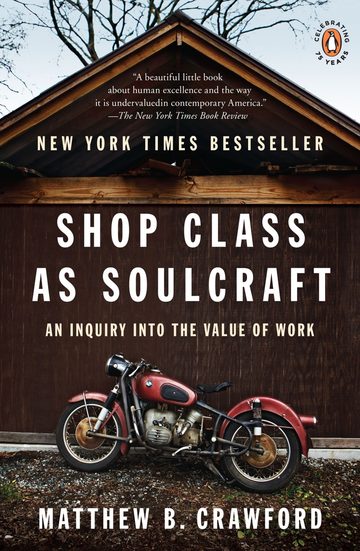
Both defend skilled work as meaningful and thoughtful, and they are often read together. Sennett is the broader academic sociologist building a theory of making; Crawford is more personal and polemical. They complement each other well.
-
What is the Homo Faber trilogy?
Sennett's three-book project on how human beings shape material and social life: The Craftsman (2008) on making, Together (2012) on cooperation, and Building and Dwelling (2018) on the city. The Craftsman is the foundation the later volumes build on.