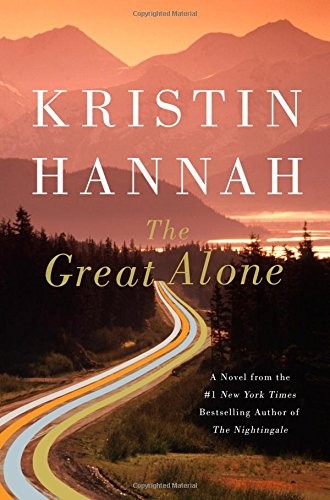
The Great Alone by Kristin Hannah is a 2018 contemporary fiction book about survival, domestic violence, wilderness and isolation. Hannah doesn't simplify Cora's choices. The novel shows the psychology of staying — hope, love, isolated dependency, the genuine danger of leaving — without judgment or easy resolution.
Summary
In 1974, Ernt Allbright brings his wife Cora and teenage daughter Leni to the Alaskan wilderness. He's a Vietnam vet with untreated PTSD, erratic behavior, and a survivalist conviction that civilization is about to collapse. Alaska is supposed to be a fresh start. Leni, who narrates the novel, is thirteen when they arrive — old enough to know something is wrong with her father, young enough to believe the family can survive it. The wilderness tests them all, and the long Alaskan darkness proves to amplify every instability Ernt carried north.
The novel is two things simultaneously: a vivid portrait of backcountry Alaska in the 1970s, and an account of the logic trap of loving a dangerous person. Hannah doesn't simplify Cora's choices. Cora knows Ernt is getting worse; she stays because leaving feels more dangerous than staying, because she loves him when he isn't like this, because the isolation has stripped away every escape route she might have taken. Hannah renders that psychology with uncomfortable accuracy — the hope, the accommodation, the self-deception that isn't quite self-deception — which is what makes the novel genuinely disturbing rather than merely sad.
Leni's coming-of-age against the backdrop of her father's deterioration is the novel's emotional spine. She falls in love with Matthew Walker, the son of a local man who has a long antagonism with Ernt, which gives the story a Romeo-and-Juliet overlay that is entirely conscious. The Alaskan wilderness — described with obvious affection and real research — is both setting and active force: beautiful and brutal, capable of killing you, indifferent to your personal disasters.
Hannah writes with her usual emotional directness. The prose isn't subtle, but the emotional mechanics are honest, and the darkness she's willing to portray here is more sustained than in The Nightingale. The Great Alone is a harder book than its commercial presentation suggests — a serious look at what it costs to love someone who is destroying you.
Talk to The Great Alone like its author wrote you back.
Get the ideas that fit your life — not generic summaries.
- Chat with the book
- Audiobook-style main ideas
- Adapts to your life and goals
- Helps you take action
Key takeaways
- 1.
Hannah doesn't simplify Cora's choices. The novel shows the psychology of staying — hope, love, isolated dependency, the genuine danger of leaving — without judgment or easy resolution.
- 2.
Alaska in the novel is more than scenery. The seasonal darkness, the physical isolation, the requirement of constant effort for survival — all amplify and parallel the family's internal weather.
- 3.
The coming-of-age narrative works because Leni is perceptive enough to see what's happening and powerless enough to not be able to stop it — a genuinely painful combination.
- 4.
Ernt is a Vietnam vet with what is recognizably PTSD, depicted in 1974 before the term existed — Hannah is careful to root his damage in historical context without using that context to excuse his violence.
- 5.
The novel argues, implicitly, that isolation is one of domestic violence's most effective tools. Alaska doesn't cause the violence, but it removes every external check on it.
- 6.
Love in this novel is examined as both a genuine good and a mechanism of entrapment — Leni and Cora love Ernt, and that love is not delusion; it coexists with his capacity to harm them.
- 7.
The survivalist community that the Allbrights join in Alaska is rendered with care — they are not cartoons, and some of them become genuine sources of support, which complicates the politics.
- 8.
The novel's second half, when the consequences of the violence land fully, is more harrowing than its commercial thriller packaging might suggest, and more honest about permanent damage.
Discussion questions
Use these on your own, with a book club, or as chat starters in Superbook. Book club version, ready to copy or print →
- 1.
Cora keeps returning to Ernt after each violent episode. Hannah shows the psychological logic of this clearly. Did you find that portrayal honest — or did you find yourself judging Cora anyway?
- 2.
Ernt's damage is rooted in Vietnam. How much does the novel ask you to hold his history against his actions, and how does that affect your reading of his culpability?
- 3.
The Alaskan wilderness is described as beautiful even as it facilitates the family's isolation. How does Hannah balance those two registers — beauty and danger — without one canceling the other?
- 4.
Leni is both the most perceptive character and the most helpless. What does the novel say about what children understand versus what children can do?
- 5.
The romance between Leni and Matthew has an explicit Romeo-and-Juliet structure. Does that parallel add to the story or feel like a genre overlay that sits awkwardly on top of the domestic violence plot?
- 6.
The survivalist community has both damaging and supportive members. How does the novel complicate the easy reading of survivalism as uniformly pathological?
- 7.
The neighbors — particularly the Walkers — know something is wrong. The novel is partly about what communities fail to do in the face of domestic violence. Does it indict them fairly?
- 8.
How does the Alaskan 1970s setting shape the story? Would the same events in a contemporary urban setting produce a different novel — or the same one?
- 9.
The novel's ending is one that many readers find genuinely devastating. Does it feel earned, or does it feel like punishment for the characters?
- 10.
The Great Alone is considerably darker than The Nightingale. Does Hannah earn that darkness — does the suffering serve the story's purposes — or does it tip into gratuitousness?
- 11.
Leni eventually escapes. What does the novel say about what survival costs — what she carries with her even after she's out?
Themes
Frequently asked questions
-
Is The Great Alone as good as The Nightingale?
Opinions split. Many readers find it darker and more psychologically acute. The Alaska setting gives Hannah a grander physical canvas than wartime France, and the domestic violence narrative is rendered with unusual honesty. Others prefer The Nightingale's historical heroism. Both are strong; this one is harder.
-
Is The Great Alone a difficult read emotionally?
Very. This is not a book with a tidy resolution. Domestic violence is depicted with realism rather than tidiness, the isolation is claustrophobic by design, and the long Alaskan darkness Hannah describes is not metaphorical — it is the condition that makes everything worse. Approach with appropriate expectations.
-
Is The Great Alone a romance?
It has a love story — Leni and Matthew — but it is not primarily a romance novel. The love story is embedded in a survival narrative about family dysfunction and domestic violence. If you're coming for the romance, the rest of the book will be harder than you expect.
-
Is there a film or TV adaptation?
As of this writing, no. The Nightingale and Firefly Lane have been adapted; The Great Alone has not.
-
Who shouldn't read this?
Readers who are sensitive to detailed depictions of domestic violence and psychological manipulation. Also readers who want commercial emotional fiction that resolves neatly — The Great Alone has Hannah's usual propulsion but a darker, more ambiguous resolution than her other major books.