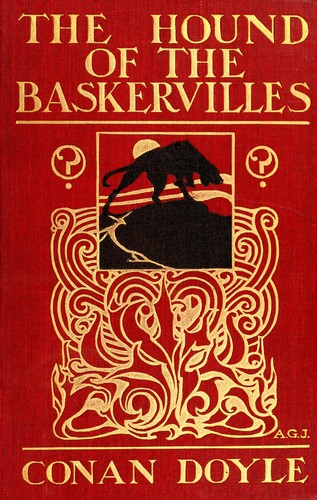
The Hound of the Baskervilles by Arthur Conan Doyle is a 1902 mystery book about superstition versus reason, isolation and the moors, inheritance and greed. The novel is structurally built on a tension between two explanatory modes: the supernatural and the rational. Conan Doyle runs them in parallel long enough to make even confident readers uncertain.
Summary
The Baskerville family has been haunted for generations by the legend of a spectral hound — a creature of supernatural vengeance said to pursue the heirs of a wicked ancestor across the Dartmoor fog. When the latest heir dies under mysterious circumstances, his doctor brings the case to Sherlock Holmes, who sends Watson ahead to the Devonshire moors with the new heir while he remains in London. The setup allows Conan Doyle to run the novel half as Gothic horror and half as detective story, and the combination is what makes it his most successful long-form work.
The Holmes novels vary considerably in quality — The Valley of Fear and The Sign of the Four are uneven — but Hound is tight and atmospheric in a way none of the others quite achieve. Much of this is Watson's narration from Dartmoor in Holmes's absence: the moors are fog, treacherous bogs, strange lights, unexplained howling. The supernatural pressure is maintained long enough that even readers who know Holmes will deliver a rational solution may find themselves unsure. Conan Doyle understood that the Gothic requires sustained dread, not just a spooky setting.
The plot mechanics are somewhat contrived — the identity of the villain requires a leap — but Conan Doyle compensates with atmosphere and pace. The set-piece confrontation is one of the best in the series. The novel also makes effective use of Holmes's unusual deployment: his absence from most of the action, and the revelation of what he was actually doing, is a piece of structural misdirection that the short story format never allowed.
The Hound of the Baskervilles is the obvious entry point for anyone who has only encountered Holmes in adaptations. It is the single Holmes work that functions as a complete, fully satisfying novel — with a beginning, a sustained middle, and a resolution that pays off the setup. Those who came first to the BBC series or the films will find the source both simpler and more effective than they expected.
Talk to The Hound of the Baskervilles like its author wrote you back.
Get the ideas that fit your life — not generic summaries.
- Chat with the book
- Audiobook-style main ideas
- Adapts to your life and goals
- Helps you take action
Key takeaways
- 1.
The novel is structurally built on a tension between two explanatory modes: the supernatural and the rational. Conan Doyle runs them in parallel long enough to make even confident readers uncertain.
- 2.
Watson as sole narrator for much of the novel — rather than Watson-reporting-Holmes — gives the book a different texture than the short stories. The uncertainty is more sustained because Watson genuinely doesn't know.
- 3.
Holmes's strategic absence from the moors is a piece of formal misdirection: it forces the reader to sit with Watson's limited perspective before the revelation of what was actually happening.
- 4.
The Dartmoor setting does more work than most settings in detective fiction. The fog, the bogs, the prison, the ancient stones — Conan Doyle builds a landscape that feels actively threatening.
- 5.
The villain's motivation is inheritance — money — which grounds the supernatural premise in the most Victorian of anxieties. The spectral hound is a confidence trick in service of a financial crime.
- 6.
Conan Doyle's rational universe insists that every seemingly supernatural phenomenon has a physical explanation. This is Holmes's worldview made structural — and Hound is its most explicit expression.
- 7.
The novel rewards rereading because several details about Holmes's activity on the moors are embedded in Watson's account. On second reading, the misdirection becomes visible.
- 8.
Sir Henry Baskerville is one of Conan Doyle's more genuinely sympathetic clients: the novel makes you care whether he survives before it delivers Holmes's solution, which is unusual for the series.
Discussion questions
Use these on your own, with a book club, or as chat starters in Superbook. Book club version, ready to copy or print →
- 1.
Conan Doyle maintains the possibility of a supernatural explanation longer than most readers expect. At what point did you become certain it was a rational crime — or did you?
- 2.
Watson functions as the reader's surrogate for most of this novel, investigating without Holmes. Does he acquit himself better or worse than the short stories typically allow?
- 3.
Holmes's deception of Watson — concealing that he is already on the moors — is one of his more ethically questionable moves. Is that justified by results, or is it a betrayal of the partnership?
- 4.
The villain is ultimately motivated by inheritance. How does the novel connect the Gothic premise to the thoroughly Victorian preoccupation with money, estate, and family lineage?
- 5.
The moors are an almost independent character in the novel. Would the book work transplanted to a different setting — a city, a sea voyage — or is Dartmoor essential?
- 6.
Conan Doyle contrasts the rational Holmes with the fearful, superstition-inclined community on the moor. Is the novel endorsing rational demystification, or is it more ambivalent about what gets lost when the supernatural is explained away?
- 7.
Compared to the short stories in Adventures of Sherlock Holmes, does the novel format suit the material better, or do you find the extended length padded?
- 8.
The identity of the villain requires a coincidence of physical resemblance. Does that stretch your credulity, or does the novel earn the reveal through other means?
- 9.
Sir Charles Baskerville is dead before the novel begins. How does his absence shape the investigation and the atmosphere — what does it mean to solve a crime for someone who can't benefit from the solution?
- 10.
The novel was written after Conan Doyle had killed Holmes at Reichenbach Falls and before he officially resurrected him. Does that context change how you read Holmes's role in the story?
- 11.
Several adaptations (especially the Jeremy Brett and the 2012 BBC Sherlock) are very well-regarded. If you've seen one, where did it improve on the novel — and where did the novel do something the adaptation missed?
- 12.
Holmes solves the case partly because he is willing to endure discomfort — living rough on the moor — in ways his clients and even Watson cannot. What does that willingness say about his character versus the formal genius the short stories usually celebrate?
Themes
Frequently asked questions
-
Is The Hound of the Baskervilles the best place to start with Holmes?
It's the best single novel, yes. If you want the short story experience first, Adventures of Sherlock Holmes gives you the most essential stories. But Hound is the one Holmes work that functions as a fully satisfying novel, and for many readers it's the right entry point.
-
Is it actually scary?
Genuinely atmospheric, which is rarer. The Dartmoor fog, the howling, the bogs — Conan Doyle sustains Gothic dread better than most detective writers try to. It is not horror, but it is more unsettling than the short stories.
-
How long does it take to read?
Around three to four hours. It is relatively short for a novel — around 60,000 words — and the pace is fast. Most readers finish it in a weekend.
-
Who shouldn't read it?
Readers expecting either pure horror or pure detective puzzle may find the hybrid unsatisfying. The horror elements are never fully committed — the supernatural is explained away — and the detective plot has a contrivance at its center. If you want one or the other undiluted, look elsewhere.
-
Are there good film adaptations?
Many. The 1939 Basil Rathbone version is classic Hollywood; the 1984 Jeremy Brett adaptation is faithful and atmospheric; the 2002 BBC film with Richard Roxburgh is underrated. BBC Sherlock's second episode (2012) is a loose but interesting modernization.