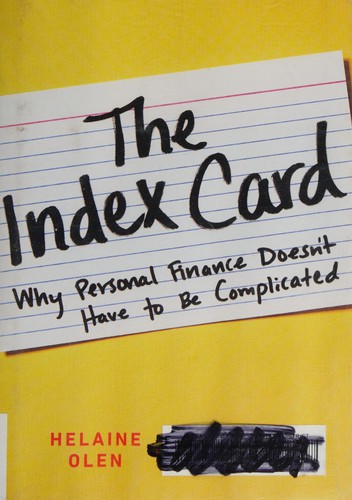
The Index Card by Helaine Olen is a 2016 economics book about personal finance, simplicity, investing. All essential personal finance advice fits on a single index card. Complexity in the financial services industry usually serves the advisor's interests more than the client's.
Summary
The Index Card began as a genuine index card. University of Chicago professor Harold Pollack scribbled his complete financial advice on one during an interview with journalist Helaine Olen, photographed it, and posted it online in 2013. It went viral. The premise — that everything you need to know about personal finance fits on a single index card — attracted millions of people exhausted by contradictory advice from an industry that profits by making money complicated.
Olen and Pollack's book expands those rules into chapters without diluting the core message: save 10 to 20 percent of your income, max out your tax-advantaged accounts, buy index funds, avoid actively managed funds and financial advisors who earn commissions, pay off your credit cards every month, and never try to time the market. Each rule gets historical context and a clear explanation of why the financial services industry actively discourages the behavior that most benefits ordinary investors.
The more pointed argument is structural. Olen, who wrote Pound Foolish as a critique of the personal finance industry, uses this book to explain why straightforward advice is rare: advisors are often paid by commissions tied to expensive products, and the financial media needs novel content even when stable boring advice works better. The index card format is a rebuke to that industry, not just a memory device.
The book is short, easy to read, and deliberately repetitive about the core rules. Some readers find the repeated emphasis reassuring; others find it thin. Anyone hoping for sophisticated tax optimization or estate planning will need other resources. What the book does well is give anxious people a firm foundation and a clear reason to stop making the situation more complicated than it needs to be.
Talk to The Index Card like its author wrote you back.
Get the ideas that fit your life — not generic summaries.
- Chat with the book
- Audiobook-style main ideas
- Adapts to your life and goals
- Helps you take action
Key takeaways
- 1.
All essential personal finance advice fits on a single index card. Complexity in the financial services industry usually serves the advisor's interests more than the client's.
- 2.
Save 10 to 20 percent of your income, starting now. The exact amount matters less than the habit; saving 10 percent consistently beats saving 20 percent erratically.
- 3.
Max out tax-advantaged accounts first: 401(k), IRA, HSA. The tax savings compound over decades and are effectively free money from the government.
- 4.
Buy index funds, not actively managed funds. The average actively managed fund underperforms its benchmark index after fees over any long horizon.
- 5.
Never try to time the market. Even professional fund managers fail at this reliably. Time in the market beats timing the market.
- 6.
Pay off your credit card balance in full every month. Credit card interest rates typically exceed any realistic investment return.
- 7.
Financial advisors who earn commissions have a structural incentive to recommend products that pay them more, not products that serve you better. Seek fee-only fiduciaries.
- 8.
Make your financial life as automatic as possible: direct deposit, automatic transfers to savings, automatic investment contributions. Remove decision points.
Discussion questions
Use these on your own, with a book club, or as chat starters in Superbook. Book club version, ready to copy or print →
- 1.
Olen argues that financial complexity mostly serves the financial industry, not investors. Do you find that claim convincing based on your own experience?
- 2.
The index card rules are simple enough to memorize. Which of them are you actually following, and which are you not? What's the gap between knowing and doing?
- 3.
The book argues that saving 10 to 20 percent of income is the most important variable. What would you have to change in your life to reach that rate?
- 4.
Pollack and Olen are skeptical of most financial advisors who earn commissions. How do you currently get financial advice, and how confident are you that the incentives are aligned with your interests?
- 5.
Index funds underperform the market in any given year roughly half the time, but outperform active funds over long horizons. How do you personally handle short-term underperformance without second-guessing your approach?
- 6.
The book was written partly as a rebuke to the personal finance media industry. How much of what you read about money helps you versus adds noise?
- 7.
Automation is one of the most reliable tools in the book — if you don't decide, you don't mess it up. What in your financial life could you automate that you haven't yet?
- 8.
Credit card debt is the most common financial problem the book identifies. What's your honest relationship with credit card debt?
- 9.
Olen is particularly critical of whole life insurance as an investment product. Do you have any products in your financial life that you chose because of a salesperson's recommendation?
- 10.
The index card assumes relatively stable circumstances. How does the advice hold up for someone with irregular income, self-employment, or significant student debt?
- 11.
If you had to write your own index card of financial rules today, what would you add or remove compared to Olen and Pollack's version?
Themes
Frequently asked questions
-
What is The Index Card about?
It's about the argument that personal finance is deliberately overcomplicated by an industry that profits from the complexity, and that the best financial advice for most people fits on a single index card: save consistently, invest in index funds, avoid expensive advisors, and pay off debt.
-
Is The Index Card worth reading?
Yes, for people who are new to personal finance or who feel overwhelmed by conflicting advice. It's short, plainspoken, and reassuring in its simplicity. If you already follow the basics it may feel thin.
-
How long is The Index Card?
Around 200 pages, or roughly four hours of reading. Each chapter covers one of the card's rules in more depth, but the structure is deliberately accessible rather than comprehensive.
-
Who should read The Index Card?
People who feel anxious or confused about money and want a simple, trustworthy framework. It's particularly good for people in their twenties and thirties who are setting up their financial lives for the first time.
-
What is a fee-only fiduciary and why does the book recommend one?
A fee-only fiduciary is a financial advisor who charges clients directly (not via commissions on products) and is legally required to act in the client's best interest. Olen argues most commission-based advisors have structural incentives to recommend expensive products over simple ones.
Similar books
The Psychology of Money
Morgan Housel
A Random Walk Down Wall Street
Burton G. Malkiel
The Total Money Makeover
Dave Ramsey
The Little Book of Common Sense Investing
John C. Bogle
