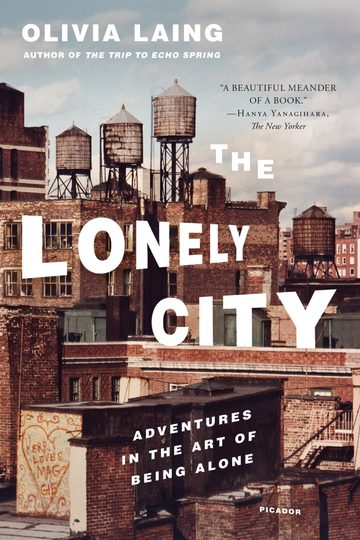
The Lonely City: Adventures in the Art of Being Alone by Olivia Laing is a 2016 memoir book about loneliness, urban isolation, art and creativity. Loneliness is not a personal failure but a widespread, politically shaped experience — cities designed around cars and commerce structurally produce it.
Summary
The Lonely City is Olivia Laing's memoir-essay hybrid about a period of acute loneliness she experienced after moving to New York City following the collapse of a relationship. Rather than treating loneliness as a private failure to be overcome, Laing treats it as a condition worth investigating — historically, aesthetically, and politically. The book is structured around artists who were themselves profoundly alone: Edward Hopper, Andy Warhol, Henry Darger, David Wojnarowicz. Their work becomes both subject and method.
Laing writes about Hopper's paintings as documents of urban disconnection — the figures in diners and hotel rooms who seem sealed off from one another even when sharing a frame. She traces Warhol's defensive use of the machine and the crowd, his terror of intimacy alongside his desperate need for it. With Darger, who died leaving thousands of pages of illustrated fantasy no one knew existed, she explores the most extreme form of loneliness: a rich interior life no one witnessed. Wojnarowicz's rage at AIDS-era invisibility becomes a chapter on how loneliness and political abandonment interlock.
What makes the book unusual is that Laing doesn't resolve her loneliness into a lesson. She allows it to persist, to become curious rather than urgent. The research is real — she draws on psychologists, sociologists, and historians of the body — but always in service of something more personal and harder to classify. The prose is precise and lyrical without being ornate. She writes about the body in urban space in a way that makes you notice your own.
The book ends not with connection achieved but with a more complicated idea: that art made in loneliness can reach across time to people it wasn't made for. That the transmission matters even when it isn't intended. It's a book about being alone in a city of millions, and about what artists do with the energy that isolation generates.
Talk to The Lonely City: Adventures in the Art of Being Alone like its author wrote you back.
Get the ideas that fit your life — not generic summaries.
- Chat with the book
- Audiobook-style main ideas
- Adapts to your life and goals
- Helps you take action
Key takeaways
- 1.
Loneliness is not a personal failure but a widespread, politically shaped experience — cities designed around cars and commerce structurally produce it.
- 2.
Edward Hopper's paintings are among the most honest documents of urban disconnection ever made — figures near each other but sealed away.
- 3.
Andy Warhol's obsession with celebrity and surfaces was partly a defensive response to a childhood of isolation and a body he experienced as alien.
- 4.
Henry Darger created one of the most elaborate private fantasy worlds in modern art history and let no one see it — raising real questions about what art is for.
- 5.
David Wojnarowicz's work shows how loneliness and political abandonment compound: to be invisible to the state is a form of forced solitude.
- 6.
The internet promised connection and delivered a peculiar intensification of loneliness — contact without touch, presence without risk.
- 7.
Art made in isolation can transmit across time to strangers who never knew the maker, which is a strange and underrated form of intimacy.
- 8.
Allowing loneliness to be explored rather than escaped is itself a kind of practice — curiosity as a way of bearing what would otherwise feel intolerable.
Discussion questions
Use these on your own, with a book club, or as chat starters in Superbook. Book club version, ready to copy or print →
- 1.
Laing argues that loneliness is partly a structural problem, not just an emotional one. What structures in your own life produce or reduce it?
- 2.
She spends a chapter on Hopper, whose paintings show people alone in public spaces. Which Hopper painting would you most likely find yourself in?
- 3.
Warhol used machines, repetition, and surfaces as a kind of armor. What are your own versions of that armor?
- 4.
Darger made thousands of pages of art that no one saw. Does art need an audience to be art? What would it mean to make something only for yourself?
- 5.
Laing distinguishes loneliness from solitude. What's the difference for you? Is there a kind of aloneness you actively seek?
- 6.
She writes about the particular loneliness of being sick in a city that doesn't see you — the AIDS crisis as political abandonment. When have you felt invisible to a system?
- 7.
The book suggests that art made in loneliness can reach across time to people it wasn't intended for. Have you ever felt that a work of art was made specifically for you, even though that's impossible?
- 8.
Laing moves through New York as an outsider. What does it feel like to walk through a city where nobody knows you? Is it freeing, disorienting, or both?
- 9.
How does the internet change the experience she describes? Would her New York loneliness have been different with a smartphone and social media?
- 10.
She never fully resolves her loneliness in the book. Does that feel honest, or does it frustrate you? What would resolution even look like?
- 11.
Which of the artists she profiles do you find most sympathetic, and why?
- 12.
Laing turns her own painful experience into something publicly useful — a book. What have you transformed from pain into something shareable?
Themes
Frequently asked questions
-
Is The Lonely City a memoir or a work of criticism?
Both, genuinely. It begins with Laing's own experience of loneliness in New York but quickly becomes a study of artists — Hopper, Warhol, Darger, Wojnarowicz — whose lives and work illuminate what loneliness does and can make. The two modes reinforce each other throughout.
-
Do you need to know the artists she writes about to enjoy the book?
No prior knowledge is required. Laing introduces each artist fully. But readers who already know Hopper's paintings or Warhol's work will find the readings richer. She makes a compelling case for looking at all of them freshly regardless.
-
Is this book only for people who are lonely?
It's most resonant if you've experienced loneliness sharply, but it's really a book about urban life, art, visibility, and the body. People who study cities, make art, or think about political abandonment will find it just as useful.
-
How long is The Lonely City?
Around 280 pages, roughly five hours at average reading pace. The prose rewards slow reading — Laing's sentences often carry more than they first appear to.
-
What's the most memorable idea in the book?
Probably the discussion of Darger: a man who lived entirely alone, worked as a janitor, and spent his private life creating a 15,000-page illustrated fantasy. Laing uses him to ask what art is when it has no audience — and what we owe each other by paying attention.