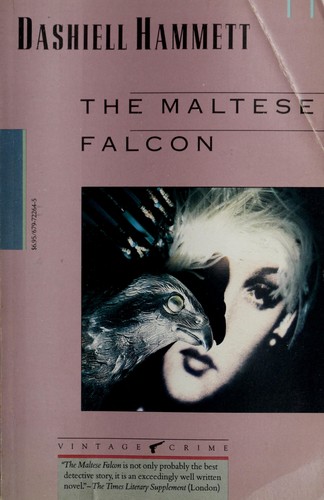
The Maltese Falcon by Dashiell Hammett is a 1930 mystery book about greed and deception, moral ambiguity, loyalty and betrayal. Spade's final speech is a moral philosophy in miniature: a professional code held not because it feels good but because abandoning it would make him useless to himself and everyone else.
Summary
San Francisco private detective Sam Spade is hired by a woman calling herself Miss Wonderly to find her missing sister — a lie within thirty seconds of the novel opening. Before long Spade's partner is dead, the woman's story has changed three times, and a peculiar cast of criminals has converged on the city to recover a priceless jeweled statuette: the Maltese Falcon. Hammett gives you almost no interiority. You watch what Spade does, hear what he says, and are left to infer what he thinks.
The book is not, at bottom, about a statuette. It is about whether a man who operates on the edge of legality has any principles worth keeping, and if so, why. Spade's famous final speech to Brigid O'Shaughnessy — explaining exactly why he's going to turn her in despite everything — is the novel's moral center. He lays out his reasoning like a theorem: not because of the law, not because he liked his partner much, but because the alternative would mean his word is worthless and he'd have to spend the rest of his career watching his back.
What makes the book endure is the hard-boiled prose style Hammett invented and the refusal to sentimentalize. Every character lies. Every motive is transactional. Spade himself is not a good man in any conventional sense — he sleeps with his partner's wife, manipulates everyone around him, keeps his own counsel at lethal cost to others. Yet his code holds, and it holds for reasons that have nothing to do with sentiment. The style is spare, declarative, and precise in a way that influenced everything from Raymond Chandler to every crime procedural ever written.
Readers who like their protagonists sympathetic and their moral compass pointing north will be frustrated. The novel gives you no one to root for cleanly. But for readers who want to think about what honor means when it's stripped of social approval, or who want to watch a master prose stylist work, The Maltese Falcon is foundational. Every crime novel written since is in conversation with it, whether the author knows it or not.
Talk to The Maltese Falcon like its author wrote you back.
Get the ideas that fit your life — not generic summaries.
- Chat with the book
- Audiobook-style main ideas
- Adapts to your life and goals
- Helps you take action
Key takeaways
- 1.
Spade's final speech is a moral philosophy in miniature: a professional code held not because it feels good but because abandoning it would make him useless to himself and everyone else.
- 2.
Hammett invented the hard-boiled detective voice — clipped, external, relentlessly observational — and the whole genre has been living in that house ever since.
- 3.
The Falcon itself is almost incidental. What drives the plot is not the object but the lies people tell and the identities they perform to get it.
- 4.
Every character in the novel is playing a role. Brigid is the most skilled performer; Spade is the most self-aware. The question is who's performing for whom.
- 5.
The novel works as a dissection of trust: how it's extended, why it's dangerous, and what happens when you discover the person you trusted was lying from the first sentence.
- 6.
Hammett's prose is deliberately surface-level. By withholding interiority, he forces the reader to do what Spade does: read behavior, not feelings.
- 7.
The Gutman character — cheerful, verbose, lethal — is a specific portrait of how charm operates as a weapon and how criminals can be more courteous than honest people.
- 8.
The book's San Francisco is not romanticized. It's a city where professional killers take cabs and people disappear without the police much caring.
Discussion questions
Use these on your own, with a book club, or as chat starters in Superbook. Book club version, ready to copy or print →
- 1.
Spade's explanation for why he turns Brigid in — the math of professional self-preservation — do you find it convincing, cold, or both?
- 2.
Brigid lies repeatedly and Spade knows it from early on. Why does he keep helping her? Is it attraction, professional habit, or something more calculated?
- 3.
Gutman is unfailingly polite even when threatening violence. What does Hammett seem to be saying about the relationship between manners and menace?
- 4.
The Falcon turns out to be a fake. Is that the point of the novel's ending, or is it a red herring about what the book is actually about?
- 5.
How does Spade's treatment of Iva Archer — his partner's widow — reflect on his character? The novel doesn't moralize about it. Should it?
- 6.
Hammett gives us almost no access to Spade's thoughts. Does this make him more or less interesting than a protagonist whose inner life is narrated directly?
- 7.
Cairo, Gutman, Wilmer — every villain is drawn with some degree of comic specificity. Does this undercut the menace or sharpen it?
- 8.
The hard-boiled detective operates outside the law but enforces a personal code. Is that a romantic fantasy, a cynical pose, or something philosophically defensible?
- 9.
Compared to a contemporary thriller like Gone Girl, where the moral ambiguity is foregrounded and commented on — which approach do you find more unsettling?
- 10.
Spade says he doesn't 'like' the work of turning Brigid in. Is that distinction between preference and principle meaningful to you, or just rationalization?
- 11.
The novel was published in 1930. Does its view of women feel dated in a way that changes how you read it, or is Brigid a complex enough character to transcend the era?
- 12.
What would the novel lose if Hammett had given us access to Spade's feelings? What would it gain?
Themes
Frequently asked questions
-
Is The Maltese Falcon worth reading in 2026?
Yes — not as a period curiosity but as the source code for modern crime fiction. The prose is still sharp, the moral puzzle still interesting. The genre conventions it created have become so familiar they're invisible, which can make the book feel less original than it is. Read it knowing that nearly everything that came after borrowed from it.
-
Is The Maltese Falcon hard to follow?
No. The plot is intricate but Hammett manages it cleanly. The challenge is tonal: the prose is so stripped-down that readers used to interior monologue may feel at a distance. Once you adjust to reading behavior rather than feeling, the book moves fast.
-
What is The Maltese Falcon actually about?
On the surface, a private detective untangling a conspiracy around a stolen jeweled statuette. Underneath, it's about what professional honor looks like when it's stripped of sentiment — and whether a man who operates in moral gray zones can have principles worth keeping.
-
Who shouldn't read The Maltese Falcon?
Readers who need a protagonist they can root for warmly. Spade is smart and principled in his way, but he's also manipulative, callous, and not especially likeable. If that kind of moral ambiguity frustrates rather than interests you, the novel will feel unrewarding.
-
Is there a film adaptation?
Yes — the 1941 John Huston film with Humphrey Bogart as Spade is a classic and remarkably faithful to the novel. Watching it after reading the book is worthwhile; Bogart's Spade matches the prose version almost exactly in tone.